
When planning a custom bookcase or replacing worn-out shelving, selecting the right wooden board for shelf installations is essential to prevent unsightly and potentially dangerous sagging. The weight of books—especially dense textbooks, heavy hardcovers, or closely packed novels—exerts continuous downward pressure on horizontal supports. Over time, inadequate shelf dimensions will lead to permanent bowing, structural failure, or damage to your stored items. Determining the ideal thickness and width (depth) of your shelf boards requires balancing the physical properties of the wood, the overall span of the shelf, and the weight of your collection. By understanding how these dimensions interact, you can build a stable, long-lasting storage system that maintains its shape and integrity for years to come.
Decoding the Core Specs: Thickness, Depth, and Span
To design a sag-free bookcase, you must first understand three critical dimensions: thickness, depth, and span. Thickness refers to the vertical height of the board when it is laid flat on its supports. This dimension is your primary defense against gravity; as a rule of thumb, even a minor increase in board thickness dramatically improves its resistance to bending.
Depth represents the front-to-back width of the shelf. This dimension determines what types of books can sit comfortably on the board without hanging over the edge. Standard novels and paperbacks generally require a depth of 200mm to 250mm, whereas larger reference manuals, binders, and art books need a depth of 300mm or more. While depth is crucial for accommodating your collection, it has a relatively minor impact on the shelf’s resistance to sagging compared to thickness.
Products mentioned in this guide
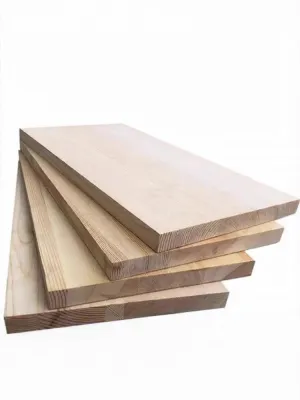
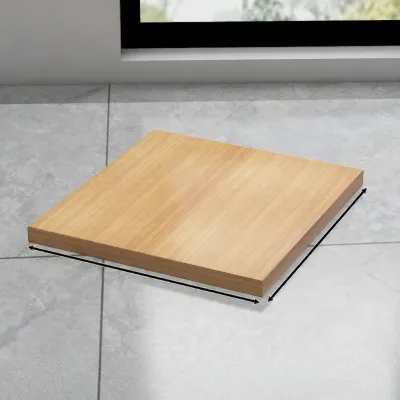
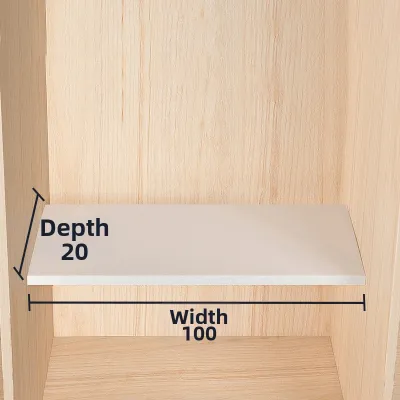
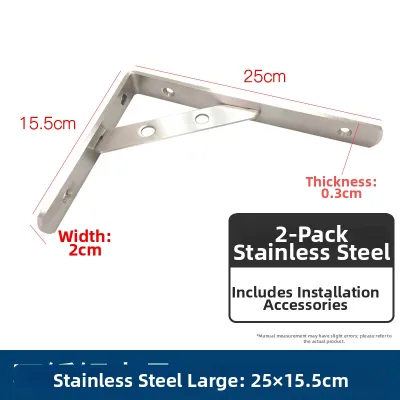
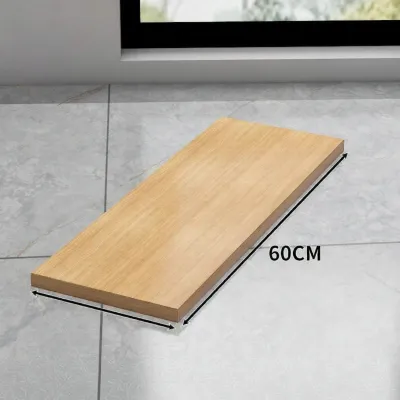
Prices are valid at publication and may change. Please refer to the product page for the latest price.
Span is the horizontal distance between the shelf’s supports, whether those are side panels, brackets, or vertical partition walls. Span is the single most critical variable in the sagging equation. The mechanical relationship between span and deflection is non-linear: doubling the span of a shelf does not merely double the sag—it actually increases the potential deflection by a factor of eight under a uniform load. Consequently, keeping spans short or significantly increasing board thickness on wider spans is essential to maintaining structural integrity.
How Wood Type Changes Your Dimension Choices
The material you choose for your shelf boards plays a massive role in determining how well they resist bending. Solid hardwoods, such as oak, ash, or teak, possess high natural stiffness and can support substantial weight over longer spans. Softwoods like pine are also popular for their ease of workability, but they generally have lower stiffness ratings than hardwoods, meaning they require shorter spans or thicker profiles to carry the same load.

Engineered wood products offer highly consistent dimensions but vary widely in performance. High-quality plywood, made from thin layers of wood glued together in alternating grain directions, provides excellent resistance to sagging and is often comparable to solid wood. In contrast, medium-density fibreboard (MDF) and particleboard are denser and heavier but have significantly less structural stiffness. Under a heavy load of books, particleboard and standard MDF will sag much sooner than plywood or solid wood of the same thickness.
It is critical to remember that a material label alone is not a performance guarantee. When purchasing a wooden board for shelf projects, always verify the manufacturer’s span ratings, grade stamps, or stiffness specifications. In Singapore’s humid climate, moisture can also affect the structural integrity of engineered woods over time. Ensure that any MDF or particleboard shelves are fully sealed with a high-quality veneer, laminate, or paint to prevent moisture absorption, which can accelerate sagging and compromise joint strength. Additionally, always factor in the weight of your specific book collection; a shelf dedicated to heavy, glossy art books requires a much stiffer setup than one holding lightweight paperbacks.
Practical Guidelines for Standard Bookshelf Builds
When planning your bookshelf layout, matching the board dimensions to standard residential furniture guidelines ensures both aesthetic appeal and structural safety. For most standard book storage, a depth range of 200mm to 300mm is ideal. If you are building shelves for oversized binders or heavy textbooks, a depth of 300mm to 350mm may be necessary.
In terms of thickness, standard choices typically revolve around 18mm (approximately 3/4-inch) and 25mm (approximately 1-inch) boards. For an 18mm thick solid hardwood or high-grade plywood board, a maximum span of 750mm is generally recommended for average book loads. If you are using 18mm MDF or particleboard, the span should be kept under 600mm to prevent eventual bowing. If your design requires longer shelves—such as a wide 900mm span—upgrading to a 25mm thick board is highly recommended.
If your desired design aesthetic demands long, thin shelves that exceed these natural span limits, you can employ several structural reinforcement strategies. Adding a solid wood front edge trim, often called a nosing, is an exceptionally effective method. Glued and nailed vertically to the front edge of the shelf, a 20mm to 40mm trim piece acts like an I-beam, drastically increasing vertical stiffness without adding significant weight. You can also utilize a rigid back panel and screw the back edge of the shelves directly into it, or install discreet center brackets anchored to the wall.
Before finalizing your cuts and assembly, always consult specific span calculators, engineering tables, or supplier charts for your exact wood species and grade. Additionally, consider the practical logistics of your build: verify the finished dimensions of the bookcase against your available wall space, and ensure the unit can be safely transported through doorways and lift access during installation.
How to Inspect and Manage Existing Shelf Sag
Even well-constructed shelves can experience slight changes over time. It is wise to periodically inspect your bookshelves for early signs of deflection. You can do this visually by crouching to eye level with the shelf, or physically by placing a long straight edge, a spirit level, or a taut string along the top surface to check for gaps.
If you notice minor bending, you can apply low-risk, reversible adjustments to manage the load. Try redistributing your heaviest books toward the outer edges of the shelf, directly next to the vertical supports, while placing lighter paperbacks in the middle. If your shelves are loose and not fixed to the frame, you can periodically flip the board upside down. This allows the weight of the books to gradually reverse the minor bow over time.
However, you should avoid making irreversible modifications to compromised boards or ignoring severe sagging. Extreme deflection can cause the board to slip off its support pins, leading to a sudden collapse. If a shelf is severely bent, do not attempt to overload it or patch it with temporary fixes. The safest course of action is to replace the board entirely or consult a qualified carpenter to install permanent structural reinforcements or additional wall anchoring.
Frequently Asked Questions (FAQ)
Is 18mm thick enough for a wooden bookshelf?
An 18mm thickness can be highly effective, but its success depends entirely on the shelf’s span and the material used. For instance, an 18mm solid hardwood or high-quality plywood board is perfectly adequate for a standard span of up to 750mm under average book loads. However, if you are using 18mm MDF or particleboard, or if your span exceeds 750mm, the shelf is highly likely to sag over time. Always verify the material’s load capacity and consult supplier span charts before finalizing your build.
Does adding a front edge trim prevent sagging?
Yes, adding a solid wood front edge trim (or nosing) is one of the most effective ways to prevent sagging. By gluing and nailing a strip of solid wood vertically along the front edge of a shelf, you significantly increase its vertical depth and structural stiffness. This modification acts as a supportive rib, allowing a thinner or less rigid board to span longer distances without bowing under the weight of your books.

Community discussion
Share your experience or ask a question. Comments are reviewed before publication.