
Choosing the right size rotating bookshelf requires balancing your room’s physical footprint with your storage volume and weight limits. Unlike a standard stationary bookcase that sits flush against a wall, a revolving model needs dedicated clearance on all sides to spin freely without scraping your walls or blocking walkways. In space-constrained homes, such as compact apartments or high-rise flats, selecting the correct dimensions ensures you maximize vertical storage without creating a cramped, hazardous layout. By measuring your floor space, calculating the rotation radius, and checking your storage needs, you can find a unit that functions smoothly and safely.
Measure Your Floor Space and Rotation Clearance
To integrate a rotating bookshelf successfully, you must first measure the physical footprint of the floor area where it will stand. Most rotating bookshelves feature a circular or square base. If you choose a square-based model, remember that the diagonal measurement of the base is wider than its flat sides. You must use this diagonal measurement as the absolute minimum width of the floor space required, as the corners of the square will swing outward during rotation.
Calculating the full rotation radius is the next critical step. This radius is the distance from the center pivot pole to the outermost edge or corner of the shelves, plus any protruding books. To prevent your books or decorative items from brushing against walls, adjacent furniture, or curtains, you should add a safety buffer of at least 5 to 10 centimeters to this radius. A simple way to visualize this is to tie a string of the calculated length to a weight, place it on the floor at the intended center point, and sweep it in a full 360-degree circle to check for physical contact.
Products mentioned in this guide
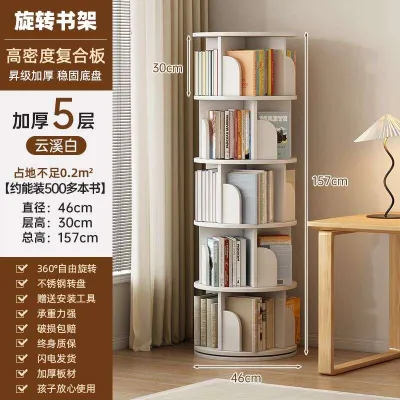
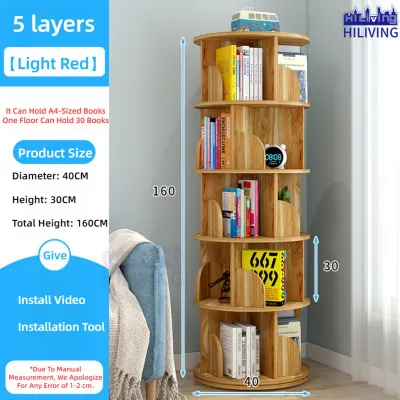
![[SG Seller]360Degrees Rotating Bookshelf Rotating Book Shelf Rotate Floor Standing Books Storage Rack](https://img.lazcdn.com/g/p/bb46c1ac353d25f9026879c97f254c6c.jpg_400x400q80.jpg_.webp)
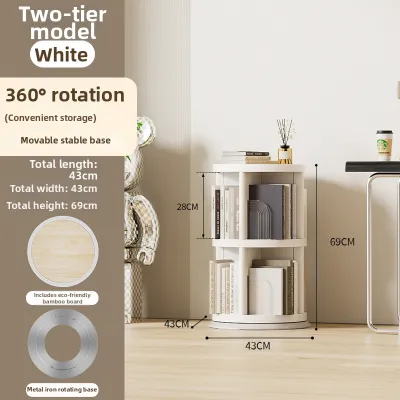
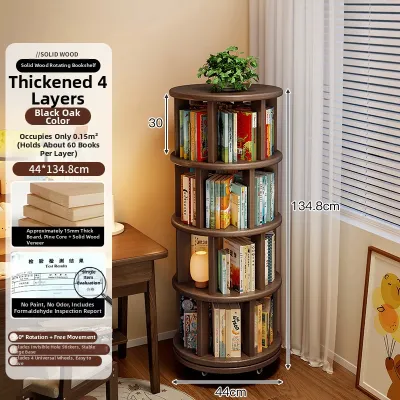
Prices are valid at publication and may change. Please refer to the product page for the latest price.
Additionally, you must identify and avoid permanent physical obstacles within this rotation path. Take note of low-profile skirting boards, wall-mounted power outlets, light switches, and the swing path of nearby doors or wardrobe panels. If the bookshelf blocks a power outlet, you may find yourself unable to plug in appliances or forced to leave a gap that compromises the room’s flow. Ensuring the rotation path remains completely clear of these elements prevents damage to both your home’s walls and the bookshelf itself.
Match Shelf Dimensions to Your Storage Needs
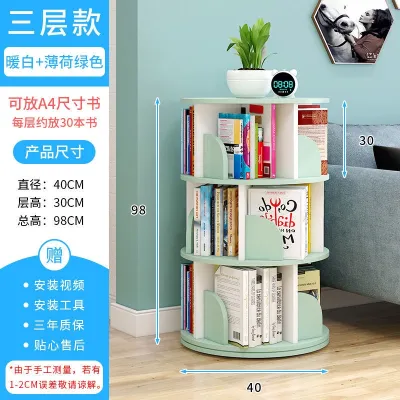
Once you have established the maximum footprint your room can accommodate, you must match the shelf dimensions to the specific items you plan to store. Different book formats require vastly different shelf heights and depths. Standard fiction paperbacks typically require a shelf height of around 20 centimeters and a depth of 15 centimeters, whereas larger academic textbooks, children’s picture books, or A4 folders need at least 30 centimeters of height and 25 centimeters of depth.

Evaluating whether to choose adjustable shelves or fixed tiers is essential for long-term usability. Fixed-tier rotating bookshelves offer excellent structural rigidity, but they limit you to specific book sizes, which can lead to wasted vertical space if you only store small paperbacks. Adjustable shelves allow you to customize the height of individual tiers, making it easier to adapt the unit as your collection changes or if you decide to display decorative objects alongside your books.
You must also balance the total height of the bookshelf with your home’s vertical clearance. While a tall, five-tier or six-tier rotating bookshelf maximizes vertical storage in a small room, it must not obstruct ceiling fixtures, light switches, or wall-mounted air conditioning units. In many modern apartments with standard ceiling heights of 2.6 to 2.8 meters, a very tall unit can feel visually overwhelming and may interfere with the airflow of your air conditioner or block the light from ceiling lamps. Measure the height of your ceiling and any low-hanging fixtures before deciding on a tall model.
Evaluate Weight Capacity and Stability Requirements
A fully loaded rotating bookshelf holds a significant amount of weight, making structural stability and load capacity primary safety considerations. Before purchasing, you must check the manufacturer’s specified weight limits per tier as well as the total maximum load capacity. Overloading a rotating shelf can warp the wood, strain the rotating mechanism, or cause the entire unit to tilt, which prevents smooth rotation and increases the risk of structural failure.
The relationship between the base width, total height, and center of gravity determines the inherent tipping risk of the bookshelf. Tall, narrow rotating bookshelves have a higher center of gravity, making them more susceptible to tipping if they are unevenly loaded or bumped. To minimize this risk, look for units with a wider, heavier base plate that anchors the center of gravity closer to the floor.
The quality of the rotating mechanism is also crucial for long-term stability. High-quality units typically utilize heavy-duty steel ball-bearing swivels that distribute weight evenly across the base. If you are considering a tall unit—especially one exceeding 1.5 meters in height—you must review the manufacturer’s manual for anti-tip anchoring options. While traditional wall anchors can restrict a bookshelf from rotating fully, some specialized models come with top-mounted pivot anchors or specific placement guidelines to ensure they remain secure.
Check Delivery and Assembly Pathways
Before finalizing your purchase, you must verify that the rotating bookshelf can be successfully delivered and assembled in your home. Many rotating bookshelves are delivered flat-packed, but the individual panels and the heavy rotating base can be incredibly bulky and heavy. You should measure the dimensions of your building’s elevator, stairwells, and apartment door frames against the packaged dimensions provided by the retailer to ensure the delivery team can safely bring the boxes inside.
Once the packages arrive, you will need adequate temporary floor space to lay out the parts and assemble the unit. Because rotating bookshelves require precise alignment of the central spindle and the rotating base, assembling them in a cramped corridor or a tight corner can lead to mistakes. Clear a spacious area in your living room or bedroom where you can lay down a protective blanket to prevent scratching your flooring during the assembly process.
Finally, review the assembly requirements and tool list in advance. While some smaller units can be put together with a simple screwdriver, larger and heavier models may require a power drill, a level to ensure the base is perfectly flat, and a second person to help lift and align the heavy tiers. Ensuring you have the right tools and assistance on hand prevents assembly errors that could compromise the smooth rotation and safety of your new bookshelf.
Frequently Asked Questions (FAQ)
Can I place a rotating bookshelf on a carpet or rug?
Placing a rotating bookshelf on a soft carpet or a thick rug can significantly affect its stability and rotation. The soft fibers of a carpet can cause the heavy base to sink unevenly, leading to a slight tilt that prevents the ball-bearing mechanism from spinning smoothly. Additionally, the bottom edge of the rotating shelves may rub against the carpet pile, causing friction and wear. If you must place the unit on a carpeted surface, check the manufacturer’s recommendations or place a rigid, flat base board underneath the bookshelf to ensure a stable, level surface for the rotating mechanism.
How do I prevent a tall rotating bookshelf from tipping over?
To prevent a tall rotating bookshelf from tipping, you must manage its center of gravity by distributing weight strategically. Always place your heaviest books, such as encyclopedias, textbooks, and large binders, on the bottom tiers, and reserve the upper shelves for lighter paperbacks or small decorative items. When loading or unloading books, try to distribute the weight evenly around the 360-degree circumference of each tier rather than stacking all heavy items on one side. Finally, always check the product manual to see if the manufacturer provides specific anti-tip hardware or placement instructions designed for rotating units.

Community discussion
Share your experience or ask a question. Comments are reviewed before publication.