
Selecting the right cabinet with door mechanism for a compact bedroom is a balancing act between floor space and daily convenience. In typical modern apartments, where bedroom square footage is premium, every centimeter matters. While sliding doors are frequently recommended as the default space-saving solution because they do not swing outward, they are not a universal fix. Swing doors offer complete visibility and easier maintenance, making them highly practical if your layout can accommodate their opening radius. Deciding between these two styles requires analyzing your room’s physical dimensions, your bed placement, and how you organize your belongings.
Space Clearance and Room Layout Requirements
To determine which wardrobe mechanism fits your bedroom, you must first measure the physical clearance zones. A swing door requires a clear arc in front of the wardrobe to open fully. Typically, standard wardrobe doors are between 40cm and 60cm wide, meaning you need at least that much unobstructed floor space directly in front of the cabinet, plus an additional 30cm to 40cm for you to stand comfortably while browsing. If your bed frame sits close to the wardrobe, this swing radius can easily block the walking aisle or collide with the mattress.
In contrast, a sliding door operates entirely within its own frame, requiring zero front clearance to open. However, this space-saving benefit comes with a trade-off in depth. Sliding door tracks and overlapping panels require an extra 8cm to 10cm of depth compared to swing doors. If a standard swing door wardrobe has an external depth of 60cm, a sliding door wardrobe with the same internal hanging capacity will require an external depth of 68cm to 70cm. You must decide whether you can spare this extra depth along the wall to save floor space in the walking aisle.
Products mentioned in this guide
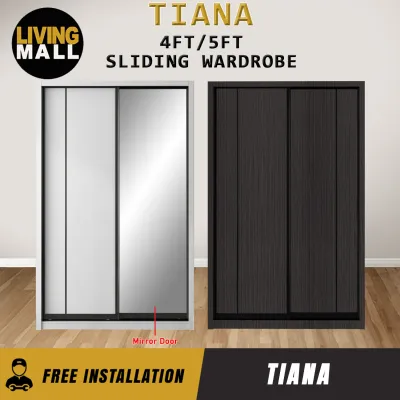
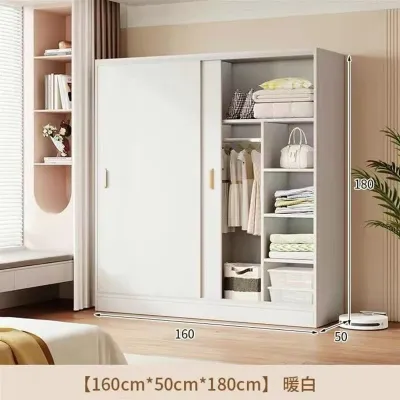
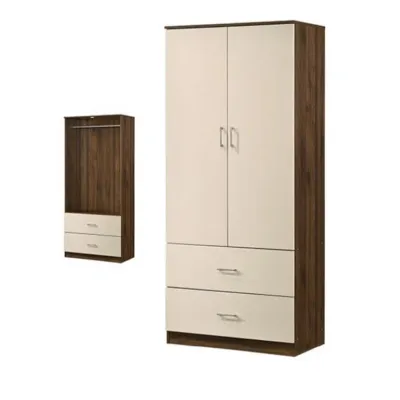
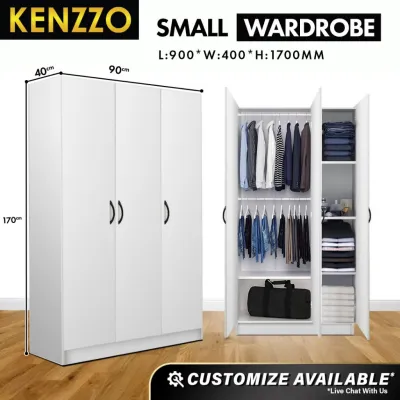
Prices are valid at publication and may change. Please refer to the product page for the latest price.
Adjacent obstacles also play a critical role in your layout decision. In compact bedrooms, bedside tables often sit directly next to the wardrobe. A swing door closest to the bed will be blocked by a nightstand, preventing you from accessing that section of the closet without moving furniture. You must also check the height and position of ceiling fans, light fixtures, and air conditioning units. An open swing door can easily strike a low-hanging ceiling fan blade or block the airflow from an air conditioner, whereas sliding doors remain flush and completely clear of overhead fixtures.
Internal Storage and Accessibility Trade-offs
The way you access your clothes daily depends heavily on the door mechanism you choose. Swing doors allow you to open the entire wardrobe simultaneously, providing a full-width view of your entire wardrobe. This is highly beneficial for couples sharing a closet or for anyone who likes to coordinate outfits by looking at all their clothes at once. It also allows for uninterrupted airflow when airing out your garments.

Sliding doors, by design, can only reveal one section of the wardrobe at a time. Because the panels slide behind one another, at least half of the wardrobe remains covered at any given moment. This overlapping design can make organizing and retrieving items feel restrictive, especially if two people are trying to get dressed at the same time. Additionally, the overlapping section in the middle of the wardrobe can create a “blind spot” that is slightly harder to reach and organize.
This accessibility difference directly impacts your choice of internal fittings. Pull-out accessories, such as internal drawers, trouser racks, and wire baskets, require precise placement in a sliding door wardrobe. If these fittings are placed too close to the overlapping frame, they will hit the door panel when pulled out. Cabinet makers often have to install spacer blocks or design narrower drawers to ensure they clear the sliding doors. Swing doors do not present this issue, as they open past 90 degrees, allowing drawers to slide out smoothly across the entire width of the compartment. Furthermore, swing doors allow you to mount full-length mirrors, tie racks, or accessory hooks on the inside of the door panels, maximizing otherwise wasted vertical space.
Maintenance, Durability, and Daily Use
Long-term reliability and maintenance are key factors in the overall cost of ownership for any cabinet with door. Sliding doors rely on a system of top and bottom tracks, rollers, and guide wheels. Over time, dust, hair, and clothing fibers inevitably accumulate in the bottom track. If not vacuumed regularly, this debris can clog the rollers, causing the doors to stick, jump off the tracks, or slide unevenly. The rollers themselves are subject to wear and tear and may require realignment or replacement after several years of daily use.
Swing doors use traditional concealed hinges, which are mechanically simpler and generally more durable. However, they are not entirely maintenance-free. Heavy door panels can put significant strain on the hinges over time, leading to door sagging. This can cause the doors to become misaligned, scrape against the bottom frame, or fail to close flush. Fortunately, adjusting modern cabinet hinges is a straightforward task that requires only a screwdriver to adjust the depth, height, and lateral alignment screws.
Dust prevention is another daily consideration. Swing doors close flush against the wardrobe frame, often utilizing soft-close dampers or magnetic catches that create a relatively tight seal against dust and pests. Sliding doors, because they must overlap to function, always have a small gap between the front and rear panels. This gap can allow dust to enter the wardrobe more easily, requiring more frequent cleaning of the interior shelves, especially in humid climates where dust can settle quickly.
Cost and Installation Considerations
Your budget and the structural condition of your bedroom will heavily influence which wardrobe style is more feasible. Sliding door wardrobes generally carry a higher price tag due to the complexity of their hardware. High-quality, heavy-duty aluminum tracks, soft-close dampers, and sturdy roller mechanisms cost more than standard concealed hinges. Additionally, because sliding door panels are typically larger and heavier, they require robust frames to prevent warping, which adds to the material costs.
Installation of sliding doors also demands a high level of precision. The floor and walls must be exceptionally flat and level. If your bedroom floor has a slight slope or uneven screed, gravity will cause the sliding doors to drift open on their own or slide to one side. Installers must spend extra time leveling the tracks using shims or adjustable plinths. Swing doors are far more forgiving of minor floor and wall imperfections, as the individual hinges can be adjusted to compensate for slight misalignments in the frame.
If you are choosing between a built-in fitted closet and a freestanding cabinet with door, installation constraints differ. Built-in sliding wardrobes are excellent for maximizing vertical space up to the ceiling, but they are permanent fixtures that cannot be easily moved. Freestanding sliding wardrobes are available but are often incredibly heavy and difficult to assemble in tight spaces. Freestanding swing door wardrobes are much lighter, easier to transport, and simpler to assemble, making them a highly flexible option for renters or those who like to rearrange their bedroom layout.
Decision Framework: Which Wardrobe Should You Choose?
To make your final decision, evaluate your bedroom layout against these specific conditions.
You should choose a sliding door wardrobe if:
- The walking aisle between your wardrobe and the bed is less than 60cm.
- You have bedside tables or other furniture placed directly adjacent to the wardrobe that would block a swinging door.
- You prefer a sleek, modern aesthetic with large, uninterrupted door panels.
You should choose a swing door wardrobe if:
- You have at least 90cm of clear space in front of the wardrobe to allow for comfortable door swing and standing room.
- You want to see your entire clothing collection at once and require unhindered access to all compartments.
- You plan to install multiple pull-out drawers, trouser racks, or door-mounted accessories.
- You prefer a lower-maintenance system with simpler hardware that is easy to adjust yourself.
Before purchasing, always use painter’s tape to map out the footprint of both options on your bedroom floor. Measure the distance to your bed frame, check for overhead ceiling fan clearance, and inspect your walls and floors for any noticeable slopes or structural pillars that could interfere with the installation.
Frequently Asked Questions (FAQ)
Can I convert a swing door wardrobe to a sliding door later?
Converting an existing swing door cabinet with door to a sliding system is technically possible but often impractical and costly. Sliding doors require a wider frame depth to accommodate the track system, which standard swing wardrobe frames do not have. To convert them, you would need to install an external track extension kit, which can look bulky and compromise the structural integrity of the wardrobe. In most cases, it is more cost-effective and structurally sound to replace the entire unit or plan for your preferred door mechanism from the start.
Do mirrored sliding doors make a small room look bigger?
Yes, mirrored sliding doors are highly effective at enhancing the visual perception of space in a compact bedroom. The large reflective surfaces bounce natural light deeper into the room, making a small space feel brighter and more open. Because sliding doors do not project into the room when opened, the mirrored surface remains flat against the wall, maintaining a clean, uncluttered look. This dual-function design also eliminates the need for a separate freestanding full-length mirror, saving valuable floor space elsewhere in your bedroom.

Community discussion
Share your experience or ask a question. Comments are reviewed before publication.