
Finding the right ergonomic chair is one of the most critical decisions you will make for your home office setup, especially when your daily routine involves sitting for eight or more hours. Among the popular entry-to-mid-level options on the market, the Sihoo M18 and Sihoo M57 frequently stand out as top contenders. Both models promise to alleviate the physical strain of prolonged sitting, yet they approach ergonomic support, material construction, and adjustability from distinct design philosophies.
Choosing between the Sihoo M18 and the Sihoo M57 is not a matter of finding a single, universally superior winner. Instead, the ideal option depends heavily on your individual physical proportions, your personal comfort preferences, and the specific environmental conditions of your workspace. By understanding how these two models differ in their core components, you can make an informed decision that protects your posture and enhances your daily productivity.
Before committing to either model, it is essential to establish a clear framework for evaluation. You will need to verify specific manufacturer specifications, measure your physical workspace, and consider how each chair’s unique features align with your body’s natural alignment. This guide breaks down the critical differences in backrest design, seating materials, adjustability, and spatial footprints to help you determine which chair will serve you best over years of daily use.
Products mentioned in this guide
Prices are valid at publication and may change. Please refer to the product page for the latest price.
Backrest Design and Lumbar Support Mechanisms
The backrest is the foundation of any ergonomic chair, responsible for maintaining the natural S-curve of your spine and preventing the slouching that leads to chronic lower back discomfort. When comparing the Sihoo M18 and the Sihoo M57, the most significant structural difference lies in how each model approaches lumbar support. Understanding these mechanisms is key to choosing a chair that matches your posture habits.
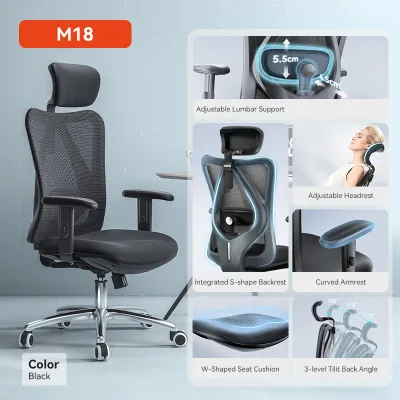
The Sihoo M18 utilizes an integrated lumbar support pad that is adjusted manually using an external dial located on the back of the chair. This design allows you to physically move the pad upward, downward, forward, and backward to target a specific area of your lumbar spine. If you prefer a highly pronounced, firm, and localized support structure that remains locked in a precise position, this manual adjustment style offers a reliable way to anchor your lower back.
In contrast, the Sihoo M57 features a separate, dynamic lumbar support piece that is designed to adapt more fluidly to your movements. This mechanism often appeals to users who shift positions frequently throughout the day, as the support structure responds to changes in sitting angles. When evaluating this design, you should check the manufacturer’s specified adjustment ranges for both height and depth to ensure the mechanism can align perfectly with the deepest curve of your lower back.
Beyond the lumbar pad itself, the overall dimensions of the backrest require careful scrutiny. You must evaluate the height and width specifications of the backrest to confirm that it provides adequate coverage for your shoulders and upper back. A backrest that is too short may press uncomfortably against your shoulder blades, while one that is too narrow might restrict your natural movement during long, intensive typing sessions.
Seat Materials and Long-Term Comfort
The material of your seat cushion directly influences your comfort, skin temperature, and circulation during extended working hours. This is particularly true in warm, humid climates like Singapore, where heat retention can quickly turn a productive afternoon into an uncomfortable experience. The Sihoo M18 and M57 present two fundamentally different approaches to seating surfaces.

The Sihoo M18 typically features a traditional, high-density foam cushion covered in a breathable fabric mesh. Foam cushions excel at distributing body weight evenly across the seat, reducing pressure points on your sit bones. However, even high-quality foam naturally retains more body heat than an open mesh design. If you work in an air-conditioned environment or prefer a softer, more traditional padded feel, a foam cushion provides a familiar and supportive base.
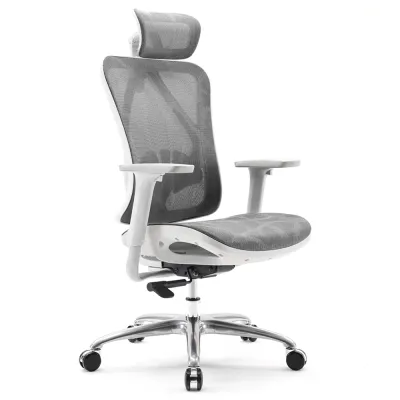
The Sihoo M57, on the other hand, opts for a full-mesh seat design. This construction replaces the foam base entirely with a suspended mesh material, allowing air to circulate freely beneath you. This design is highly effective at keeping you cool in warm environments, but it offers a firmer sitting experience. When considering a full-mesh chair, it is crucial to verify the mesh tension rating from the manufacturer’s specifications, as mesh that is too loose can sag over time, while mesh that is too tight may feel overly rigid.
Regardless of the material you choose, the shape of the seat’s front edge is a critical ergonomic factor. You should look for a waterfall seat edge design, which curves gently downward at the front. This curve is engineered to minimize pressure on the back of your thighs and knees, preserving healthy blood circulation to your lower legs during long, uninterrupted work sessions.
Adjustability Features and Body Fit
A truly ergonomic chair must adapt to your body, rather than forcing your body to adapt to the chair. Adjustability is the primary mechanism through which you customize a chair to fit your unique torso length, arm span, and desk height. Comparing the adjustability dimensions of the Sihoo M18 and M57 reveals distinct differences in how customizable each model is.
Armrest adjustability is a key differentiator between these two models. One model may offer basic height adjustments, while the other provides multi-directional adjustments, such as armrests that move up and down, forward and backward, and rotate inward or outward. Before purchasing, measure your desk’s clearance height and compare it to the chair’s maximum armrest height to ensure you can slide the chair fully under your desk when not in use.
Headrest adjustability is equally important for supporting your neck and head during phone calls, video meetings, or moments of relaxation. You should measure your torso length from your seat to your neck and compare this to the chair’s headrest adjustment range. A headrest that cannot be raised high enough will press against your shoulders, while one that is too low will push your head forward into an unnatural, strained posture.
Finally, evaluate the recline tension and locking positions of each model. A good ergonomic chair should allow you to tilt back comfortably, with tension that matches your body weight so you do not feel like you are falling backward or struggling to push against the backrest. Check the manufacturer’s specifications to see how many locking angles are available, allowing you to secure the chair in your preferred upright working posture or a relaxed reclining angle.
Spatial Footprint and Assembly Requirements
Before finalizing your choice, you must ensure that the chair physically fits within your designated workspace and can be safely delivered and assembled. Ergonomic chairs often have a larger footprint than standard task chairs, making spatial measurements a vital step in your pre-purchase checklist.
Begin by measuring your available floor space and comparing it to the chair’s base diameter, which is typically the widest part of the unit. You must also verify that the chair’s maximum seat height aligns with your desk height to maintain a 90-degree angle at your elbows while typing. If you live in a high-rise apartment or condominium in Singapore, consider the dimensions of your building’s lift and doorways to ensure the delivery box can easily pass through without obstruction.
The stability and durability of the chair depend heavily on its base material and weight capacity. Check the manufacturer’s specifications to identify whether the base is constructed from reinforced nylon, steel, or aluminum. A robust metal base generally offers greater long-term stability and a higher weight capacity, which is essential for maintaining balance when reclining fully.
Lastly, review the assembly requirements before your chair arrives. Most ergonomic chairs are shipped flat-packed and require self-assembly. Check the product manual online to see what tools are included, how many steps are involved, and the estimated setup time. If you are uncomfortable with basic assembly, you may want to look for retailers that offer professional installation services upon delivery.
Final Decision Framework: M18 or M57?
To make your final decision, you should weigh the specific design characteristics of each model against your daily habits, physical needs, and workspace environment. Neither chair is a one-size-fits-all solution, but each excels under different conditions.
Choose the Sihoo M18 if you prefer the familiar, cushioned support of a high-density foam seat, require a highly localized and manually lockable lumbar support pad, and are looking for a reliable ergonomic entry point that fits standard desk setups. This model is particularly well-suited for air-conditioned rooms where heat retention is less of a concern.
Choose the Sihoo M57 if you prioritize maximum breathability to stay cool in warm climates, require highly adjustable multi-directional armrests to align perfectly with your keyboard tray or desk height, and prefer a dynamic, self-adjusting lumbar support that moves with your body. This model is ideal for users who want a full-mesh sitting experience and require more precise customization options.
Neither model may fit if your height, weight, or torso length falls outside the manufacturer’s recommended ranges, or if you require highly specialized orthopedic support for a pre-existing spinal condition. In these cases, standard consumer office chairs may not provide the necessary adjustments.
Verify first if you have chronic back pain, neck strain, or other medical concerns. If you have specific physical limitations, you should consult a medical professional or physical therapist, and attempt to test both chairs in person at a local showroom before making a final purchase.
Frequently Asked Questions (FAQ)
How do I know if the chair's seat depth is correct for my legs?
To determine if a chair’s seat depth is correct for your body, sit all the way back against the backrest so your spine is fully supported. In this position, there should be a gap of approximately two to three fingers between the front edge of the seat cushion and the back of your knees. This gap is crucial because it prevents the seat from pressing against the blood vessels and nerves behind your knees, ensuring healthy circulation during long sitting sessions. If a chair’s seat is too deep, it will force you to slide forward, losing the support of the backrest; if it is too shallow, your thighs will not be adequately supported, leading to increased pressure on your hips. If your leg length falls outside standard proportions, you should check if the chair model you are considering offers an adjustable seat slider to customize this depth.

Community discussion
Share your experience or ask a question. Comments are reviewed before publication.