
Organizing a diverse footwear collection within a wardrobe system requires stackable shoe boxes that match the specific dimensions of your shoes, offer secure interlocking mechanisms, and fit the physical limits of your closet shelves. The optimal setup balances visibility, structural stability, and ease of access so that sneakers, high heels, and boots remain protected and accessible without causing the storage tower to collapse. In Singapore’s humid climate, selecting the right materials and ventilation features is also essential to prevent mold growth and preserve the integrity of your footwear over time.
Core Criteria for Stackable Shoe Storage
Before purchasing any storage units, it is essential to establish the fundamental checks for stability, access, and space efficiency. Relying on generic storage containers often leads to unstable stacks that tip over or boxes that do not fit within your existing wardrobe layout.
Interlocking mechanisms are critical for vertical stability. While flat lids rely purely on friction, they are highly susceptible to sliding when stacked several units high. Interlocking designs feature molded grooves, tabs, or recessed channels on the top lid that lock into corresponding feet or ridges on the bottom of the box above it. This physical connection prevents lateral shifting and ensures the stack remains upright even when you open and close the doors.
Products mentioned in this guide
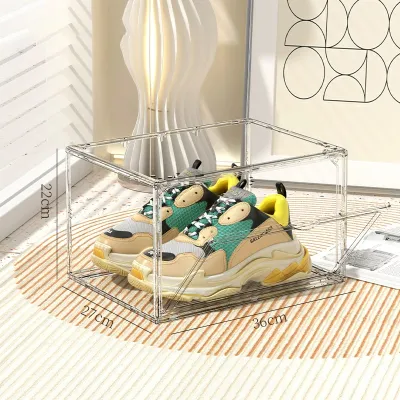
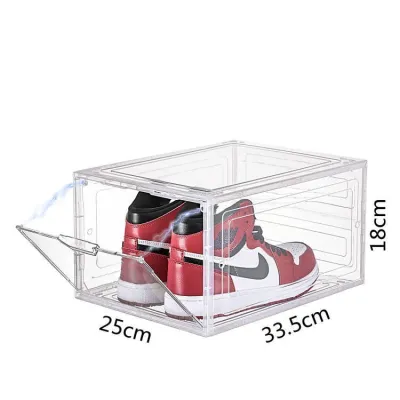
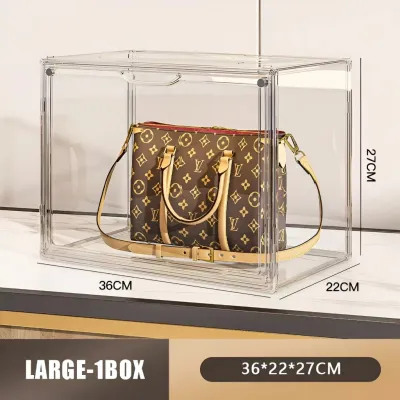
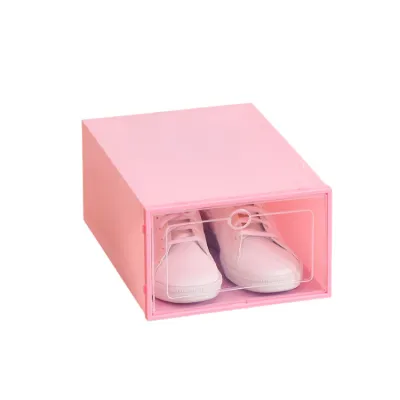
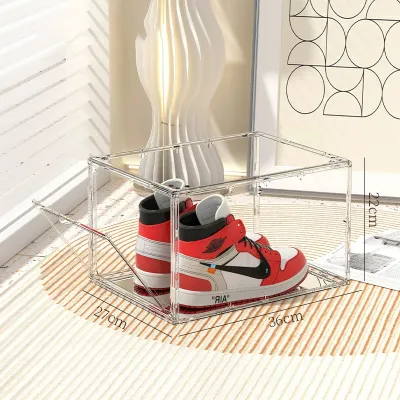
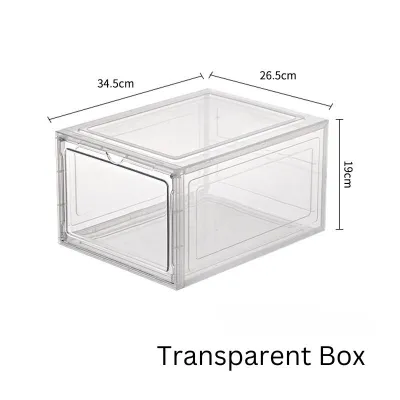
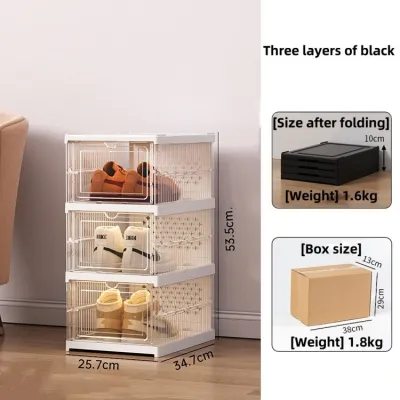
Prices are valid at publication and may change. Please refer to the product page for the latest price.
Weight capacity limits must also be verified to prevent the lower units from collapsing. The bottom box in a stack bears the cumulative weight of all the boxes and shoes above it. If you plan to stack units five or six high, ensure the manufacturer specifications confirm that the material can support that load without bowing or cracking. When multiple boxes are stacked, the load is not always distributed evenly; if a box is slightly misaligned, the weight concentrates on a single corner, which can cause the plastic to warp or crack over time.
Finally, door clearance and shelf depth measurements are vital for seamless wardrobe integration. Measure the internal shelf depth from the back wall to the inside face of the closed door to ensure the boxes do not prevent the wardrobe doors from closing fully. Additionally, check the clear opening of your wardrobe doors, especially if you have sliding doors that restrict access to one side of the closet.
Matching Box Dimensions to Your Footwear
Footwear silhouettes vary wildly, meaning a standard shoe size does not translate directly to a standard box size. A chunky platform sneaker occupies significantly more volume than a minimalist running shoe or a pair of flat sandals of the exact same size. Measuring your specific shoes is the only way to avoid buying boxes that are too shallow or short.

Sneakers and Everyday Flats
To accommodate bulky casual shoes, you must measure the longest and tallest points of your largest pairs. Use a physical measuring tape to find the absolute length from the heel pull-tab to the tip of the outsole, as well as the height from the bottom of the sole to the highest point of the collar.
Modern athletic footwear often features flared outsoles or extended heel counters that project beyond the actual fabric upper. When measuring, do not rely on the shoe’s nominal size; physically measure the widest part of the sole. High-top basketball shoes or thick-soled trail runners require extra vertical clearance, often needing boxes with an internal height of at least 18 centimeters to avoid compressing the ankle collar.
When browsing options, always check the internal versus external box dimensions. Online listings often highlight external dimensions to help you plan shelf space, but the internal usable space is what dictates whether your shoes will fit. Thick plastic walls, interlocking lips, and door frames can reduce internal clearance by one to two centimeters, which can cause wider sneakers to rub against the sides and suffer scuffs.
High Heels and Wedges
High heels present a unique spatial challenge because they stand vertically but taper down. To store them upright without bending or damaging the shoe structure, calculate the heel height plus the toe box depth to determine the required vertical clearance.
To maximize space inside a single box, many people use the alternating placement method—placing one shoe facing forward and the other facing backward. While this saves horizontal width, it requires a wider box to accommodate the widest parts of both the toe box and the heel counter side-by-side. Ensure you measure the combined width of the pair in this alternating position before selecting a box width.
For delicate materials like suede, patent leather, or embellished satin, the method of access is just as important as the size. Top-opening boxes require you to unstack the entire column to access a pair at the bottom, increasing the risk of tipping and friction damage. Side-opening or front-drop doors allow you to slide the shoes out horizontally without disturbing the stack, protecting delicate heels from catching on the frame.
Boots and Tall Footwear
Ankle, mid-calf, and knee-high boots require specialized storage strategies because standard shoe boxes are rarely tall enough to accommodate their shafts. For ankle boots, look for extra-tall stackable units or modular containers designed with a vertical clearance of at least 20 to 25 centimeters.
Using cedar wood boot trees adds significant weight to the footwear. If you store boots with heavy wooden shapers inside stackable boxes, the cumulative weight of the stack increases rapidly. In such cases, opt for lightweight foam or inflatable shapers to keep the overall weight within the safe limits of your wardrobe shelves and the lower storage units.
If you must store taller boots in standard closet systems, evaluate folding techniques carefully. Folding soft shafts can cause permanent creasing, cracking, or peeling in genuine leather and synthetic materials. To maintain structural integrity, insert rigid boot shapers or inflatable trees into the shafts and store them horizontally in long, flat boot boxes, or dedicate a taller, non-stacked section of your wardrobe for upright boot storage.
Evaluating Stackability and Wardrobe Fit
Verifying that your chosen boxes will remain stable and fit within your specific closet layout requires careful calculation and physical inspection. A stack that looks secure in a product photo may behave differently when loaded with heavy footwear on a wardrobe shelf.
Begin by checking the interlocking lip depths and anti-slip features on the base of the boxes. A shallow lip of less than two millimeters offers minimal resistance against tipping. Look for deeper grooves or physical peg-and-hole locking systems that secure the units together. Anti-slip rubber pads or textured patterns on the base of the bottom box can also prevent the entire stack from sliding on smooth wardrobe shelves.
Next, measure your wardrobe shelf width to calculate the optimal number of boxes per row. Divide the total internal width of the shelf by the external width of a single shoe box, accounting for wardrobe hinges, door tracks, or shelf support brackets that might protrude into the storage space. For example, if your shelf is 90 centimeters wide and each box is 26 centimeters wide, you can fit exactly three boxes side-by-side, leaving a 12-centimeter gap that can be used for slim items or left clear for ventilation.
The material of your wardrobe shelves also plays a role in stability. Wire shelving, common in some modular closet systems, provides uneven support that can cause plastic boxes to wobble or tilt. For wire shelves, place a solid acrylic liner or a thin wooden board beneath the bottom row of boxes to create a flat, stable foundation. Solid wood or laminate shelves offer the best support but are susceptible to scratching; using felt pads on the bottom corners of the lowest box can protect your cabinetry.
Finally, verify the top-shelf weight limits and structural integrity of your closet system. Wardrobe shelves, especially those made of particleboard or medium-density fiberboard (MDF), have weight limits. A tall stack of heavy plastic boxes filled with leather shoes can weigh upwards of 10 to 15 kilograms. Check your wardrobe manufacturer’s manual to verify the maximum load capacity of individual shelves to prevent sagging or structural failure over time.
Material, Visibility, and Ventilation Trade-offs
The choice of material affects not only the appearance of your closet but also the long-term preservation of your footwear. Different materials offer distinct trade-offs regarding visibility, airflow, and structural rigidity.
Clear plastic boxes, such as those made of acrylic or polypropylene, offer high visibility, allowing you to locate specific pairs instantly. However, if your wardrobe is positioned near a window or receives direct sunlight, clear plastic offers no protection against ultraviolet (UV) rays. Over time, UV exposure can cause white midsoles to yellow and colored fabrics to fade. If your closet is exposed to natural light, consider tinted or opaque boxes for sensitive or high-value footwear.
Fabric or cardboard boxes offer greater breathability, which helps prevent moisture buildup and musty odors—a crucial consideration in humid environments. However, these materials lack the structural rigidity of hard plastic. When stacked, fabric and cardboard boxes tend to bow or sag under weight, especially in high-humidity conditions where cardboard absorbs moisture from the air and loses its strength. Limit fabric or cardboard stacks to no more than two or three units high, and reserve them for lightweight footwear like flats or sandals.
In tropical climates, high relative humidity can trap moisture inside sealed plastic boxes, creating an environment prone to mold and mildew. Ventilation slots or rear air vents are essential to promote continuous airflow. However, larger ventilation holes can allow dust and small insects to enter. To strike the right balance, look for boxes with mesh-covered vents or small, strategically placed air slits that allow air exchange while keeping dust accumulation to a minimum.
Regardless of the material you choose, always check the manufacturer’s care labels for cleaning and maintenance instructions. Plastic boxes can typically be wiped down with a damp microfiber cloth and mild soap, while fabric boxes may require vacuuming or spot cleaning. Ensure the boxes are completely dry before placing shoes inside to avoid trapping moisture.
Building Your Conditional Shortlist
To find the right stackable shoe boxes without wasting time or money, follow a systematic framework to filter options from online marketplaces and retailers.
First, create a precise dimension checklist based on your shoe measurements and wardrobe dimensions. Document the maximum external width, depth, and height that your shelves can accommodate, alongside the minimum internal dimensions required for your largest shoes.
Second, filter your search by access type. If you plan to stack boxes more than three units high, filter specifically for drop-front or side-opening doors. Reserve top-lid access boxes only for single-layer storage or low stacks where unstacking is not a daily inconvenience.
Third, verify the retailer’s return policies before placing a large order. Because sizing mismatches and structural defects can occur, ensure you can return or exchange the boxes if they arrive damaged, if the plastic is warped, or if the interlocking mechanisms do not align properly. Purchasing a single sample box to test the fit and quality before buying a complete set is a highly practical way to avoid bulk return hassle.
Frequently Asked Questions (FAQ)
How many stackable shoe boxes can I safely stack?
The safe stacking limit depends on the box material, interlocking design, and total weight. For rigid, heavy-duty plastic boxes with deep interlocking grooves, a stack of six to eight units is generally stable, provided the bottom box is rated for that cumulative weight and the stack is placed on a level, solid surface. For lighter plastic or fabric boxes, limit the stack to three to four units to prevent bowing, tipping, or collapsing. Always refer to the manufacturer’s specific stacking guidelines and weight limits.
Do I need to keep the original shoeboxes for resale value?
For high-value collector sneakers or designer heels, keeping the original cardboard shoebox is highly practical as it preserves the resale value and authenticity appeal for buyers. However, original cardboard boxes are prone to deteriorating, absorbing moisture, and harboring pests in humid climates. To protect both the shoes and the original packaging, store the shoes in clear, breathable, stackable plastic boxes for daily use, and store the empty original boxes flat-packed in a dry, climate-controlled area. If storing shoes long-term in original boxes, wrap them in acid-free tissue paper and place silica gel packets inside to absorb excess moisture.

Community discussion
Share your experience or ask a question. Comments are reviewed before publication.