
Selecting a kids’ pull-out bed frame—often referred to as a trundle bed—is an excellent space-saving solution for Singapore’s compact apartments, HDB flats, and condominiums. However, because these beds feature moving parts, sliding tracks, and multi-level structures, prioritizing safety is paramount before making a purchase. To ensure your child’s sleeping environment is secure, a pull-out bed frame must comply with rigorous international safety standards that govern structural integrity, material non-toxicity, and mechanical safety. Parents should look for compliance with recognized benchmarks such as the European standard EN 747, the American ASTM F1427, and the Consumer Product Safety Improvement Act (CPSIA). Beyond official certifications, conducting hands-on physical checks of the frame’s stability, the smoothness of the sliding tracks, and the snugness of the mattress fit is essential to eliminate risks of entrapment, pinching, or structural collapse.
Verifying Safety Certifications and Product Labels
When shopping for a kids’ pull-out bed frame in Singapore, your first line of defense is verifying the manufacturer’s safety certifications. High-quality children’s furniture should carry clear, permanent labels indicating compliance with international safety standards. For bunk beds or elevated frames that incorporate a pull-out trundle, look for references to EN 747 or ASTM F1427. These standards ensure the bed has undergone rigorous testing for load capacity, stability, and structural durability. For single-level pull-out beds, general children’s furniture standards like EN 1725 or ASTM safety specifications apply.
Do not rely solely on retail descriptions or verbal assurances from showroom staff. Ask the retailer or brand directly for official test reports or certificates of compliance issued by accredited third-party testing laboratories, such as TÜV SÜD, SGS, or Intertek. A reputable manufacturer will readily provide these documents to prove their products have passed mechanical and chemical safety tests. Ensure the certificate specifically matches the model name and SKU of the bed frame you intend to buy.
Products mentioned in this guide
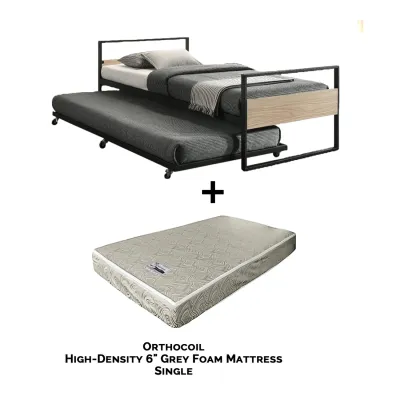
![[Ready Stock] Single Pullout Metal Bed Frame | Sturdy Steel Bedframe | Fast & Free Delivery](https://img.lazcdn.com/g/p/69c91378bde358f1083de8c5e0c47a6f.png_400x400q80.png_.webp)
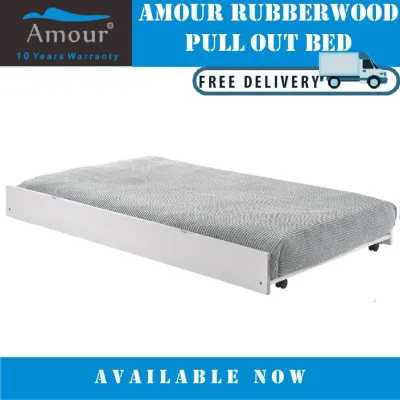
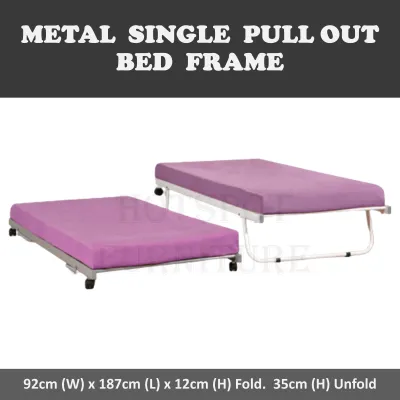
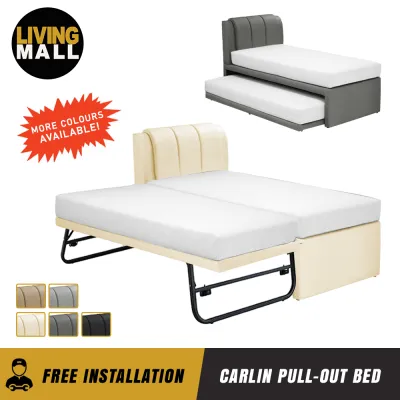
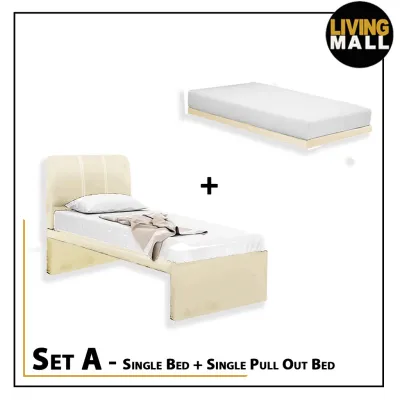
Prices are valid at publication and may change. Please refer to the product page for the latest price.
In Singapore’s tropical climate, bedrooms are frequently closed and air-conditioned, which can trap airborne chemicals. Therefore, material safety is just as critical as structural integrity. Look for certifications that guarantee low chemical emissions, such as the Singapore Green Label, Greenguard Gold, or compliance with European E1 formaldehyde standards. These labels confirm that the adhesives, paints, and finishes used on the wooden or engineered wood frame do not release harmful volatile organic compounds (VOCs) into your child’s sleeping space.
Inspecting the Pull-Out Mechanism and Moving Parts
The defining feature of a pull-out bed frame is its sliding trundle mechanism, which also presents the highest risk of mechanical failure or injury if poorly designed. When visiting a local furniture showroom, physically test the pull-out mechanism yourself. The lower bed should glide out smoothly along its tracks or castors without requiring excessive force. If the mechanism jams, jerks, or derails under normal lateral pressure, it poses a risk of tipping or sudden collapse when a child attempts to operate it.

A reliable locking mechanism is non-negotiable for any pull-out bed. When the trundle is fully extended, it must lock securely into place so that it cannot slide back unexpectedly if a child steps on the edge or rolls over during sleep. Similarly, when the bed is stored away, a secure catch or stopper should prevent the trundle from rolling out on its own, especially if your home has slightly uneven flooring. Check whether the wheels or castors feature individual locks or if the frame utilizes a built-in track-stop system.
Carefully inspect the frame for potential pinch points, sharp metal edges, or exposed hardware. Run your fingers along the tracks, joints, and handles. Children’s fingers are small and easily trapped in the gaps between the sliding trundle and the main bed frame. Ensure that all moving joints, springs, or gears are completely enclosed or shielded. Pull-out handles or cutouts should have smoothly rounded edges with no rough wood splinters or sharp metal burrs that could cause cuts or abrasions.
Checking Structural Stability and Entrapment Risks
Structural stability is the foundation of children’s furniture safety. Give the assembled bed frame a firm shake from different angles to check for wobbling, swaying, or creaking. In Singapore’s humid environment, solid wood frames (such as rubberwood, oak, or beech) or heavy-duty powder-coated steel frames generally offer superior long-term stability compared to low-grade particle board, which can absorb moisture and weaken over time. Pay close attention to the joint connections; look for robust metal-on-metal barrel nut and bolt connections rather than simple wood screws, which can strip and loosen.
Entrapment is a severe hazard that parents must actively prevent. If the main bed frame features guardrails or slatted headboards and footboards, measure the gaps between the slats. According to international safety guidelines, these gaps should be narrow enough to prevent a child’s head, torso, or limbs from slipping through and becoming trapped. Generally, gaps should be kept under 75mm to 95mm. Additionally, the height of the guardrails on the upper bed must extend sufficiently above the top of the mattress to prevent accidental falls during sleep.
The fit of the mattress within both the main frame and the pull-out trundle is critical to eliminating dangerous gaps. If a mattress is too small for the frame, a child can slide into the space between the mattress edge and the wooden side rails, leading to suffocation or limb entrapment. Before purchasing, obtain the exact internal dimensions of both bed compartments. Ensure your chosen mattresses fit snugly, leaving no more than a two-finger gap (approximately 2cm to 3cm) on any side. Keep in mind that pull-out trundles often require a thinner mattress than the main bed to slide smoothly underneath without catching.
Safe Assembly, Maintenance, and Stopping Conditions
Ensuring the long-term safety of a kids’ pull-out bed frame requires proper assembly and diligent ongoing maintenance. If you choose to assemble the bed yourself, strictly follow the manufacturer’s step-by-step instructions and use only the provided hardware. Never substitute missing screws with random hardware from a local DIY store, as incorrect thread pitches or lengths can compromise the frame’s structural integrity. If you utilize a professional delivery and installation service in Singapore, inspect the completed assembly thoroughly before the technicians leave, checking that every bolt is fully tightened and the frame is perfectly level.
Establish a routine maintenance schedule to inspect the bed frame every few months. Singapore’s high humidity and temperature fluctuations can cause solid wood to expand and contract, which naturally loosens joints over time. Use an Allen key or screwdriver to gently tighten all structural bolts, brackets, and castor attachments. Inspect the wooden slats supporting the mattresses to ensure none are cracked, sagging, or splintering. Clean the sliding tracks regularly to remove dust, hair, and debris that could obstruct the wheels and cause the mechanism to jam.
Parents must be vigilant about identifying warning signs that indicate the bed is no longer safe for use. If you notice persistent squeaking that does not resolve after tightening the bolts, visible cracks in the load-bearing joints, bent metal tracks, or a locking mechanism that fails to engage, discontinue use of the bed immediately. Do not attempt temporary DIY fixes with tape, glue, or non-standard brackets. Instead, contact the manufacturer or the local retailer to request official replacement parts or professional repair services to restore the bed’s safety.
Frequently Asked Questions (FAQ)
Are bunk beds with pull-out trundles safer than standard pull-out sofa beds for children?
Yes, dedicated bunk beds with pull-out trundles are significantly safer for children than standard pull-out sofa beds. Bunk beds and trundles designed specifically for kids are engineered to meet strict children’s furniture safety standards, featuring robust guardrails, secure mattress supports, and stable frames. In contrast, standard pull-out sofa beds are designed for occasional adult guest use and often feature complex folding metal mechanisms, heavy tension springs, and deep scissor-like pinch points. These moving parts pose severe finger-trapping and crushing hazards for young children. Furthermore, sofa beds typically lack guardrails and do not provide the flat, supportive sleeping surface necessary for a child’s developing spine.
How often should parents inspect the pull-out tracks and locking mechanisms?
Parents should perform a quick visual check of the pull-out tracks and locking mechanisms weekly, especially if the trundle bed is used daily. A more thorough physical inspection should be conducted every three to six months. During this comprehensive check, test the smoothness of the sliding mechanism, verify that the safety locks or wheel stoppers engage firmly, and ensure that all fastening screws securing the tracks to the bed frame are tight. If your child frequently plays on or around the bed, or if you notice any changes in how smoothly the trundle glides, inspect the mechanical components immediately to prevent accidental derailment or collapse.

Community discussion
Share your experience or ask a question. Comments are reviewed before publication.