
When transitioning your child from a crib, selecting a safe small bed requires careful inspection of specific physical features. The most critical safety checks include evaluating guardrail dimensions to prevent falls, measuring slat spacing to avoid entrapment, verifying structural stability and weight limits, and ensuring all surface finishes are non-toxic and smooth. By systematically checking these elements against the manufacturer’s specifications and observable build quality, you can create a secure sleeping environment for your toddler.
Transitioning to a first proper bed is a major milestone for both you and your child. While a smaller bed frame is highly practical for compact bedrooms, safety must remain the absolute priority during your search. Unlike adult furniture, children’s beds must accommodate active movement, unpredictable sleeping positions, and the natural curiosity of a toddler.
To make an informed decision, you need to look beyond aesthetic appeal and focus on structural integrity and physical dimensions. Evaluating these features before making a purchase helps prevent common nighttime accidents and gives you peace of mind. This guide outlines the essential safety checks you should perform when selecting a small bed for your child.
Products mentioned in this guide

![[Pre-order]Half height storage bed home small unit boys and childrens bed combination under bed desk wardrobe integrated half height storage bed](https://img.lazcdn.com/g/p/6bbb66554d99671bd9bffb739b19ba1b.jpg_400x400q80.jpg_.webp)


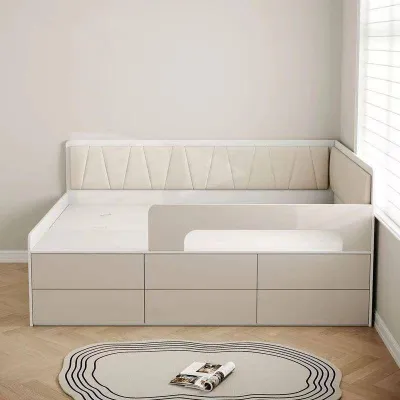
Prices are valid at publication and may change. Please refer to the product page for the latest price.
Evaluating Guardrails for Fall Prevention
Guardrails serve as the primary barrier preventing your child from rolling out of bed during the night. Because toddlers transition from the fully enclosed environment of a crib, they often lack the spatial awareness to stay within the boundaries of an open mattress. Checking the design, height, and security of these rails is your first line of defense.
Begin by checking the guardrail height relative to the thickness of the mattress you plan to use. A guardrail that seems tall on an empty bed frame can become dangerously shallow once a thick mattress is inserted. Measure the distance from the top of the mattress to the top of the guardrail; there should be a substantial protective barrier remaining to prevent your child from rolling over the edge.
Next, inspect the gaps between the guardrail and the bed frame, as well as the gaps within the guardrail itself. These spaces must be narrow enough to prevent a child’s head, torso, or limbs from slipping through. A gap that is too wide poses a serious risk of entrapment, where a child might slide halfway out of bed and become stuck.
You should also verify whether the guardrails are permanently fixed or designed to be removable. Permanent rails offer maximum stability and cannot be accidentally dislodged by an active child. If you choose a model with removable or fold-down rails, inspect the locking mechanism to ensure it requires adult strength to operate and cannot be released by curious toddler fingers.
Checking Slat Spacing to Prevent Entrapment
Entrapment hazards are a critical concern when evaluating any small bed. Children often explore their surroundings with their hands, feet, and heads, making it essential that all gaps in the bed’s construction are safe. Slat spacing on the headboard, footboard, and mattress support base must be carefully measured.

When examining the bed frame, measure the distance between the vertical slats or spindles on the headboard and footboard. These gaps should be narrow enough to prevent a child’s head or body from passing through. Standard safety practices suggest keeping these gaps minimal, typically matching the strict spacing requirements used for cribs to ensure complete safety.
Inspect the headboard and footboard for any decorative cutouts, scrollwork, or intricate designs. While these features can look charming, they often create wedge-shaped openings where a child’s head or limbs could become trapped. Opt for simple, solid panels or closely spaced vertical slats to eliminate these physical hazards entirely.
The fit of the mattress within the bed frame is another critical area to check. Ensure the mattress fits snugly against the interior frame on all sides, leaving no significant gaps at the edges or corners. A loose-fitting mattress creates a dangerous void where a child could slip down, leading to entrapment or suffocation risks.
Assessing Structural Stability and Weight Limits
A toddler’s bed must be built to withstand more than just quiet sleeping. Children frequently jump, climb, and play on their furniture, meaning the bed frame must possess exceptional structural stability. Verifying the load capacity and joint construction will ensure the bed remains safe under active use.
Start by reviewing the manufacturer’s stated weight limit for the bed frame. This limit must comfortably accommodate your growing child, but it should also account for additional weight. Parents often sit on the edge of the bed for bedtime stories or comfort during the night, so the frame must support this combined weight without bowing or cracking.
Examine the joint construction in the product specifications or during a physical inspection. Look for reinforced corners, heavy-duty metal-on-metal connection hardware, and robust wooden or metal joints. Avoid frames held together solely by simple wood screws driven directly into the timber, as these can easily strip, loosen, and compromise the bed’s stability over time.
If you are inspecting a display model in a showroom, physically test the bed for stability. Shake the headboard and push down on the corners to check for wobbling, shifting, or squeaking. If you are purchasing online, carefully review the assembly instructions to verify if the design includes center support legs, sturdy slats, or floor leveling features to maintain balance on uneven surfaces.
Verifying Surface Finishes and Physical Smoothness
The materials and finishes used on a child’s bed have a direct impact on their health and physical safety. Toddlers frequently touch, lean against, and sometimes even chew on their bed frames. Ensuring the surfaces are chemically safe and physically smooth is a non-negotiable step in your evaluation.
Always look for product labels or manufacturer documentation indicating the use of non-toxic, lead-free, and phthalate-free paints, stains, or sealants. Certifications such as GREENGUARD Gold or compliance with regional toy safety standards provide assurance that the furniture does not release harmful volatile organic compounds (VOCs) into your child’s bedroom.
Perform a thorough physical inspection of the bed’s surfaces to check for smoothness. Run your hands along the wooden or metal frame to ensure there are no splinters, sharp edges, rough seams, or protruding hardware. All screws, bolts, and brackets should be countersunk or completely flush with the frame to prevent scratches or snagged clothing.
If the bed includes any fabric, mesh, or soft upholstered components, verify that these materials meet relevant safety and flammability standards. Check that the fabric is tightly secured to the frame without loose threads or dangling cords, which could present a choking or entanglement hazard to a young child.
Safe Assembly and Strategic Room Placement
Even the safest bed frame can become hazardous if it is assembled incorrectly or placed in a dangerous location. Proper setup and strategic positioning within the bedroom are essential to maximizing the safety features of your child’s new small bed.
When assembling the bed, follow the manufacturer’s instructions strictly and systematically. Use all the provided hardware, brackets, and support slats, and never attempt to use makeshift or substitute parts. Double-check every connection after assembly to ensure all bolts are fully tightened and the frame is completely rigid.
Strategic room placement is vital for preventing accidents. Position the bed well away from windows, blind cords, curtains, and electrical outlets to eliminate strangulation and fall hazards. Additionally, keep the bed clear of heavy furniture like tall dressers or bookshelves that could pose a tipping hazard if a child attempts to climb on them.
Ensure there is adequate clearance around the bed to allow for safe entry and exit without your child bumping into walls or other furniture. To cushion any accidental rolls or falls during the initial transition period, consider placing a low-pile rug or a soft play mat on the floor directly beside the bed.
Frequently Asked Questions (FAQ)
At what age is it safe to transition to a small toddler bed?
There is no single, universal age for transitioning a child to a small bed, as readiness depends on physical and behavioral milestones. Most children make the transition between 1.5 and 3 years of age. A key physical sign of readiness is when your child is able to climb out of their crib, or when the crib mattress at its lowest setting no longer prevents them from climbing over the rail. Behavioral signs include expressing a strong desire for independence or showing interest in a larger bed.
Do I need to anchor a small toddler bed to the wall?
Standard freestanding small beds that sit low to the ground typically do not require wall anchoring. However, if the bed frame is integrated with shelving, a hutch, a bookcase, or any elevated storage units, you must anchor the entire structure to the wall using anti-tip kits. Any furniture that a child might attempt to climb must be securely fastened to a wall stud to prevent catastrophic tip-over accidents.

Community discussion
Share your experience or ask a question. Comments are reviewed before publication.