
Quick Answer: Which Locked Shoe Cabinet Should You Choose?
Finding a reliable shoe cabinet with lock in Singapore requires balancing security, entryway space, and budget. Because every home’s layout and household size differ, there is no single universal brand that suits everyone. Instead, the ideal choice depends on whether you prioritize cost-effectiveness, custom-tailored dimensions, or premium security features.
Mass-market retail brands offer affordable, standardized cabinets with basic locks that are suitable for simple storage needs. In contrast, engaging local custom carpentry allows you to maximize tight HDB or condominium foyers with floor-to-ceiling storage and heavy-duty, integrated locking hardware. Premium imported brands provide high-end aesthetics and advanced electronic locking systems but require a larger financial investment and have fixed dimensions. By understanding the trade-offs between these options, you can select a secure storage solution that fits your home perfectly.
How to Evaluate Build Quality and Lock Reliability
To ensure your shoe cabinet remains secure and functional over years of daily use, you must look beyond surface aesthetics. A locking mechanism is only as reliable as the cabinet structure supporting it. If the doors are thin or the frame is unstable, a lock can easily be bypassed by simply flexing the door panel or prying open the gap between the doors. When evaluating cabinets, look for reinforced mounting points around the lock area and check that the door frames are rigid enough to resist physical force.
Products mentioned in this guide
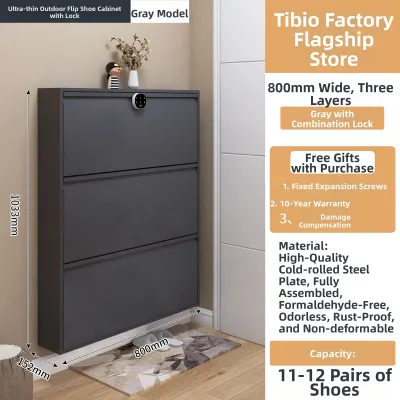
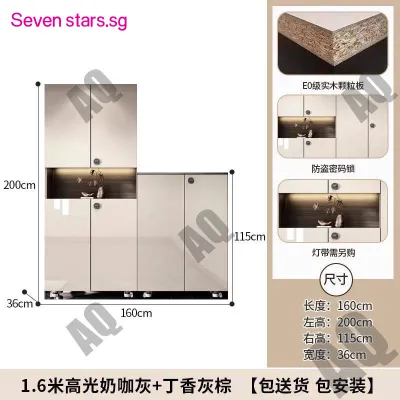
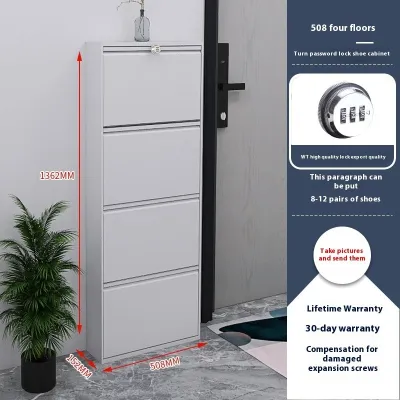
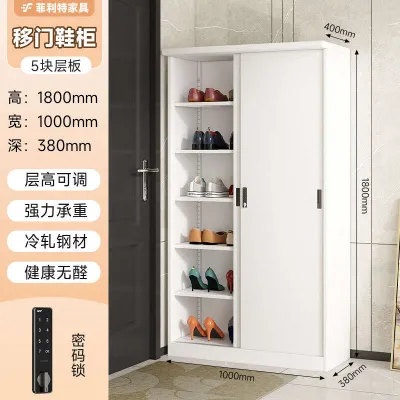
Prices are valid at publication and may change. Please refer to the product page for the latest price.

True storage capacity must also be measured accurately. Many manufacturers state capacity based on small, narrow shoes packed tightly together. To find the actual capacity for your household, look at the internal depth and the adjustability of the shelves. A standard shoe cabinet should have an internal depth of at least 32cm to 35cm to accommodate larger shoe sizes comfortably without forcing the doors shut, which puts constant pressure on the lock latch.
Build quality is heavily determined by the materials and hardware used. High-density fiberboard (HDF), quality plywood, or solid wood are far more durable and secure than low-density particleboard, which can crumble under the weight of heavy locks. Pay close attention to the hinges; heavy-duty, adjustable soft-close hydraulic hinges are essential for keeping the doors perfectly aligned. If the hinges sag by even a few millimeters over time, the lock latch will fail to align with the strike plate, rendering the lock useless or causing it to jam. Always check the manufacturer’s care and assembly instructions to verify how the joints are secured and how to maintain the cabinet’s structural integrity.
Comparing Brand Categories for Locked Shoe Cabinets
The market for shoe cabinets in Singapore can be broadly divided into three main categories, each offering distinct advantages and trade-offs regarding lock reliability, capacity, and cost. Understanding these categories will help you navigate showrooms and online product specifications more effectively.
Mass-Market and Flat-Pack Furniture Brands
Mass-market furniture retailers and online marketplaces are popular choices for budget-conscious homeowners. These brands offer highly standardized, freestanding shoe cabinets that are readily available for quick delivery. The locking mechanisms on these units are typically basic, consisting of simple cam locks, key-and-latch systems, or pre-installed metal hasps designed for external padlocks.
While these options are highly affordable, their storage capacities are fixed and may not accommodate diverse shoe collections. When browsing mass-market options, always check the detailed product specifications for the exact internal shelf dimensions and material composition. Many budget cabinets are constructed from particleboard, which is highly susceptible to moisture absorption. In Singapore’s humid climate, moisture can cause particleboard to swell and warp, leading to door misalignment that prevents the lock from latching properly. Additionally, because these units are often flat-packed, the quality of the final assembly is critical. If you assemble the cabinet yourself, use a spirit level to ensure the frame is perfectly plumb and square, as even a minor tilt will cause the door and the lock to misalign over time.
Local Custom Carpentry and Built-in Specialists
For homeowners who want to maximize every square centimeter of their entryway, local custom carpentry is often the most effective solution. This route is particularly valuable in Singapore, where HDB flats and condominiums frequently feature narrow foyers, awkward niches, or structural walls next to household shelters that cannot be altered.
By working with a local carpenter or interior designer, you can design a built-in shoe cabinet that spans from floor to ceiling, maximizing vertical storage capacity. This approach allows you to specify high-grade mechanical deadbolts or integrated digital smart locks that match your home’s main door lock. You can also customize the interior layout with adjustable shelving, pull-out drawers, and dedicated compartments for boots or umbrellas. Before signing a contract, ask the carpenter for physical material samples. Ensure they use high-quality plywood cores rather than particleboard, and verify that all exposed edges feature thick ABS edge-banding. In Singapore’s humid environment, proper edge-banding is essential to seal the wood against moisture and prevent delamination. You should also request the exact brand and model specifications of the lock hardware to ensure it meets your durability expectations.
Premium and Imported Furniture Brands
Premium furniture boutiques and imported international brands cater to homeowners who prioritize high-end aesthetics, superior craftsmanship, and advanced hardware. These freestanding cabinets often feature sophisticated design elements, such as solid timber frames, metal accents, tinted glass doors, and integrated LED lighting.
The locking mechanisms on premium cabinets are typically highly advanced. You will often find integrated electronic smart locks, biometric fingerprint scanners, or high-security mechanical key systems that blend seamlessly into the cabinet’s design. However, it is important to note that premium imported cabinets may have slightly lower internal capacities relative to their external dimensions. This is due to the use of thicker decorative wood panels, double-walled construction, and internal structural framing that reduces the usable interior volume. When considering a premium imported cabinet, always verify the manufacturer’s warranty terms. Ensure that the warranty covers not only the cabinet structure but also the electronic or mechanical locking components, as replacing proprietary imported hardware can be costly and time-consuming.
Types of Locking Mechanisms and Their Reliability
Selecting the right locking mechanism is crucial for ensuring both convenience and security. Different lock types offer varying levels of physical resistance, ease of access, and maintenance requirements.
- Cam Locks and Key Locks: These are the traditional mechanical locks found on most standard shoe cabinets. They operate by turning a physical key, which rotates a metal latch (the cam) behind the door frame to secure it. Cam locks are highly cost-effective, simple to operate, and easy to replace if the keys are lost. They provide a basic level of privacy and are excellent for keeping children or pets out of the cabinet. However, they offer limited resistance against forced entry and can be bypassed with basic tools if sufficient force is applied.
- Digital and Smart Locks: Digital locks utilize PIN codes, RFID cards, or biometric fingerprints to grant access, eliminating the need to carry physical keys. This is highly convenient for large households, as access codes can be easily shared or updated. However, digital locks require active battery management. Singapore's high relative humidity can cause moisture to accumulate inside the battery compartment, leading to battery leakage, corrosion of electronic contacts, and potential lock failure. If you choose a digital lock, select a model with a high-quality, moisture-resistant casing and a low-battery warning indicator. It is also wise to choose a model that features an external emergency power port (such as a micro-USB or USB-C port) so you can power the lock from a power bank if the batteries die completely.
- Magnetic Catches and Child-Safety Locks: These mechanisms are designed to keep cabinet doors firmly closed and prevent accidental opening by toddlers or pets. Magnetic catches use strong magnets to hold the doors shut, while child-safety locks often utilize adhesive straps or magnetic keys. While these systems are highly effective at preventing child access and keeping the entryway looking neat, they do not provide physical security against unauthorized adult access or theft.
When visiting furniture showrooms in Singapore, use this practical checklist to evaluate the reliability of a cabinet’s lock and door hardware:
- Latch Depth: Lock the cabinet and try to gently pull the door. The latch should engage deeply and securely into the strike plate with minimal movement.
- Hinge Play: Open the cabinet door fully and gently lift it up and down. High-quality hinges should have zero play or wobbling, ensuring the door remains perfectly aligned.
- Door Clearance: Open and close the doors multiple times to ensure they swing smoothly without scraping against the frame or adjacent panels.
- Frame Rigidity: Gently push the side of the cabinet to check for swaying. A rigid frame prevents structural shifting that could cause the lock to jam.
Assessing Storage Capacity for Singapore Homes
To choose a shoe cabinet that meets your household’s needs, you must accurately calculate your storage requirements while considering the spatial constraints of Singaporean entryways.
Calculating your required capacity starts with a detailed inventory of your shoe collection. Categorize your shoes by height and width, as different styles require different amounts of vertical space. Standard flats, sandals, and sneakers typically require 10cm to 15cm of vertical clearance. High heels, ankle boots, and high-top sneakers need 15cm to 25cm, while tall boots can require 30cm or more. If you have a diverse collection, prioritize cabinets with adjustable shelving. Look for units with pre-drilled peg holes spaced 3cm to 5cm apart, which allow you to customize the shelf heights and eliminate wasted vertical space. Pull-out drawers or vertical slide-out racks can also maximize storage depth, but ensure the sliding tracks are heavy-duty and rust-resistant.
Spatial constraints are a major consideration in Singaporean homes. In many HDB flats and condominiums, the entryway corridor is narrow, meaning a deep cabinet can obstruct foot traffic. Measure your available space carefully, ensuring that the cabinet’s depth allows the doors to open fully without hitting adjacent walls or furniture.
If you are considering placing a locked shoe cabinet in a common corridor outside your HDB flat, you must comply with the Singapore Civil Defence Force (SCDF) fire safety guidelines. These regulations dictate that a minimum clear escape passage of 1.2 meters must be maintained along the corridor at all times. Placing a bulky cabinet that reduces this clearance is a safety hazard and can result in fines or orders to remove the furniture.
Finally, consider delivery and installation logistics. Before purchasing a large, pre-assembled cabinet, measure the width and height of your home’s main doorway, as well as the dimensions of your building’s lift. If a cabinet is too large to fit into the lift or through your front door, you may incur significant return fees or additional handling charges for manual delivery up the stairs.
Decision Guide: Which Locked Shoe Cabinet Fits Your Needs?
To make your final decision, evaluate your household’s specific requirements against this practical decision framework:
- Choose mass-market flat-pack if: Your budget is a primary consideration, and you want a cost-effective, ready-made solution. Standard cabinet dimensions fit your entryway perfectly without modification, and you only require basic privacy locks to keep children, pets, or casual visitors from opening the cabinet. The cabinet will be placed in a fully sheltered, dry indoor area where moisture exposure is minimal.
- Choose custom carpentry if: You have an awkward or narrow entryway layout, such as a niche next to an HDB household shelter, that requires a precise fit. You have a large shoe collection and want to maximize vertical storage space with a floor-to-ceiling built-in unit. This option is also ideal if you want to select and integrate specific, high-grade mechanical or digital locking hardware that matches your home's overall security system, and you want to choose specific materials, laminates, and edge-banding to ensure maximum durability in Singapore's climate.
- Choose premium imported brands if: You want a freestanding statement piece that serves as a design highlight in your foyer. You prioritize advanced security features, such as biometric fingerprint scanners or integrated smart home locks, and you are willing to invest a higher budget for premium materials, superior finishes, and proprietary hardware.
Before finalizing your purchase, perform these essential verification checks:
- Warranty Coverage: Verify whether the manufacturer's warranty covers both the cabinet frame and the locking hardware, especially if you are opting for an electronic digital lock.
- Internal Depth: Measure the internal shelf depth to ensure it is at least 32cm to 35cm, accommodating your largest pair of shoes comfortably.
- Hinge Load Capacity: Ensure the door hinges and cabinet frame are robust enough to support the weight of a fully loaded cabinet without sagging, which would cause the lock to misalign.
Frequently Asked Questions (FAQ)
Can I add a lock to an existing shoe cabinet?
Yes, retrofitting a lock onto an existing shoe cabinet is entirely possible. You can install aftermarket options such as cam locks, digital keypad locks, or simple padlock hasps. However, before proceeding, you should check the cabinet manufacturer’s care instructions and warranty terms, as drilling into the doors or frame will likely void your warranty.
When installing a lock, be extremely cautious with engineered wood materials like MDF, particleboard, or thin veneers. Drilling without proper pilot holes or using incorrect screw sizes can easily split the wood, ruin the laminate finish, or cause the wood fibers to crumble, leaving the lock insecure. If you are unsure of the cabinet’s material composition, consult a professional handyman or the manufacturer before attempting any modifications.
Are digital locks on shoe cabinets reliable in Singapore's climate?
Digital locks can be highly reliable, but Singapore’s tropical climate—characterized by high relative humidity and ambient salt spray in coastal areas—presents unique challenges. Excess moisture can seep into battery compartments, leading to rapid battery drain, corrosion of electronic contacts, and potential lock failure.
To minimize these risks, look for digital locks with a high Ingress Protection (IP) rating or those explicitly rated for humid environments. Always use high-quality, leak-proof alkaline batteries, and establish a strict routine to replace them every 6 to 12 months. Ensure the cabinet is placed in a well-ventilated, dry area away from direct rain exposure, and check the lock manufacturer’s instructions for regular maintenance of electronic components.

Community discussion
Share your experience or ask a question. Comments are reviewed before publication.