
Choosing a wardrobe for a Housing & Development Board (HDB) bedroom requires balancing storage capacity with limited floor space. F31 Furniture offers a variety of freestanding and modular wardrobes that can be a highly practical choice for HDB flats, provided you carefully verify their physical dimensions against your room’s layout. Because HDB bedrooms often feature tight corners, low-hanging air-conditioning trunking, and structural beams, a successful purchase depends entirely on pre-purchase planning and precise measurements rather than relying on standard size assumptions. By evaluating your specific storage habits, door clearance needs, and delivery logistics, you can determine if an F31 wardrobe aligns with your home’s requirements.
Measuring Your HDB Bedroom Space and Constraints
Before browsing any furniture catalog, you must establish the exact physical boundaries of your bedroom. HDB bedrooms, particularly in newer Build-To-Order (BTO) flats, are designed with compact footprints where every centimeter counts. Start by measuring the length and width of the floor area where you intend to place the wardrobe. Do not rely solely on the floor plan dimensions provided by the developer, as actual built dimensions can vary slightly due to plastering and wall finishes. Always measure the space at three different heights—floor level, mid-wall, and ceiling level—to account for any slight tilting or unevenness in the concrete walls.
Additionally, you must account for existing architectural features that cannot be moved. Skirting boards along the base of the wall will prevent a wardrobe from flushing completely against the wall, effectively adding a few centimeters to the required depth. Look upward to check for air-conditioning trunking, electrical casing, and structural beams that might obstruct a tall wardrobe. If your bedroom has a ceiling fan, measure its blade span to ensure that opening the wardrobe doors or standing near the unit does not interfere with the fan’s path. Window sills and light switches must also remain fully accessible after the wardrobe is installed.
Products mentioned in this guide
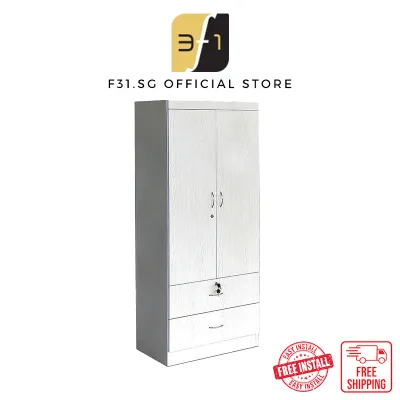
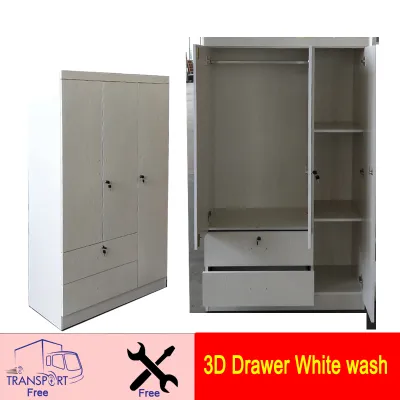
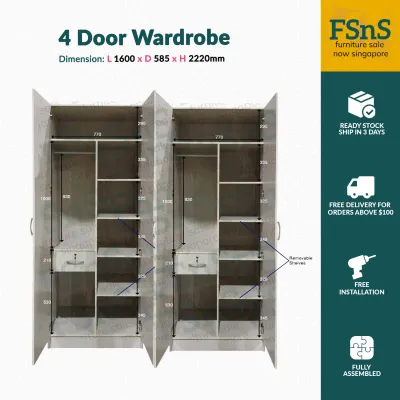
Prices are valid at publication and may change. Please refer to the product page for the latest price.
Finally, consider the clearance required for operating the wardrobe doors. If you are looking at hinged doors, you must measure the swing radius to ensure they can open fully without hitting your bed frame, bedside tables, or bedroom entry door. For sliding doors, while they eliminate the need for front clearance, you must account for the extra depth the sliding track system requires. Sliding door wardrobes are typically deeper than hinged ones to accommodate the overlapping tracks, which can restrict the walking path between the wardrobe and the foot of your bed.
Checking F31 Furniture Wardrobe Specifications
Once you have your room’s exact measurements, you can begin cross-referencing them with the specifications of F31 Furniture wardrobes. When browsing their online catalog or visiting a showroom, look past the aesthetic appeal and focus immediately on the listed width, depth, and height. Ensure that the manufacturer’s stated dimensions represent the outermost edges of the unit, including any decorative crown moldings, base plinths, or protruding door handles. If these details are not explicitly clear on the product listing, contact the retailer directly to confirm the absolute maximum dimensions.

The choice of door mechanism is a critical specification that dictates how the wardrobe interacts with your room. A sliding door model is often preferred in narrow HDB bedrooms because it allows you to place the bed closer to the wardrobe. However, you must verify the track depth; some sliding mechanisms require up to 10 centimeters of the wardrobe’s total depth just for the doors to slide smoothly, which reduces the actual internal hanging space. If you opt for a hinged door model, check the hinge quality and whether they feature soft-closing mechanisms, which prevent doors from slamming against the frame and causing wear over time.
Material specifications are equally important for long-term durability in a humid tropical climate. Review the product labels to identify the primary materials used, such as engineered wood, medium-density fibreboard (MDF), or solid wood veneers. Since high humidity can cause certain compressed wood materials to swell or warp if exposed to moisture, check the type of laminate or protective finish applied to the exterior and interior surfaces. Ask the retailer about care instructions, such as the recommended cleaning agents and whether the joints are reinforced with metal brackets or dowels to handle the weight of heavy winter wear or bedding.
Matching Your Storage Needs with the Interior Layout
A wardrobe’s external fit is only half the battle; the internal configuration must match your daily storage habits. Before choosing an F31 model, take an inventory of your clothing. If your wardrobe consists primarily of formal wear, dresses, and long coats, you will require a higher ratio of hanging space. Conversely, if you fold most of your clothing, such as t-shirts, jeans, and activewear, you will benefit more from deep shelving units and pull-out drawers.
Examine the adjustability of the internal components. Fixed shelves limit your storage flexibility, whereas adjustable shelving allows you to reconfigure the interior as your wardrobe changes over the seasons. Check if the model includes specialized compartments, such as integrated trouser racks, tie organizers, or lockable drawers for valuables. If you plan to store heavy items like luggage, spare bedding, or winter coats, verify the load capacity of the shelves and hanging rods with the retailer to prevent sagging or structural failure.
Consider whether the internal layout of the F31 wardrobe is modular or fixed. Modular designs allow you to purchase additional components, such as extra drawers or hanging rails, to customize the interior to your liking. If the model has a fixed layout, ensure that the height of the hanging rods is comfortable for your reach and that the drawers slide smoothly on their runners without sticking or derailing when fully loaded.
Navigating Delivery and Assembly in HDB Flats
Purchasing a wardrobe involves logistical challenges that are unique to high-rise HDB living. Before finalizing your order with F31 Furniture, you must confirm the packaging dimensions of the disassembled wardrobe. The flat-pack boxes or pre-assembled sections must be able to fit inside your HDB block’s lift cabin and navigate the narrow corridors and doorways of your flat. If the items are too large for the lift, you may face additional manual carrying charges, often calculated per floor in S$, which can significantly increase your overall cost.
Assembly is another critical factor to clarify before delivery. Large wardrobes are heavy and complex to assemble, requiring precise leveling to ensure the doors align and slide or swing correctly. Check whether professional installation is included in the purchase price or if it requires an additional service fee. If you choose to assemble the unit yourself, ensure you have the necessary tools, such as a spirit level, rubber mallet, and power drill, and that you follow the manufacturer’s anchoring instructions to secure the wardrobe to the wall to prevent tip-over accidents.
Lastly, review the warranty terms and after-sales support policies provided by the retailer. A reliable warranty should cover structural defects, warping of doors, and hardware failures like broken hinges or drawer runners for a reasonable period. Understand the process for claiming warranty support, including whether you need to transport the defective parts back to the showroom or if a technician will conduct on-site inspections and repairs at your flat.
Deciding if F31 Furniture Is the Right Choice
To make your final decision, synthesize your spatial, functional, and logistical findings. You should proceed with purchasing an F31 wardrobe if the model’s dimensions fit comfortably within your measured bedroom space, leaving adequate clearance for walking and door operation. It is a suitable choice if the internal layout matches your clothing inventory and the delivery and assembly logistics align with your HDB flat’s accessibility.
If you find that a specific F31 model’s depth or width slightly exceeds your comfortable clearance, look for alternative freestanding options within their catalog, such as models with sliding doors or narrower profiles. Freestanding wardrobes offer the flexibility of being easily moved or replaced during future home renovations.
However, if your HDB bedroom has highly irregular walls, prominent structural beams, or awkward alcoves that leave unusable gaps, freestanding furniture may not maximize your space efficiently. In such cases, you might want to explore custom carpentry or modular wardrobe systems. While custom built-ins are generally more expensive and permanent, they can be tailored to fit from floor to ceiling, sealing off awkward gaps and maximizing every square inch of your bedroom.
Frequently Asked Questions (FAQ)
Can F31 wardrobes be adapted for awkward HDB corners?
Freestanding F31 wardrobes are manufactured to standard dimensions and cannot be physically cut or altered to fit irregular corners or structural columns. If you have an awkward alcove or a protruding pillar, you can check with the retailer to see if they offer modular units of varying widths that can be placed side-by-side to fill the space. Alternatively, you can use filler panels or decorative trim to close small gaps between the wardrobe and the wall, creating a semi-built-in look. For highly complex layouts, custom carpentry remains the most effective solution.
How do I measure my HDB bedroom accurately for a wardrobe?
To measure your bedroom accurately, use a metal measuring tape and take measurements at the top, middle, and bottom of the wall where the wardrobe will stand. This accounts for any wall bowing or uneven flooring common in older flats. Measure the distance to the nearest obstacles, such as bed frames, door frames, and window sills, to ensure adequate clearance. Don’t forget to factor in the height of skirting boards, the location of electrical outlets, light switches, and the projection of air-conditioning pipes or ceiling fans.

Community discussion
Share your experience or ask a question. Comments are reviewed before publication.