
To select the perfect cabinet shelf rack, you must measure the absolute minimum internal width, height, and depth of your cabinet space. This means finding the narrowest points, subtracting obstructions like hinges or door lips, and leaving a small clearance margin of 1 to 2 centimetres. Taking these precise steps ensures your new modular organizer slides in smoothly and allows the cabinet doors to close completely.
Why Accurate Cabinet Measurements Matter
Built-in cabinets, especially in Singapore’s humid climate, can experience subtle shifting, warping, or settling over time. This means a cabinet that looks perfectly square is often slightly irregular. If you purchase a cabinet shelf rack based on a single, hasty measurement, you risk buying a unit that is too wide to clear the door frame or too deep to let the door latch shut. This leads to wasted storage space, potential damage to the interior laminate, and the hassle of returning items to online marketplaces.
Modular shelf racks offer excellent adaptability, but they still require an accurate baseline measurement to ensure their adjustable ranges align with your physical space. A rack that is even a few millimetres too wide can scrape against the cabinet walls during installation, chipping the protective melamine coating and exposing the underlying wood to moisture. By taking the time to measure precisely, you protect your cabinetry investment and maximize your usable storage volume.
Products mentioned in this guide
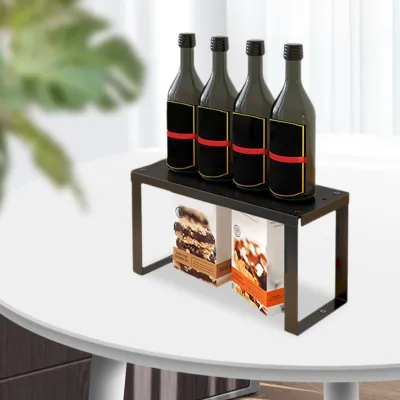
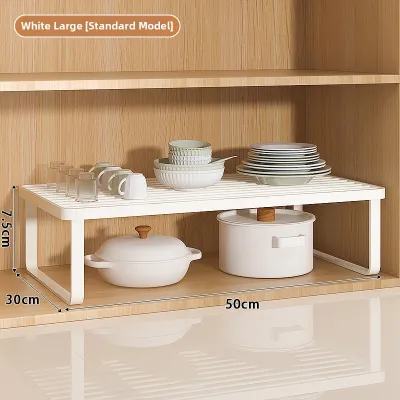
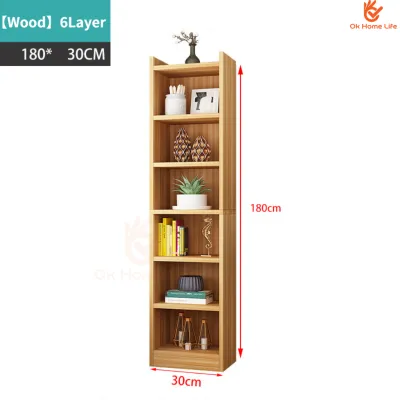

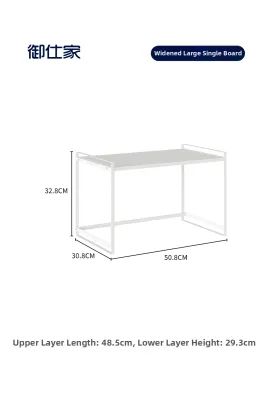
Prices are valid at publication and may change. Please refer to the product page for the latest price.
Furthermore, accurate measurements allow you to plan your storage layout more effectively. Knowing the exact dimensions of your cabinet interior helps you determine whether a single wide rack or multiple smaller, stacked units will serve your needs better. This foresight prevents the frustration of buying organizing tools that ultimately crowd your space rather than decluttering it.
Essential Tools for Measuring Cabinet Interiors
Before you begin measuring, gathering the right tools will ensure your readings are accurate to the millimetre. Relying on makeshift measuring methods or flexible materials often leads to errors that can ruin your organizing plans.

- Rigid steel measuring tape: Avoid using soft tailor's tape, which can sag, stretch, or bend around corners, leading to inaccurate readings. A high-quality steel tape measure remains stiff over long distances, allowing you to capture precise straight-line measurements inside deep cabinet cavities.
- Notepad or smartphone: Record every measurement immediately rather than trying to memorize them. Label each reading clearly as width, height, or depth, and note where in the cabinet (front, middle, back) the measurement was taken.
- Small flashlight: Cabinet interiors are notoriously dark, especially in deep corner units or under-sink compartments. A small flashlight or your smartphone's torch will help you read the tape measure markings accurately in dim corners.
- Spirit level: Check if the cabinet floor or existing shelves are level. An uneven base can cause a tall modular rack to lean, reducing its stability and load capacity once fully loaded with heavy kitchenware or pantry items.
Step-by-Step Guide to Measuring Cabinet Interiors
Measuring a cabinet interior requires a systematic approach. You cannot simply measure the front opening and assume the back wall shares the exact same dimensions. Always measure at multiple points to account for structural irregularities, and use the smallest figure as your final reference.
Measuring Width: Accounting for Hinges and Obstructions
To find the true usable width of your cabinet, you must measure the internal horizontal distance at three different heights: near the bottom, in the middle, and near the top. Record all three measurements and identify the smallest number. This smallest figure represents your baseline width, ensuring the rack will fit even at the cabinet’s narrowest point.
The most critical step in this process is identifying the “clear opening width.” Open the cabinet doors fully and look for any protruding hardware. Door hinges, magnetic catches, door stops, or sliding track mechanisms often extend into the entry path. Measure the distance between the innermost edge of the left hinge and the opposite cabinet wall (or the right hinge, if it is a double-door cabinet). If a modular rack is wider than this clear opening, you will not be able to slide it into the cabinet, even if the interior cavity is technically wide enough.
Measuring Height: Checking for Fixed Shelves and Lips
To determine the vertical clearance available for your modular shelf rack, measure the distance from the cabinet floor (or the top of an existing fixed shelf) to the underside of the cabinet ceiling. Take this measurement at both the front opening and along the back wall, as older cabinets can sag slightly in the middle.
Look closely for any overhanging face frames, raised bottom lips, or sliding door tracks at the top or bottom of the opening. A raised lip at the bottom of the cabinet opening can block a rigid shelf rack from entering, even if the interior height is sufficient. Subtract the height of any such obstructions from your total vertical measurement to find the true clearance height.
Measuring Depth: Avoiding Door Closure Issues
To measure the depth, extend your tape measure from the back wall of the cabinet to the front edge of the cabinet box. Do not assume the door sits flush with the outer edge of the frame. If your cabinet doors are inset—meaning they sit inside the frame when closed—you must subtract the thickness of the door (typically 1.5 to 2 centimetres) from your depth measurement.
Additionally, check for any permanent obstructions along the back wall, such as plumbing pipes, electrical conduits, outlet covers, or backing panels that bulge forward. If you plan to store items behind the rack, or if the cabinet back has a curved corner, reduce your usable depth accordingly. This ensures the cabinet doors can close and latch securely without pushing against the front of the rack.
Matching Measurements to Modular Shelf Rack Sizes
Once you have recorded your minimum width, height, and depth, you can confidently compare them to product specifications. Modular shelf racks often feature expandable widths (e.g., adjusting from 40 cm to 70 cm) or adjustable shelf heights.
Ensure your cabinet’s minimum width falls comfortably within the rack’s adjustable range. Do not select a rack where your cabinet width is exactly at the maximum limit, as this leaves no room for error or minor adjustments. For example, if your cabinet’s clear opening width is 60 cm, an expandable rack with a range of 40 to 65 cm is ideal, whereas a rack with a range of 60 to 90 cm may be too difficult to install.
Always leave a clearance gap of at least 1 to 2 centimetres on all sides of the rack. This tolerance allows you to install, adjust, and remove the rack without scraping the cabinet’s interior laminate or wood veneer. It also promotes healthy airflow, which is essential in Singapore’s humid environment to prevent mold and mildew growth in dark, enclosed spaces.
Before finalizing your purchase, check the product labels and manufacturer specifications for load capacity, weight distribution, and material care instructions. Do not assume a rack is sturdy simply because it is made of metal or solid wood; check the actual rated capacity (e.g., 10 kg per tier) to ensure it can support your heavy pots, pans, or small appliances.
Finally, consider the structural integrity of your cabinet when choosing between fixed-size modular units and expandable tension-based units. Tension-based racks exert outward pressure on the cabinet walls to stay in place. If your cabinets are made of thin plywood or lightweight MDF, excessive tension can cause the walls to bow or crack. In such cases, a freestanding, fixed-size modular rack is a safer choice.
Common Measuring Mistakes to Avoid
One of the most frequent errors is measuring only once. A single measurement fails to capture the natural warping or misalignment common in older or heavily loaded cabinets. Always take multiple readings across different points to ensure you capture the absolute minimum dimensions.
Another mistake is measuring the exterior of the cabinet. While exterior dimensions are useful for planning room layouts, they do not reflect the interior storage space, which is reduced by the thickness of the cabinet walls (often 1.5 to 1.8 cm per side). Always place your tape measure inside the cabinet box to get accurate internal readings.
Forgetting to account for the door swing radius is also common. If your cabinet door does not open past 90 degrees, a wide rack might hit the inside of the door when you try to slide it in. Always verify that the door opens wide enough to allow a straight, unobstructed path for the rack during installation.
Installation and Adjustment Tips for Modular Racks
Before installing your new cabinet shelf rack, inspect the cabinet wall material. Built-in kitchen cabinets in Singapore are commonly constructed from melamine-faced chipboard (MFC) or medium-density fibreboard (MDF). These materials can chip or strip easily if you use screw-mounted racks or over-tighten tension rods.
Always read the manufacturer’s instructions carefully to understand the tightening limits. Over-tightening can compromise the structural integrity of both the rack and the cabinet. If you are using a screw-mounted rack, pre-drilling small pilot holes can prevent the wood or MDF from splitting.
To protect your cabinet’s interior finish, apply small adhesive felt pads or silicone bumpers to the contact points of the shelf rack. This prevents the metal or plastic feet from scratching the laminate during installation or when adjusting the shelf height later.
Frequently Asked Questions (FAQ)
Can I use a tension-based shelf rack in any cabinet?
Tension-based racks require solid, parallel, and rigid walls to maintain a secure grip. They are highly effective in solid wood or thick plywood cabinets. However, you should avoid using them in cabinets with thin backing panels, glass doors, or fragile partition walls, as the outward pressure can cause cracking or structural failure. Always refer to the manufacturer’s manual for specific surface compatibility and weight limits.
What if my cabinet walls are not perfectly straight?
If your cabinet walls are uneven or out of square, choose an adjustable modular rack equipped with independent leveling feet. These feet can be adjusted individually to compensate for a sloping cabinet floor. Alternatively, you can place small plastic or wooden shims under the rack’s feet to stabilize the unit. Always use your narrowest width and shortest height measurements when purchasing to ensure the rack fits without being forced against the walls.

Community discussion
Share your experience or ask a question. Comments are reviewed before publication.