
Selecting the right fabric sofa for a Housing & Development Board (HDB) flat requires balancing seating comfort with the physical realities of Singaporean apartment layouts. When browsing InnDesign fabric sofas, your decision hinges on three core factors: available floor space, walkway clearance, and the visual weight of the upholstery. Because HDB living rooms serve as multi-functional hubs, a sofa that is too large can disrupt the flow of the home, while one that is too small may fail to provide adequate seating.
For compact 2-room and 3-room flats, the general approach is to prioritize space-saving profiles, such as streamlined 2-seaters or compact 3-seaters with raised legs that allow light to pass underneath. Standard 4-room flats offer more flexibility, making them suitable for standard 3-seater sofas paired with an ottoman or compact L-shaped configurations that fit neatly into corners. Spacious 5-room and Executive flats can accommodate larger modular setups or deep-seated sofas that act as room dividers in open-concept layouts.
As you plan your purchase, keep in mind that specific model availability, current stock status, and exact S$ pricing must be verified directly with InnDesign. This guide provides the structural framework to help you evaluate different configurations so you can make an informed choice when visiting a showroom or browsing online.
Products mentioned in this guide
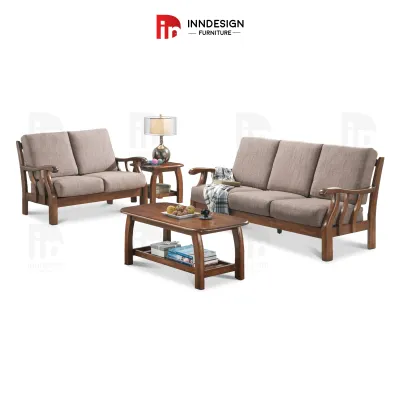
Prices are valid at publication and may change. Please refer to the product page for the latest price.
Measuring Your HDB Living Room for a Fabric Sofa
Before committing to any fabric sofa model, taking precise measurements of your living room is essential to avoid layout mistakes. Begin by measuring the length of the wall where you intend to place the sofa. Use a metal measuring tape for accuracy, and measure from corner to corner along the floor. Be sure to subtract the thickness of any skirting boards, as these can prevent the sofa from sitting completely flush against the wall, effectively reducing your available floor space.
Next, measure the depth of the room to determine how far the sofa can extend into the living area without obstructing daily movement. Mark the proposed footprint of the sofa on the floor using masking tape or newspaper to visualize how much physical space it will occupy. During this step, locate all wall-mounted power outlets, light switches, and data ports. Ensure the height and depth of the sofa will not block access to these essential utilities, or plan to position the sofa slightly forward to allow room for plugs.
Walkway and clearance rules are critical for maintaining a comfortable flow throughout your home. As a general standard, aim to leave at least 75 to 90 centimeters of clear walkway space between the edge of the sofa and any facing furniture, such as a coffee table or television console. If the sofa is positioned near pathways leading to balconies, kitchens, or bedroom corridors, ensure that its depth does not force family members to walk sideways or navigate tight corners.
Finally, do not overlook delivery access, which is a common bottleneck for HDB residents. Measure the height and width of your front door frame, as well as any internal corridors or tight corners inside your entryway. You must also verify the dimensions of your HDB estate’s lift, including the door opening width, internal cabin height, and diagonal depth. If a large sofa cannot fit into the lift, it may need to be carried up the staircase, which often incurs additional manual handling fees in S$ and must be coordinated with the delivery team beforehand.
Choosing InnDesign Fabric Sofas by HDB Flat Type
HDB floor plans have evolved significantly over the decades, resulting in diverse living room proportions, structural pillars, and window placements. Older flats often feature long, narrow living areas, while newer Build-To-Order (BTO) layouts tend to favor more square or open-concept spaces. These architectural variations mean that a sofa configuration that works beautifully in one flat type may feel cramped or awkward in another.

To find the right fit, you must adapt your sofa selection to these fixed structural elements. For instance, structural pillars cannot be removed, and low-set windows must not be completely blocked by high sofa backrests. By understanding the typical spatial constraints of your specific HDB flat type, you can narrow down your options to configurations that maximize seating comfort without compromising the room’s natural light or ventilation.
2-Room and 3-Room HDB Flats (Compact Layouts)
In compact 2-room and 3-room HDB flats, floor space is at a premium, requiring a highly strategic approach to furniture selection. For these layouts, prioritize 2-seater or compact 3-seater fabric sofas that feature slim armrests. Wide, padded armrests can add 20 to 30 centimeters of unnecessary width to a sofa without increasing the actual seating area. Choosing a model with a streamlined frame ensures you get maximum seating capacity within a limited footprint.
Visual weight is another crucial consideration in smaller rooms. Sofas that sit flat on the floor can look bulky and make a small room feel even more enclosed. Instead, look for InnDesign models with raised legs—either wooden or metal—that elevate the base of the sofa off the ground. This design choice allows light to pass underneath, creating an illusion of spaciousness and making the living room feel more open and airy.
When positioning the sofa, evaluate modular or apartment-sized configurations that can be placed flush against a single wall. This setup keeps the center of the room clear and prevents the furniture from blocking natural light from windows or obstructing the airflow from fans or air conditioning units. Always check the manufacturer’s specifications for the total depth of the sofa; in compact flats, a depth of 85 centimeters or less is generally recommended to ensure the sofa does not encroach on the central walking path.
4-Room HDB Flats (Standard Layouts)
Standard 4-room HDB flats offer a moderate amount of space, providing homeowners with greater flexibility in how they arrange their living room furniture. In these layouts, a standard 3-seater fabric sofa is often the starting point. To add flexibility without cluttering the room, consider pairing the 3-seater with a separate ottoman or a light accent chair. An ottoman can serve as a footrest, extra seating for guests, or even a temporary coffee table when topped with a tray, and it can be easily moved aside when not in use.
If your 4-room living layout features a distinct corner or a recessed wall, an L-shaped or sectional fabric sofa can be an excellent way to maximize seating. Positioned correctly, an L-shaped sofa utilizes corner space that might otherwise go wasted. However, it is important to choose a configuration where the chaise lounge section does not block the main pathway to the bedrooms or the kitchen.
When selecting fabric textures and colors for a standard 4-room flat, consider how they interact with your flooring and lighting. Standard HDB flats often rely on a mix of natural light from the main window and artificial overhead lighting. Lighter fabric colors, such as beige, light gray, or pastel tones, can help bounce light around the room, making it feel larger. If you prefer darker or highly textured fabrics, ensure you have adequate accent lighting, such as floor lamps or warm downlights, to prevent the sofa from looking like a dark void in the corner of the room.
5-Room and Executive HDB Flats (Spacious Layouts)
Spacious 5-room and Executive HDB flats provide the luxury of larger floor areas, allowing you to explore more expansive seating arrangements. In these homes, small sofas can look lost or disproportionate. Instead, plan for large U-shaped configurations or deep-seated modular fabric sofas. These larger setups help anchor the living room, creating a dedicated and cozy conversation zone that is perfect for hosting larger families or social gatherings.
One of the main design advantages of a spacious flat is the ability to use a floating sofa placement. Rather than pushing the sofa flat against a wall, you can position it in the middle of the room. This technique is particularly effective in open-concept layouts, where the back of a long fabric sofa can serve as a stylish, low-profile divider between the living area and the dining zone. It maintains an open feel while clearly defining the function of each space.
Before installing a heavy, multi-piece modular sofa, it is wise to verify structural weight limits and floor protection requirements. While HDB floors are designed to handle standard residential loads, heavy furniture can scratch or dent certain flooring materials over time, such as vinyl, laminate, or polished marble. Use felt pads or rubber floor protectors under the sofa legs to distribute the weight evenly and prevent damage when moving the modules for cleaning or rearranging.
What to Verify Before Buying an InnDesign Fabric Sofa
Purchasing a fabric sofa is a long-term investment, making it essential to perform several key verifications before finalizing your order. First, pay close attention to fabric care and maintenance. Fabric upholstery is susceptible to dust, spills, and wear, so you should check the manufacturer’s labels for specific care instructions. Verify whether the sofa features removable and washable cushion covers, which make cleaning significantly easier. If the covers are not removable, ask about the fabric’s inherent stain resistance or whether it has been treated with a protective coating to repel liquids.
Second, clarify the details surrounding assembly and installation. Confirm whether professional assembly is included in your purchase price or if it requires an additional fee in S$. If you plan to assemble the sofa yourself, ask the retailer about the required tools, the complexity of the process, and the estimated setup time. Professional installation is often recommended for large or modular configurations to ensure the frame is correctly aligned and securely fastened.
Third, carefully review the warranty and after-sales support terms. A comprehensive warranty should cover structural components, such as frame stability and joint integrity, as well as cushion sagging and fabric tearing under normal domestic use. Be sure to read the fine print to understand what actions might void the warranty, such as using unapproved chemical cleaners or exposing the sofa to direct, prolonged sunlight.
Finally, understand the retailer’s return and exchange policies, especially concerning custom or made-to-order fabric configurations. Custom orders—where you select a specific fabric type, color, or non-standard module combination—are often subject to strict non-refundable policies or high restocking fees. Ensure you are completely satisfied with your measurements, fabric choice, and layout configuration before signing the purchase agreement.
Frequently Asked Questions (FAQ)
How do I clean and maintain an InnDesign fabric sofa in a humid climate?
Singapore’s humid tropical climate requires consistent maintenance to keep fabric upholstery fresh and free from mold or musty odors. Always refer to the specific care label attached to your sofa for the manufacturer’s recommended cleaning methods. For routine maintenance, vacuum the sofa at least once a week using an upholstery attachment to remove dust, pet dander, and loose dirt that can settle into the fabric fibers.
In the event of accidental spills, act quickly by blotting the liquid immediately with a clean, dry microfiber cloth; avoid rubbing, as this can push the stain deeper into the fabric. Keep your living room well-ventilated by opening windows or using a dehumidifier during particularly humid periods. For deep cleaning or stubborn stains, consult the manufacturer or a professional upholstery cleaning service to ensure you use approved cleaning agents that will not damage the fabric or void your warranty.
Can I customize the fabric and configuration of my InnDesign sofa?
Many furniture brands offer customization options, but it is important to distinguish between in-stock configurations and made-to-order designs. In-stock models are typically available for faster delivery but come in limited fabric colors and standard sizes. If you choose to customize the fabric type, color, or overall configuration to fit your HDB flat’s specific dimensions, you should expect longer lead times for manufacturing and shipping.
Before placing a custom order, verify the current lead times, any S$ pricing adjustments, and the brand’s non-refundable policies for bespoke items. It is highly recommended to request physical fabric swatches from the showroom. Take these swatches home to view them under your flat’s actual lighting conditions—both natural daylight and evening artificial light—as colors can look significantly different in your home compared to a brightly lit showroom.

Community discussion
Share your experience or ask a question. Comments are reviewed before publication.