
Determining the ideal shoe rack box capacity for your home requires balancing your personal footwear collection with the physical constraints of your living space. By auditing your shoes, measuring your floor area, and calculating how many modular units can safely stack, you can build an organized system that fits your lifestyle. This guide walks you through a practical, step-by-step process to calculate the exact number of boxes you need, ensuring your entryway or closet remains functional, safe, and clutter-free.
Step 1: Audit Your Shoe Collection
Before purchasing any modular storage, you must know exactly what you are storing. Begin by gathering every pair of shoes scattered throughout your home. Group them into distinct categories: everyday footwear, seasonal items, and specialty designs like high heels, bulky sneakers, or tall boots. This categorization is crucial because different styles occupy vastly different volumes, and a standard box may not accommodate every type of shoe.
Standard shoe boxes are typically designed for low-profile footwear like flats, sandals, and standard sneakers. If your collection includes high-top sneakers, platform heels, or ankle boots, these will require taller or wider specialized boxes. Counting these separately prevents the common mistake of buying a uniform set of boxes only to find that a portion of your collection does not fit inside them.
Products mentioned in this guide
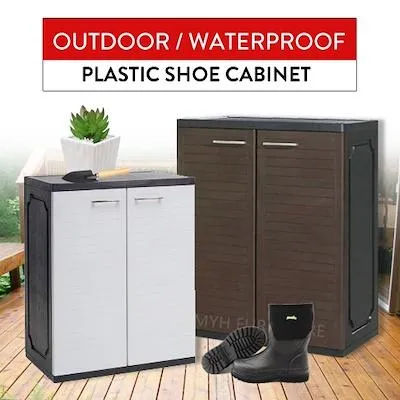
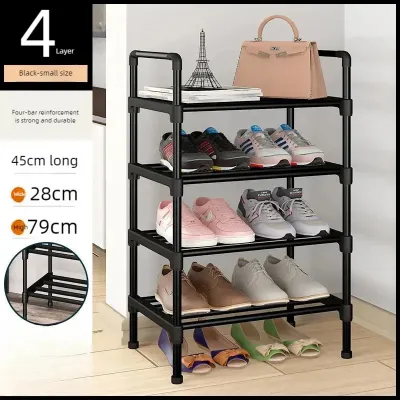
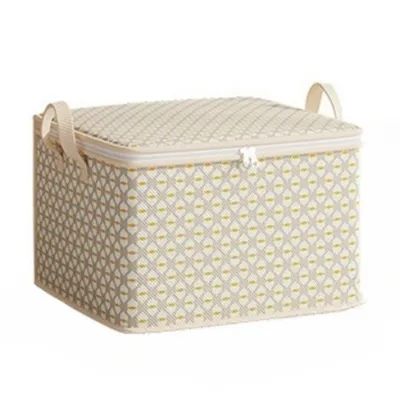
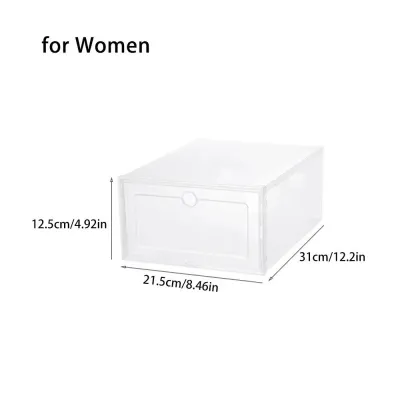
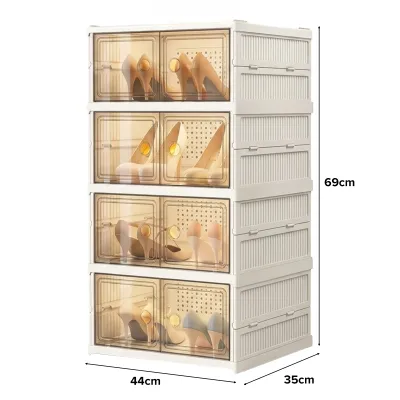
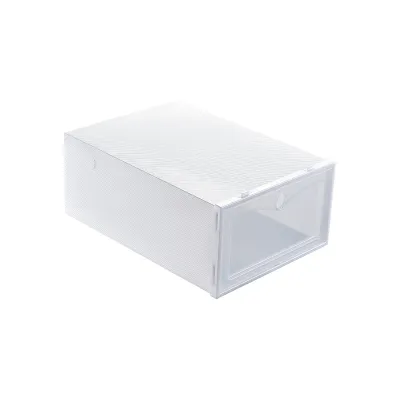
Prices are valid at publication and may change. Please refer to the product page for the latest price.
This audit is also the perfect opportunity to streamline your collection. Examine each pair and decide whether to keep, donate, or discard items that are worn out or no longer worn. Storing shoes you do not use wastes valuable real estate in your home and increases the cost of your storage setup. By establishing an accurate count of your active collection, you set a realistic baseline for your storage capacity.
Additionally, consider where different types of footwear should live. You might want your daily work shoes and casual sneakers near the main entrance, while formal shoes or seasonal boots can be stored in a bedroom closet. Separating your collection by frequency of use helps you determine if you need one large centralized shoe rack box system or multiple smaller setups placed in different rooms.
Step 2: Measure Your Available Space
Once you have a clear count of the shoes you intend to store, you must evaluate where the shoe rack box system will live. Use a measuring tape to find the precise width and depth of your designated floor area. Be sure to account for baseboards, which can push the boxes away from the wall, as well as door swings, nearby furniture, and the clearance needed for walkways. In compact entryways or corridors, even a few centimeters of protrusion can obstruct daily movement.

Next, determine the safe and practical vertical limit for your stack. Measure from the floor to the ceiling, or to the underside of any hanging rods or shelves if you are placing the boxes inside a wardrobe. Consider your own reachability; storing daily-use shoes above shoulder height can make them inconvenient to access. Visually, an excessively high stack can also make a narrow hallway feel cramped, so aim for a height that balances storage capacity with the room’s overall proportions.
Environmental factors must also influence your placement and material choices. In a tropical climate like Singapore’s, high humidity levels can trap moisture inside sealed plastic containers, potentially leading to mold or material degradation. If you are placing your stackable boxes in an area prone to humidity or direct sunlight, look for boxes with built-in ventilation slots and UV-resistant properties, and avoid placing them in unventilated, damp corners.
Furthermore, assess the evenness of your flooring. Uneven tiles or warped wooden floors can cause a tall stack of modular boxes to lean, compromising stability. Checking the level of your floor beforehand allows you to plan for shims or choose a location with a more stable foundation.
Step 3: Calculate Your Required Box Capacity
With your shoe count and space measurements ready, you can calculate the exact number of boxes your space can accommodate. Start with your baseline requirement: if you have 30 pairs of shoes and each standard box holds one pair, your baseline is 30 boxes. However, this number must be reconciled with the physical limits of your room.
To find your footprint limit, divide the width of your available floor space by the width of a single shoe rack box, rounding down to the nearest whole number. Do the same for the depth. Multiplying these two numbers gives you the maximum number of boxes that can sit side-by-side on the floor. For example, if your floor space allows for a row of three boxes, that is your horizontal base.
Next, calculate your vertical limit. Divide your maximum safe stacking height by the height of a single box, rounding down to ensure you do not exceed your target height. If your safe height limit allows for a stack of eight boxes, and your horizontal base is three boxes wide, your absolute spatial capacity is 24 boxes (3 columns multiplied by 8 rows).
Finally, compare your baseline requirement against this spatial maximum. If your baseline requirement is 30 boxes but your space only accommodates 24, you face a decision: you must either find an alternative storage location for the remaining six pairs, opt for a more compact box design, or further declutter your collection. Conversely, if your spatial capacity exceeds your baseline, you have room for future purchases or can arrange the boxes with empty spaces for a cleaner, less crowded aesthetic.
Keep in mind that modular systems offer the flexibility to create non-rectangular configurations. If a straight vertical stack does not fit, you can arrange the boxes in a stepped pattern under a staircase or in an L-shape around a corner. Calculating these alternative layouts can help you maximize unusual spaces without exceeding safety limits.
Step 4: Verify Safety, Clearances, and Stability
Before finalizing your purchase of any shoe rack box system, you must verify that the planned configuration is structurally sound and safe for daily use. Always check the manufacturer’s specifications for the maximum recommended stack height and weight capacity. Even if your ceiling height allows for a stack of ten boxes, the structural integrity of the bottom boxes might only support a stack of six or seven before warping under the weight.
Accessibility is another critical factor. Ensure there is sufficient clearance in front of the stack to fully open the box doors, pull-out drawers, or drop-front panels. If the boxes open outward into a narrow corridor, they should not block the walkway or collide with adjacent walls and furniture when open. Test these clearances conceptually before assembling the entire unit.
For taller configurations, stability is paramount. Look for modular boxes that feature interlocking mechanisms, such as tabs or grooves that lock the units together vertically and horizontally. If your planned stack is tall or if you live in a household where the unit might be bumped, plan to install anti-tip wall anchors or straps to secure the top of the rack to the wall, preventing accidental tipping.
Additionally, consider the assembly conditions and how the boxes are delivered. Some modular systems arrive flat-packed and require manual assembly, while others are pre-assembled. Ensure you have the tools and space required to put them together, and verify that the packaged boxes can easily fit through your doorways or lift access during delivery.
Frequently Asked Questions (FAQ)
Can I mix different sizes of stackable shoe boxes in one rack?
Mixing different sizes of stackable shoe boxes is possible, but it requires careful planning to maintain structural stability. When you combine boxes with varying widths or depths, they may not interlock correctly, which can compromise the safety of the entire stack. To prevent tipping, always place the largest, deepest, and heaviest boxes at the very bottom of the configuration to create a stable base. Keep vertical columns uniform in size whenever possible, and avoid placing wider boxes on top of narrower ones, as this uneven weight distribution can cause the plastic to warp or slide.
How do I accommodate tall boots in a standard shoe rack box setup?
Standard shoe boxes are rarely tall enough to accommodate knee-high or mid-calf boots without folding them, which can damage the material over time. To solve this, look for specialized boot boxes designed with extra height and depth, and integrate them at the base of your stack. If you must use standard-sized boxes, store your boots flat across two adjacent boxes if the dividers are removable, or use flexible boot shapers to store them horizontally in larger storage bins elsewhere. Checking the manufacturer’s product line for compatible, oversized modular units is the best way to maintain a cohesive look while protecting your footwear.

Community discussion
Share your experience or ask a question. Comments are reviewed before publication.