
Selecting the right capacity for a slim shoe rack cabinet requires balancing your household’s daily footwear needs with the physical limitations of your entryway. In space-conscious homes, such as apartments in Singapore, a slim cabinet is an essential furniture piece to keep corridors organized and free of clutter. However, the advertised capacity of these units can be misleading, as manufacturers often base their estimates on small, flat shoes. To find a cabinet that truly fits your lifestyle, you must calculate your household’s active shoe rotation, account for varying shoe shapes, and verify the physical dimensions of both the cabinet and your entryway.
Assessing Your Household's Footwear Needs
To establish a realistic baseline for your storage needs, start by categorizing your household’s footwear into daily rotation and long-term storage. Daily rotation includes the shoes your family wears multiple times a week, such as school shoes, work heels, and casual sandals. In tropical climates, lightweight flats and slip-ons are common, and these take up minimal space. However, sports shoes, running sneakers, and formal footwear require significantly more physical volume.
A practical approach is to multiply the number of household members by their average active pairs. For instance, a family of four where each person keeps three pairs of shoes in active rotation will require space for at least 12 pairs at the entryway. Any shoes worn only occasionally, such as hiking boots or dress shoes for special events, should ideally be stored in bedroom closets or secondary storage areas to keep the entryway cabinet dedicated to daily essentials.
Products mentioned in this guide
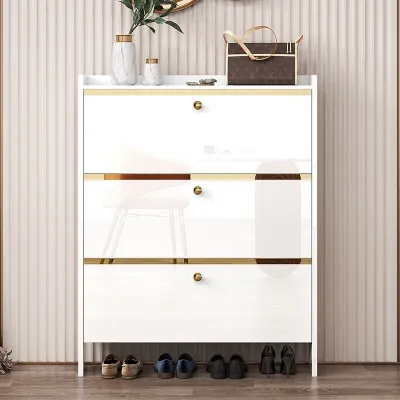
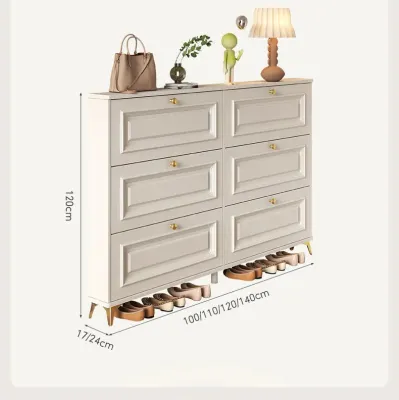
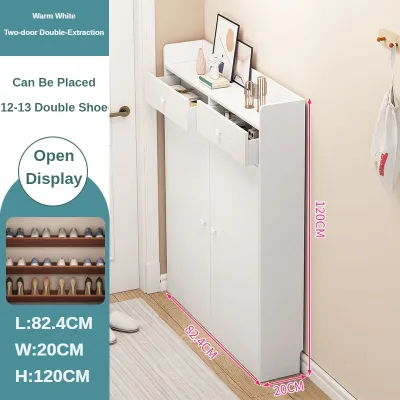
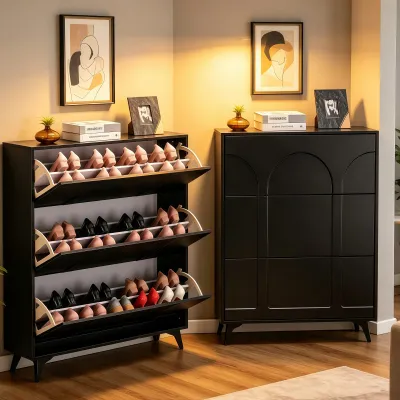
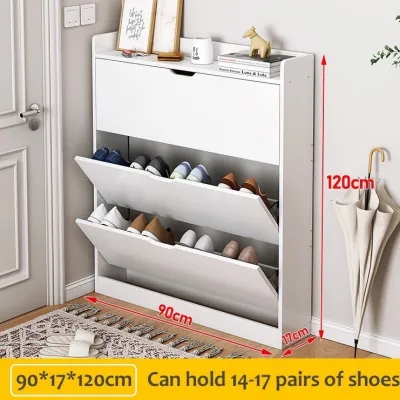
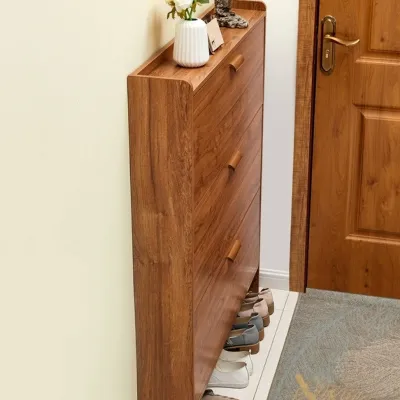
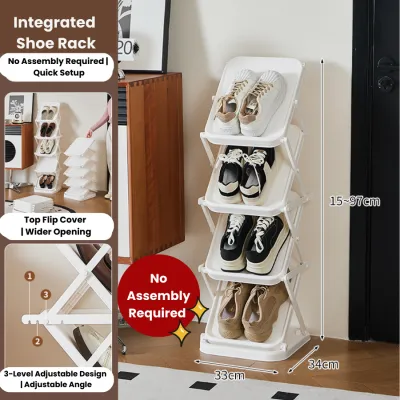
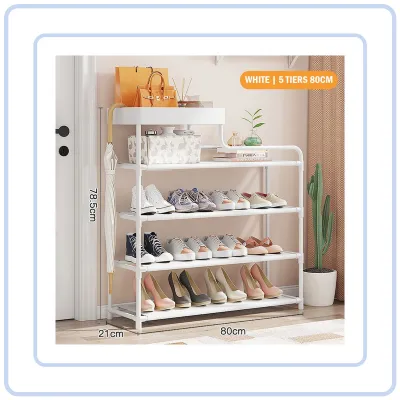
Prices are valid at publication and may change. Please refer to the product page for the latest price.
Additionally, plan for future changes in your household’s lifestyle. If you have young children, their shoe sizes will increase rapidly, and their footwear will soon occupy as much space as adult shoes. If you anticipate adding more members to the household or expanding your fitness routine with specialized footwear, choosing a cabinet with a slightly larger capacity than your current baseline will prevent you from outgrowing the furniture within a year or two.
Understanding Realistic Capacity in Slim Cabinets
Slim shoe cabinets are specifically designed to minimize floor footprint, often featuring a depth of only 15 to 24 centimeters. To achieve this narrow profile, many designs utilize tilt-out drawers where shoes are stored vertically or at an angle, rather than sitting flat on traditional shelves. While this design is highly efficient for narrow hallways, it significantly alters how you must calculate usable storage space.

The “maximum capacity” printed on a product label is often a theoretical number based on standard flat shoes, such as low-profile loafers or women’s flats in smaller sizes. If your household wears bulky running shoes, high-top sneakers, or men’s formal shoes in larger sizes, the actual capacity of the cabinet will be much lower. Bulky soles can prevent tilt-out drawers from closing fully, or force you to store shoes sideways, which immediately cuts the usable capacity in half.
Internal height restrictions and fixed dividers within the compartments also play a critical role. Many slim cabinets feature fixed internal plastic or wooden dividers that split a single drawer into two shallow rows. If these dividers cannot be adjusted, taller shoes like ankle boots, high heels, or high-top sneakers will not fit. Before purchasing, always look past the marketed “pair count” and check the detailed internal compartment dimensions on the product label to ensure your largest shoes can physically fit inside.
Matching Cabinet Dimensions to Your Available Space
Before committing to a specific cabinet capacity, you must verify that the physical unit will fit your home safely and function without obstruction. Begin by measuring the exact floor footprint of your intended entryway or hallway. It is crucial to ensure that the cabinet does not block the main door’s swing path or narrow the corridor to the point of violating local building or fire safety guidelines regarding clear escape routes.
Beyond the closed footprint, you must account for the clearance required when the cabinet is in use. Tilt-out drawers and hinged doors swing outward into the walking path. Measure the distance from the wall to ensure that when the drawers are fully extended, there is still enough space for a person to stand comfortably in front of the cabinet and retrieve their shoes. Additionally, check that the opening mechanisms do not collide with nearby baseboards, light switches, electrical outlets, or adjacent furniture.
Safety is a paramount consideration for slim, tall furniture. Because these cabinets have an extremely shallow depth and a high center of gravity, they are highly susceptible to tipping over when multiple drawers are opened simultaneously or when a heavy load is placed in the upper compartments. Most manufacturers specify that these units must be anchored securely to the wall. Before buying, check your wall type—whether it is solid concrete, brick, or drywall—to ensure you have the correct drilling tools and wall plugs. If you are renting and cannot drill into the walls, you may need to opt for a lower, wider cabinet that offers greater natural stability without wall anchoring.
Evaluating Shelf Adjustability and Organization Features
To maximize the efficiency of a slim shoe rack cabinet, look for internal features that offer flexibility. Adjustable or removable shelves are highly valuable, as they allow you to customize the height of individual compartments. If a cabinet features removable internal dividers, you can easily reconfigure the space to accommodate taller boots during wet weather or keep flat sandals tightly packed together in a double-tiered arrangement.
While maximizing space is important, you must also pay close attention to the manufacturer’s specified weight limits per shelf. Storing multiple pairs of heavy leather shoes or work boots on a single, unsupported shelf can lead to bowing, sagging, or structural failure of the joints over time. Ensure that the materials and joint construction are sturdy enough to handle your household’s specific footwear weight.
You can also enhance the capacity of a slim cabinet by utilizing specialized organization accessories. For flat-shelf designs, double-decker shoe slots allow you to stack one shoe directly above the other, effectively doubling the capacity of a single shelf. For tilt-out designs, check if the unit is compatible with slim, tiered inserts or door-mounted organizers that can hold small items like keys, shoehorns, or cleaning brushes. These small additions help keep the main compartments dedicated entirely to footwear, ensuring you get the absolute most out of your cabinet’s slim profile.
Frequently Asked Questions (FAQ)
How many pairs of shoes can a typical slim cabinet actually hold?
A typical slim cabinet with a depth of 15 to 24 centimeters generally holds between 9 and 18 pairs of shoes, depending on the number of tiers and the overall width. However, this estimate is highly dependent on shoe size and style. If your household primarily wears bulky athletic sneakers, platform shoes, or larger men’s sizes, the practical capacity may be reduced by 30% to 50%. To get an accurate estimate, compare the internal width and depth of the cabinet’s compartments against the physical dimensions of your family’s shoes.
Should I buy a taller or wider slim cabinet for a large family?
For a large family with limited entryway floor space, a taller slim cabinet is often the most efficient choice because it utilizes vertical wall space without blocking narrow walkways. However, tall units have a higher risk of tipping and require mandatory wall anchoring to ensure safety, especially in homes with children or pets. If wall drilling is not possible, or if you have a long, empty hallway, a wider and lower slim cabinet is a safer, self-supporting alternative that also provides a convenient top surface for keys and daily essentials.

Community discussion
Share your experience or ask a question. Comments are reviewed before publication.