
Finding the right laundry shelf cabinet for your HDB service yard is a balancing act between maximizing storage and respecting the tight physical limits of Singapore’s public housing layouts. Because service yard configurations differ significantly between older resale flats and modern Build-To-Order (BTO) units, there is no single standard cabinet size that works for every household. A cabinet that looks perfectly proportioned in a showroom or on an online marketplace can easily block a utility pipe, obstruct a window, or restrict access to your washing machine once installed.
To avoid costly purchasing mistakes, you must treat your service yard as a dynamic zone where appliances, plumbing, and structural elements coexist. Determining the ideal cabinet size requires a systematic approach: measuring the raw physical space, mapping out fixed utility obstacles, selecting a configuration that matches your safe zones, and verifying that the unit can actually be delivered and assembled in your home. By focusing on precise verification and checking manufacturer specifications, you can find a storage solution that enhances your laundry routine without cluttering your limited floor area.
Measure Your Available Floor and Wall Space
Before browsing for furniture, you need to establish the absolute maximum outer dimensions of the zone where you plan to place the cabinet. Grab a high-quality metal tape measure rather than relying on digital measuring apps, which can sometimes miscalculate tight corners or vertical distances. Measure the total width of the designated wall, the maximum depth that still allows you to stand comfortably, and the total height from the floor to the ceiling or any low-hanging beams.
Products mentioned in this guide
![[DEKOREA] DEKORACK Washing Machine Shelf / Laundry Cabinet Storage / Shelf Rack Washing Machine](https://img.lazcdn.com/g/p/2f01c399bcca8fb759c486214f70b324.jpg_400x400q80.jpg_.webp)
![[LOVEHOUSE] DEKORACK Washing Machine Rack / Cabinet Shelf for Laundry Management Storage](https://img.lazcdn.com/g/p/275713d990bc70e22f7255c4eb4d4af3.jpg_400x400q80.jpg_.webp)
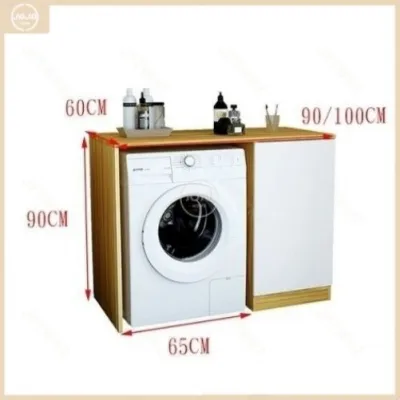
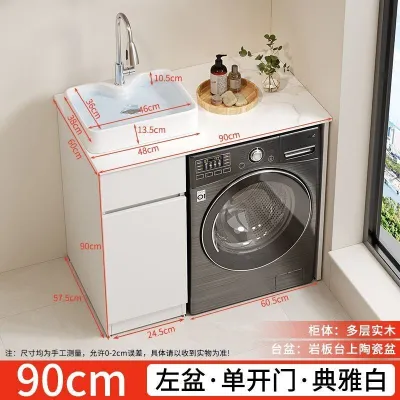
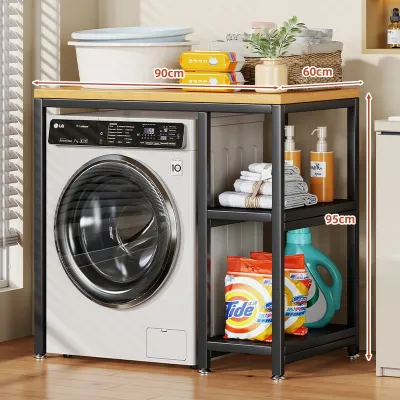
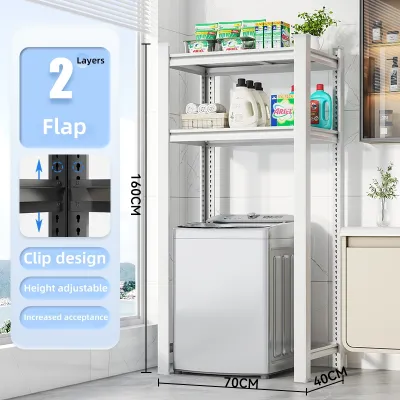
Prices are valid at publication and may change. Please refer to the product page for the latest price.
When measuring the width and depth, do not assume your walls are perfectly square or that the floor is completely flat. Take measurements at three different points: near the floor, in the middle of the wall, and near the top. Use the smallest of these three measurements as your absolute limit to ensure the cabinet will not get wedged during installation.
Pay close attention to the base of your walls, where skirting boards can protrude by one to two centimeters. If a cabinet does not have a recessed base or a cutout to accommodate skirting, it will be pushed away from the wall, creating an awkward gap at the back and reducing your available floor space in front.
Additionally, inspect the wall surface for any protruding textures, tile trim, or uneven plastering. If you are planning to install a tall, free-standing cabinet, even a minor floor slope or wall protrusion can cause the unit to tilt forward or wobble. Checking these physical boundaries early prevents you from buying a unit that is even a few millimeters too wide or unstable for your specific wall.
Map Out Fixed Obstacles and Required Clearances
An HDB service yard is rarely a blank canvas; it is a highly functional utility hub packed with pipes, meters, and appliances. When calculating the usable footprint for your laundry shelf cabinet, you must account for the space occupied by your washing machine and its associated connections. For instance, a front-loading or top-loading washing machine requires a mandatory rear gap of at least 10 to 15 centimeters to accommodate water inlet hoses, drainage pipes, and power plugs without bending or pinching them.

Next, map out the locations of exposed plumbing, copper gas pipes, water meters, and your water heater. These fixtures are typically mounted on the walls and cannot be relocated. If a cabinet is placed directly in front of a water meter or an electrical outlet, you will lose access to essential controls. Ensure your cabinet dimensions allow for a clear path of access, or choose an open-frame shelving unit that can easily straddle these fixtures without blocking them.
Ventilation and natural light are also critical factors in a service yard, which is designed to help dry your clothes and disperse heat from appliances. Your cabinet must not block the swing path of service yard windows, nor should it cover ventilation grilles or access panels meant for estate maintenance. If your service yard features a ceiling-mounted automated laundry rack, measure its fully lowered position to ensure a tall cabinet will not collide with the drying poles or hanging laundry.
Finally, consider the swing clearance of your washing machine door and the service yard entrance door itself. If you choose a cabinet that is too deep, you may find yourself unable to fully open your front-loader’s door or squeeze past the cabinet when carrying a heavy basket of wet clothes. Mark these door swing paths on the floor with masking tape to visualize the remaining safe zone for your new furniture.
Match Cabinet Dimensions to Your Safe Zones
Once you have subtracted all obstacles and clearances from your raw measurements, you will be left with a ‘safe zone’ of net usable space. You can now use these dimensions to choose between different cabinet profiles and configurations. For exceptionally tight layouts, a slim-profile cabinet with a depth of 30 to 35 centimeters is often the most practical choice, as it keeps the central walkway clear while still providing storage for detergent bottles, pegs, and cleaning cloths.
If you have more floor space, a standard-depth cabinet of 45 to 60 centimeters can accommodate larger items like laundry baskets, folded towels, and bulky detergent refills. However, if floor space is at an absolute premium, look upward. Utilizing vertical space with tall utility cabinets or wall-mounted overhead units allows you to maximize storage without sacrificing valuable floor area.
When evaluating tall cabinets, check the manufacturer’s specifications for internal shelf adjustability. Fixed shelves can limit your storage options, whereas adjustable shelves allow you to customize the interior layout to fit tall spray bottles, iron boards, or storage bins.
You must also verify the load-bearing capacity of the shelves, especially if you plan to store heavy liquid detergents, fabric softeners, or small appliances like irons and steamers. Look for manufacturer-specified weight limits per shelf and ensure the cabinet’s construction is robust enough for your intended use. If you are mounting shelves or cabinets directly to the wall, verify whether your service yard walls are made of solid concrete or lightweight partition boards, as this will dictate the type of wall anchors and fasteners required for a safe, stable installation.
Verify Delivery Routes and Assembly Conditions
A laundry shelf cabinet can only organize your service yard if it can actually reach the space. Before finalizing your purchase, especially for pre-assembled or oversized units, you must measure the entire delivery path. Start by measuring the width of your HDB main door, the clearance of any internal corridors, and the turning radius around tight corners leading to the service yard.
Do not forget to check the dimensions of your estate’s lift cabin. If the packaged cabinet is too long or bulky to fit inside the lift, delivery personnel may have to carry it up the stairs, which can incur additional fees or even result in a failed delivery. Check the manufacturer’s packaging dimensions, which are usually listed on the product specification sheet, and compare them against your lift door and cabin measurements.
If you are purchasing a flat-pack cabinet that requires self-assembly, you must ensure there is enough physical space to build the unit. Assembling a cabinet often requires laying the side panels flat on the floor, which demands a much larger working footprint than the finished cabinet’s actual dimensions. If your service yard is too cramped for assembly, identify an alternative assembly zone, such as your living room or hallway, and verify that the fully assembled cabinet can be safely maneuvered through the kitchen and into the service yard afterward.
Lastly, review the manufacturer’s assembly instructions to identify any specific clearance requirements. Some cabinets require you to slide the back panel in from the top or screw hinges from the side during the final steps. If your cabinet fits too tightly against the walls or ceiling, you may find it impossible to complete these assembly steps in a confined service yard.
Frequently Asked Questions (FAQ)
Can I place a laundry shelf cabinet over a front-loading washing machine?
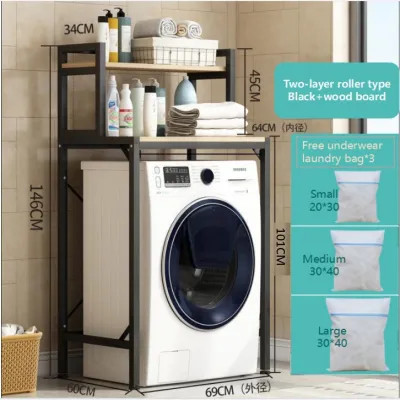
Yes, you can place a laundry shelf cabinet over a front-loading washing machine, provided you choose a unit specifically designed as an over-washer storage rack or a tall, open-base shelving unit. Before purchasing, check your washing machine manufacturer’s guidelines regarding clearance; front-loaders vibrate during high-speed spin cycles, so the cabinet frame must not touch the appliance sides to prevent noise and structural wear. Ensure the cabinet’s lowest shelf sits high enough to allow full access to the washer’s detergent drawer and control panel. Additionally, the cabinet’s design must leave the rear wall accessible so you can easily reach the water taps and power outlets in an emergency.
What depth is best for a service yard cabinet to maintain airflow?
To maintain healthy airflow and prevent moisture buildup in a humid HDB service yard, a cabinet depth of 30 to 40 centimeters is generally ideal. This shallow profile prevents the cabinet from blocking the natural cross-ventilation paths between your kitchen and the service yard windows. Always leave a gap of at least 2 to 5 centimeters between the back of the cabinet and the wall to allow air to circulate, which helps prevent trapped condensation and mold growth. If your service yard is particularly damp or prone to rain splashing, consider choosing open-shelving units or cabinets with slatted doors rather than fully enclosed solid doors, as this design promotes continuous ventilation for both your storage and your laundry supplies.

Community discussion
Share your experience or ask a question. Comments are reviewed before publication.