
Selecting the right foldable storage cabinet for a Singapore Board of Housing and Development (HDB) flat requires balancing tight floor plans with the physical clearance needed to operate the furniture. The most effective options are those featuring low-profile operational clearances—such as bi-fold doors, sliding panels, or collapsible vertical frames—that fit comfortably within the typical 900mm to 1200mm corridor and walkway limits of local apartments. By choosing cabinets that match your specific room layout and spatial constraints, you can maximize your home’s storage capacity without creating physical bottlenecks or blocking essential pathways.
Modern HDB flats, particularly newer Build-To-Order (BTO) units, feature highly optimized layouts where every square meter counts. Standard swing-door cabinets often prove impractical because their doors require a wide radius to open fully, which can easily block a narrow bedroom walkway or obstruct a service yard entrance. A foldable storage cabinet solves this issue by minimizing its physical footprint when not in use, but you must select and position these units with a clear understanding of your flat’s unique architectural dimensions.
Measure Your HDB Space: Footprint vs. Operational Clearance
When planning your storage layout, you must distinguish between the cabinet’s static footprint and its dynamic operational clearance. The static footprint is the physical floor space the cabinet occupies when it is completely closed or folded. The operational clearance is the total space required to actually use the cabinet, which includes fully opening its doors, extending drop-leaf panels, pulling out internal drawers, or completely unfolding a collapsible frame. Failing to account for this distinction often results in furniture that fits perfectly against the wall but cannot be opened without hitting a bed frame, a dining chair, or an adjacent wall.
Products mentioned in this guide
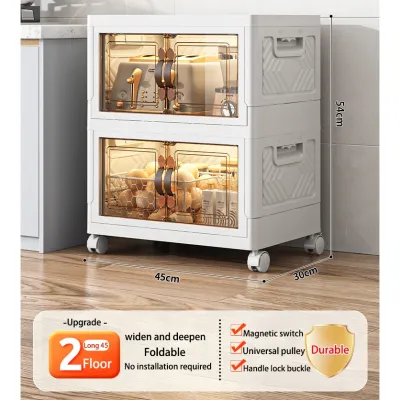
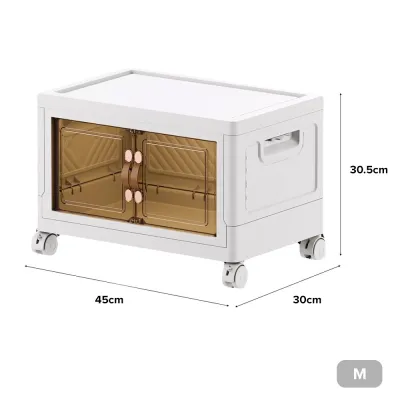
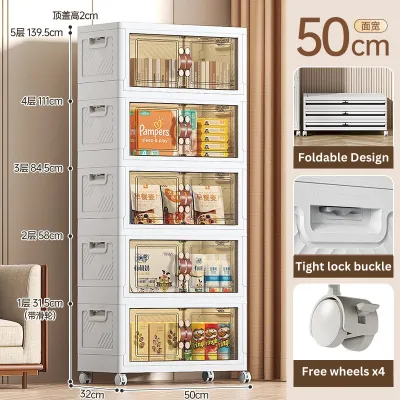
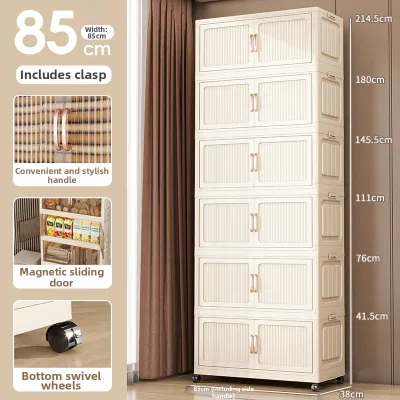
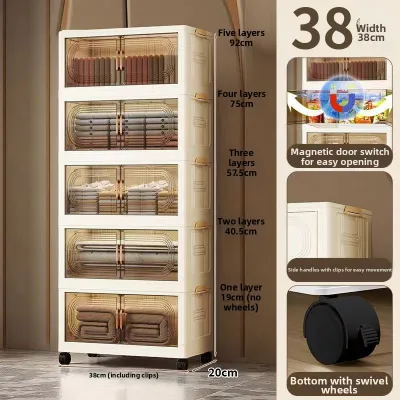
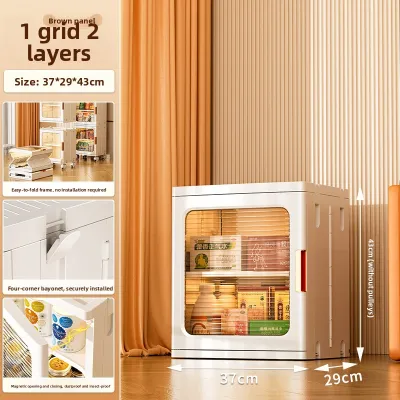
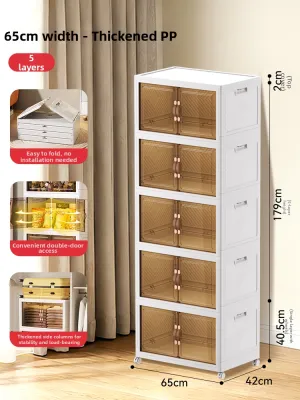
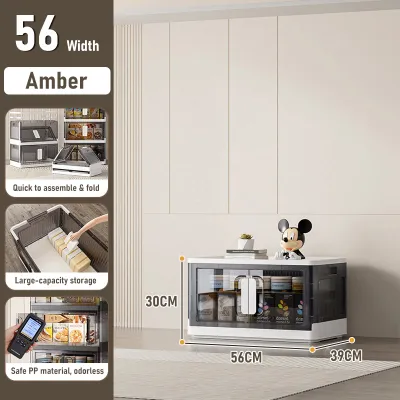
Prices are valid at publication and may change. Please refer to the product page for the latest price.
To ensure your walkways remain clear and safe, you must map out the door swing arcs and extension paths of your proposed cabinet before buying. Main corridors and walkways inside HDB flats typically measure between 900mm and 1200mm in width. If you place a foldable cabinet with a 450mm deep swing door in a 1000mm wide hallway, opening the door will leave only 550mm of clearance, forcing family members to squeeze past or wait for the door to close. To prevent these bottlenecks, aim to maintain a minimum clear passage of at least 700mm even when the cabinet doors or folding leaves are fully extended.
Additionally, you must identify and measure any vertical or horizontal obstructions along your walls. Singaporean flats are highly standardized, but they frequently feature structural elements that interfere with flush-mounted or tall foldable furniture. Look out for the following common obstructions:
- Air-Conditioning Trunking: These thick plastic conduits often run horizontally along the upper portions of bedroom and living room walls, preventing tall cabinets from sitting flush against the wall or blocking top-folding mechanisms.
- Skirting Boards: Standard floor skirting boards project about 10mm to 15mm from the wall. If your foldable cabinet relies on a wall-anchored folding desk or shelf, you must account for this bottom gap to ensure the unit remains perfectly vertical when deployed.
- Ceiling Fans: High-folding wall units or tall collapsible racks must clear the rotation radius of ceiling fans to prevent dangerous physical contact.
- Built-In Wardrobes and Door Frames: Measure the clearance near existing built-ins to ensure your foldable cabinet does not block the opening of wardrobe doors or the main entryways to your rooms.
Layout-Specific Foldable Storage Solutions for HDB Zones
Each zone of an HDB flat presents unique spatial challenges and environmental conditions. To make the most of your home, you should tailor the type of foldable storage cabinet you use to the specific demands of each room.

Living Room and Dining Area
As the highest-traffic communal spaces in an HDB flat, the living and dining areas require furniture that can quickly adapt to different activities without cluttering the main thoroughfares. In narrow living rooms, a standard bulky TV console or sideboard can make the space feel cramped. Instead, consider utilizing bi-fold door sideboards or TV consoles. Because bi-fold doors fold back on themselves as they slide open, they require only half the front clearance of a standard swing door, keeping your primary living room walkways clear during daily use.
For the dining area, drop-leaf console tables with integrated hidden storage are highly effective. When folded down, these units function as slim entry tables or decorative consoles, often measuring less than 300mm in depth. When you need to host guests or sit down for meals, you can raise one or both leaves to create a full dining surface. To optimize placement, position these units along the longest uninterrupted wall in your dining zone, ensuring they do not sit directly in the swing path of your main entrance door or kitchen entryway.
Bedrooms and Study Nooks
With queen-sized or king-sized beds occupying the majority of the floor space in HDB bedrooms, finding room for a dedicated study desk or extra wardrobe storage can be difficult. For compact study nooks, a wall-mounted fold-down desk with integrated shelving is an excellent space-saving solution. When closed, these units resemble a shallow cabinet on the wall, occupying minimal visual and physical space. When unfolded, the cabinet door drops down to become a sturdy work surface, exposing internal shelves that store your laptop, books, and stationery.
Within your wardrobe or bedroom corners, collapsible wardrobe inserts and hanging organizers can provide flexible storage for seasonal clothing, winter wear for overseas travel, or bulky bedding. These fabric or lightweight plastic organizers can be folded completely flat when empty and tucked away under the bed. Speaking of the bed, you can also utilize under-bed foldable storage bins equipped with low-clearance wheels. Before purchasing, measure the vertical clearance under your bed frame—which typically ranges from 150mm to 250mm—to ensure the bins can slide in and out smoothly without catching on the frame.
Household Shelter (Bomb Shelter)
Every modern HDB flat includes a reinforced concrete household shelter, commonly used as a utility or storeroom. Because this room is designed for emergency protection, HDB regulations strictly prohibit any drilling, hacking, or mounting of fixtures into the reinforced concrete walls, floor, or steel door. To maximize storage in this space without violating housing rules, you must rely entirely on freestanding, drill-free organization systems.
Freestanding collapsible shelving units made of heavy-duty metal are ideal for household shelters. These units can be unfolded and locked into place in minutes without any tools, providing multiple tiers of vertical storage for household supplies, tools, and dry pantry items. To optimize the shelter’s layout, choose narrow-depth bi-fold cabinets or slim folding racks that fit neatly into the recessed corners of the room. This ensures that the storage units do not interfere with the swing path of the heavy, thick steel shelter door, which must always be able to open and close fully without obstruction.
Service Yard and Balcony
Singapore’s tropical climate means that service yards and balconies are constantly exposed to high humidity, ambient heat, and occasional driving rain. Standard wooden or cheap engineered-wood cabinets will quickly warp, swell, and develop mold in these environments. For these semi-outdoor zones, you must select weather-resistant foldable utility cabinets made of durable materials such as powder-coated aluminum, stainless steel, or high-density UV-stabilized plastics like polypropylene.
Wall-mounted pegboards featuring folding shelves are highly effective in the service yard for keeping laundry detergents, pegs, and cleaning tools organized. When you need to hang large laundry loads or dry bedsheets, you can fold the shelves flat against the pegboard to free up physical space. To prevent moisture buildup and mold growth behind your storage units, always leave a ventilation gap of at least 20mm to 50mm between the back of the cabinet and the wall, allowing continuous air circulation to dry out any trapped humidity.
Critical Features to Check for Singapore's Climate and Daily Use
Before purchasing any foldable storage cabinet, you must evaluate its build quality and material specifications to ensure it can withstand daily operation and Singapore’s humid tropical climate. Focus on these four critical areas during your selection process:
- Folding Mechanism Durability: The hinges, gas struts, and sliding tracks are the primary failure points on any foldable furniture. Look for hardware made of high-quality stainless steel (ideally grade 304 or 316) to prevent rust caused by high humidity. If the cabinet uses gas struts for fold-down panels, verify that they feature smooth hydraulic dampening to prevent the doors from slamming down or snapping back up violently.
- Material Suitability: Avoid cabinets made of untreated medium-density fibreboard (MDF) or low-grade particle board, especially for use in service yards, kitchens, or balconies. These materials act like sponges in humid air, leading to structural sagging and mold. Instead, opt for solid wood treated with water-resistant polyurethane coatings, melamine-faced chipboard (MFC) with high-quality ABS edge-banding, or rust-proof metals.
- Weight Capacity and Stability: Foldable joints and cantilevered surfaces have lower weight capacities than solid, fixed furniture. Always check the manufacturer's specified load limits for both the main frame and any folding leaves or shelves. To maintain stability and prevent the unit from tipping over when partially folded or fully extended, always store your heaviest items on the bottom-most solid shelves, keeping the center of gravity as low as possible.
- Ease of Maintenance: Dust, pet dander, and cooking grease can quickly accumulate in the tracks, hinges, and crevices of folding mechanisms. Choose cabinets with smooth, wipeable surfaces and open, accessible tracking systems that can be easily cleaned with a vacuum crevice tool or a damp microfiber cloth.
Foldable Mechanisms Compared: Clearances and Best Applications
Different folding mechanisms offer varying trade-offs between physical space savings and ease of access. The table below compares the most common mechanisms used in HDB flats to help you make an informed decision based on your specific layout constraints.
| Mechanism Type | Required Front Clearance | Best HDB Application | Key Limitations |
|---|---|---|---|
| Bi-fold Doors | Minimal (approx. 150mm – 250mm) | Living room sideboards, narrow hallway cabinets, shoe storage | Hinges require regular lubrication; doors can misalign if overloaded. |
| Sliding Doors | Zero (0mm) front clearance | Tight bedrooms, walk-in wardrobes, kitchen counters | Only 50% to 70% of the cabinet interior is accessible at any single time. |
| Roll-down Shutters (Tambour) | Zero (0mm) front clearance | Kitchen appliance garages, compact study desks, pantry units | Shutter tracks can trap dust and debris; individual broken slats are difficult to replace. |
| Collapsible Frames (Fold-flat) | Varies (requires full clearance to expand) | Household shelters, temporary guest rooms, service yards | The entire unit must be completely emptied of items before it can be folded flat. |
When choosing between these mechanisms, consider how often you need to access the stored items. For daily-use items like shoes or kitchen condiments, bi-fold or sliding doors are highly practical because they offer quick access with minimal physical effort. For seasonal or emergency items stored in the household shelter, collapsible frames are excellent because they can be packed away entirely when not needed, freeing up valuable floor space.
HDB Wall Rules and Safety Tips for Foldable Installations
If you plan to install a wall-mounted foldable storage cabinet or fold-down desk, you must understand the structural composition of your HDB walls to ensure a safe and legal installation. HDB flats feature different wall types, each requiring specific mounting hardware and techniques:
- Concrete Structural Walls: These are load-bearing walls made of reinforced concrete. Drilling into these walls requires a heavy-duty hammer drill and specialized masonry drill bits. You must use high-quality plastic wall plugs or metal sleeve anchors to secure your cabinet. Note that you must never cut, damage, or drill into any structural steel rebars hidden within these walls.
- Non-Structural Partition Walls: Modern HDB flats often use lightweight concrete panels or drywall partitions to separate bedrooms and living spaces. These walls cannot support heavy cantilevered loads. If you are mounting a fold-down desk or a heavy cabinet on a partition wall, you must locate the internal metal or wooden studs and secure the mounting brackets directly into them using specialized toggle bolts or heavy-duty drywall anchors. Never mount a load-bearing folding unit directly into plasterboard alone.
Safety must always be your top priority when installing tall or wall-mounted foldable furniture. Freestanding foldable cabinets that are tall and narrow are highly susceptible to tipping over, especially when shelves are fully extended or if children attempt to climb them. Always use the manufacturer-provided anti-tip safety kits to anchor tall cabinets securely to the wall.
If you are unsure about the load-bearing capacity of your walls, the location of hidden electrical wiring or water pipes, or the correct installation techniques, do not attempt the installation yourself. Always consult the official HDB renovation guidelines or hire a qualified, HDB-registered contractor to perform the installation safely and in compliance with local housing regulations.
Frequently Asked Questions (FAQ)
Can I install wall-mounted foldable cabinets in my HDB household shelter?
No, you cannot install wall-mounted foldable cabinets in your HDB household shelter. HDB regulations strictly prohibit any drilling, hacking, or mounting of fixtures into the reinforced concrete walls, floor, ceiling, or steel door of the household shelter, as this can compromise its structural integrity and protective function during an emergency. To organize your shelter safely and legally, you must use freestanding, drill-free storage solutions. Excellent alternatives include freestanding collapsible metal shelving units that fold flat when not in use, or heavy-duty vertical tension-pole shelving systems that hold themselves in place using compression between the floor and the ceiling.
How do I prevent mold on foldable cabinets placed in the HDB service yard?
To prevent mold on foldable cabinets in your service yard, you must focus on material selection and proper air circulation. Avoid using cabinets made of untreated wood, MDF, or cheap particle board, which absorb moisture from the air and encourage mold growth. Instead, choose rust-proof aluminum, stainless steel, or high-density plastic cabinets. Always leave a physical ventilation gap of 20mm to 50mm between the back of the cabinet and the service yard wall to prevent damp, stagnant air pockets. Additionally, regularly wipe down the cabinet surfaces with a mild disinfectant, keep the service yard windows slightly open to promote air exchange, and clean out any dust or lint from the folding hinges and tracks.
Are foldable storage cabinets sturdy enough to hold heavy items like books?
Yes, heavy-duty foldable storage cabinets can hold books and other heavy items, but you must carefully check the manufacturer’s specific weight ratings first. Foldable joints, hinges, and cantilevered surfaces are natural structural weak points compared to solid, fixed furniture. To ensure safety and prevent structural damage, always place your heaviest books or items on the bottom-most, non-folding base shelves of the cabinet to keep the center of gravity low. Avoid overloading the upper folding shelves or cantilevered drop-leaf surfaces, and regularly inspect the hinges and locking pins for any signs of metal fatigue, bending, or loose screws.
Community discussion
Share your experience or ask a question. Comments are reviewed before publication.