
Finding the right single mattress firmness requires balancing your primary sleeping position with your body weight to keep your spine in neutral alignment. While side sleepers generally need a softer, contouring surface to cushion their shoulders and hips, stomach sleepers require a firmer mattress to prevent their midsection from sinking. Back sleepers typically find their ideal support in a balanced medium to medium-firm feel. By understanding how your body weight interacts with mattress materials and checking specific manufacturer guidelines, you can select a single mattress that supports your body comfortably night after night.
Choosing a mattress is a highly personal decision, and there is no single option that suits everyone. A single mattress is an excellent choice for children’s rooms, guest bedrooms, or compact studio apartments where space optimization is key. However, because the sleeping surface is narrower than a double or queen bed, selecting the correct firmness is even more critical to ensure you can use the entire width of the bed comfortably. By taking a systematic approach to evaluating your sleep posture, body type, and the physical specifications of the mattress, you can make an informed investment that protects your sleep quality for years to come.
Quick Diagnostic: Matching Firmness to Your Sleep Profile
To begin your search, it helps to understand how mattress manufacturers categorize firmness. Most brands use a standard 1-to-10 firmness scale, where 1 represents an extremely soft, cloud-like surface and 10 represents a surface as rigid as a wooden floor. Most mattresses on the market fall within the 3-to-8 range, catering to the vast majority of sleepers.
Products mentioned in this guide
![[Bulky] DREAMAX Equinox Rest 8 Inch Comfort Pocket Spring Mattress / 20cm / Bed (SG) / sd](https://img.lazcdn.com/g/p/c25e074503162de8fade85f5c4b33c8d.jpg_400x400q80.jpg_.webp)
Prices are valid at publication and may change. Please refer to the product page for the latest price.
Your primary sleeping position is the most reliable starting point for identifying your target firmness range. Side sleepers generally find comfort in the 3-to-5 (soft to medium) range, back sleepers typically align well with the 5-to-7 (medium to medium-firm) range, and stomach sleepers usually require a 7-to-8 (firm) surface.
However, these numerical ratings are highly subjective and vary significantly between manufacturers. A “medium” mattress from one brand might feel like a “medium-firm” from another due to differences in material composition, layer thickness, and coil tension. Furthermore, your body weight acts as a major modifier; a lighter individual will experience a mattress as firmer because they exert less downward force, while a heavier individual will compress the comfort layers more deeply, making the same mattress feel softer. Therefore, these ratings should serve as a preliminary guide rather than an absolute rule.
Step 1: Diagnose Your Primary Sleeping Position
Your sleeping position dictates how your body weight is distributed across the mattress surface and where pressure points are likely to develop. To maintain a healthy posture, your spine should remain in a neutral, straight line from your neck down to your pelvis throughout the night.

Side Sleepers
When you sleep on your side, your shoulders and hips protrude and bear the majority of your body weight. If your mattress is too firm, these areas cannot sink into the surface, forcing your spine to curve unnaturally and causing high-pressure zones that restrict circulation. This often leads to tossing, turning, and waking up with sore joints. Side sleepers benefit most from a softer to medium mattress (firmness level 3 to 5) that features thick comfort layers, such as memory foam or natural latex, which contour to the body’s natural curves and relieve pressure on the shoulders and hips.
Back Sleepers
Back sleeping naturally distributes your body weight relatively evenly across the mattress, but it presents a different challenge: supporting the natural inward curve of your lower back. If a mattress is too soft, your pelvis will sink too deeply, flattening your lumbar curve and straining the surrounding muscles. If the mattress is too firm, a gap will form between your lower back and the bed surface, leaving your lumbar spine unsupported and tense. Back sleepers generally require a medium to medium-firm mattress (firmness level 5 to 7) that offers a balanced combination of surface contouring and deep structural support.
Stomach Sleepers
Stomach sleeping is the most demanding position in terms of support requirements. When you lie on your stomach, gravity naturally pulls your midsection downward. If your mattress is too soft, your hips and pelvis will sink deep into the comfort layers, arching your lower spine backward into an unnatural position. This hyperextension is a common cause of chronic lower back pain. To prevent this, stomach sleepers need a firm mattress (firmness level 7 to 8) with minimal surface sinkage to keep the pelvis level with the shoulders and maintain proper spinal alignment.
Combination Sleepers
If you regularly rotate between multiple positions during the night, you are a combination sleeper. Your primary challenge is finding a middle-ground firmness that accommodates all your positions without making you feel “stuck” when you try to turn over. A medium-firm mattress (firmness level 5 to 6) is often the most versatile choice. Additionally, combination sleepers should look for responsive materials, such as pocketed coils or latex comfort layers, which quickly adapt to movement and provide the necessary bounce to facilitate easy position changes.
Step 2: Adjust for Body Weight and Type
Once you have identified your baseline firmness based on your sleeping position, you must adjust this choice to account for your body weight. The physical interaction between your body mass and the mattress materials determines how deeply you compress the comfort and support layers.
Lighter Individuals
Sleepers who weigh less than 60 kg exert relatively little downward pressure on a mattress. If a lighter individual sleeps on a standard medium-firm mattress, they may not compress the comfort layers enough to experience any contouring or pressure relief, making the bed feel exceptionally hard. To compensate, lighter individuals should generally choose a mattress that is one step softer than the standard recommendation for their sleeping position. For example, a lighter back sleeper may find a medium-soft mattress provides the perfect balance of comfort and support.
Average Weight Individuals
Sleepers weighing between 60 kg and 80 kg typically experience mattress firmness exactly as the manufacturer intended. If a mattress is rated as a medium-firm 6, it will feel like a true medium-firm to someone in this weight range. If you fall into this category, you can generally rely on standard firmness recommendations and focus your decision on material preferences and specific comfort features.
Heavier Individuals
Sleepers who weigh more than 80 kg exert substantial downward force, causing them to compress comfort layers deeply. On a soft or standard medium mattress, a heavier individual may sink completely through the comfort layers and bottom out against the rigid support core, leading to severe pressure points and poor spinal alignment. To prevent this, heavier individuals usually need a firmer mattress (often one step firmer than standard recommendations) or a mattress specifically engineered with high-density foam layers and robust, heavy-gauge pocketed coils to provide adequate resistance and durability.
Verifying Specifications
To ensure a mattress can support your weight over time, look beyond subjective marketing terms and examine the technical specifications. Check the density of any foam layers; high-quality polyurethane foam should have a density of at least 28 kg/m³, while memory foam should ideally be 45 kg/m³ or higher for long-term durability. For hybrid or spring mattresses, check the coil count and the wire gauge. A lower gauge number indicates thicker, stiffer wire, which provides more robust support and resists sagging under heavier loads.
Step 3: Evaluate Single Mattress Specifics
When shopping for a single mattress, there are several structural and spatial factors unique to this size that can influence your comfort and the overall feel of the bed.
Edge Support
Edge support refers to the firmness and stability of the mattress perimeter. Because a standard single mattress in Singapore is relatively narrow—typically measuring 91 cm in width—you are highly likely to sleep close to the edge of the bed. If the mattress has weak edge support, you may experience a rolling-off sensation when sleeping near the perimeter, effectively reducing the usable sleeping surface. Look for single mattresses that feature reinforced foam encasements or thicker, double-row pocket coils around the outer edge to maximize your sleeping area and ensure stability when sitting on the side of the bed.
Size Variations
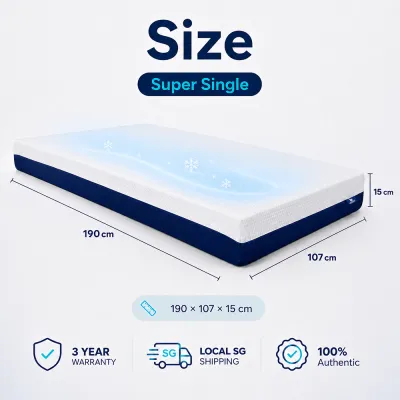
Before finalizing your purchase, verify the exact dimensions of your bed frame and room layout. While a standard single mattress in Singapore measures 91 cm by 190 cm, a super single mattress measures 107 cm by 190 cm. If you are an active sleeper who tends to move around, a super single offers valuable extra width that can prevent you from feeling cramped. However, you must ensure your bed frame is designed to accommodate these specific dimensions and that your bedroom has sufficient clearance for doors and wardrobe panels to open freely.
Motion Isolation
In larger beds shared by couples, motion isolation is a top priority to prevent one partner’s movements from waking the other. For a single mattress, however, motion isolation is far less critical since the bed is designed for a single sleeper. This allows you to deprioritize heavy, motion-dampening foam layers and instead allocate your budget toward high-quality support materials, durable edge reinforcement, or advanced cooling features. In Singapore’s warm and humid climate, prioritizing breathable open-cell foams or pocket spring systems that promote airflow can significantly improve your sleep comfort.
Step 4: How to Test and Verify Your Choice
Because firmness is highly subjective, verifying your choice through practical testing and careful research is essential to avoid a costly purchasing mistake.
In-Store Testing
When testing mattresses in a showroom, do not simply sit on the edge of the bed or lie down for a few seconds. To get an accurate impression, lie down in your primary sleeping position for at least 10 to 15 minutes. Wear comfortable clothing and ask the showroom staff for a pillow that matches the height and loft you use at home. Your pillow and mattress work as a system; testing a mattress with an unsuitable pillow can distort your spinal alignment and lead to an inaccurate assessment of the mattress’s firmness.
Sleep Trials
Many modern mattress brands offer home sleep trials, allowing you to test the mattress in your own home for a set period, typically ranging from 100 to 120 nights. When evaluating a sleep trial, read the terms and conditions carefully. Most manufacturers require a mandatory break-in period of 3 to 4 weeks before you can initiate a return. This period is necessary because your body needs time to adjust to a new support profile, and the mattress materials require time to settle and soften slightly. Additionally, check if there are any return shipping fees or restocking charges associated with the trial.
Reading Specifications
To make a truly objective decision, compare the physical construction of the mattresses you are considering. Look at the thickness and order of the layers. A mattress with a thick comfort layer of memory foam over pocketed coils will offer a very different feel and pressure relief profile compared to a simple all-foam mattress. By understanding the materials used—such as natural latex for responsiveness and cooling, or high-density memory foam for deep contouring—you can select a single mattress that matches your physical needs rather than relying on vague marketing descriptions.
Frequently Asked Questions (FAQ)
Can I use a mattress topper to change the firmness of my single mattress?
A mattress topper is an effective way to make a mattress that is too firm feel softer by adding a layer of cushioning material, such as memory foam, latex, or fiberfill, to the surface. However, a topper cannot fix a mattress that is too soft, sagging, or structurally degraded. If the core support layers of your single mattress have failed, adding a topper will simply follow the contour of the sag, failing to provide the necessary spinal alignment.
Is a firm mattress always better for back pain?
No, the belief that a firm mattress is universally better for back pain is a common myth. Proper spinal alignment and pain relief depend entirely on matching the mattress firmness to your sleeping position and body weight. A mattress that is too firm can create severe pressure points for side sleepers and leave the lower back unsupported for back sleepers, potentially worsening back pain. The ideal mattress is one that provides enough support to keep your spine neutral while offering sufficient cushioning to relieve pressure.
How long does it take to adjust to a new mattress firmness?
It typically takes between 21 to 30 days for your body to fully adjust to a new mattress firmness. During the first few weeks, you may experience mild stiffness or discomfort as your muscles and spine adapt to the new support structure, especially if your old mattress was sagging or unsupportive. This is why most mattress brands require you to sleep on a new mattress for at least 3 to 4 weeks during a home sleep trial before requesting a return or exchange.

Community discussion
Share your experience or ask a question. Comments are reviewed before publication.