
Choosing the right shoe box capacity requires balancing the physical dimensions of your footwear with the exact internal clearance of your storage furniture. In space-constrained homes, such as high-rise apartments, maximizing entryway storage without obstructing walkways is a daily necessity. By categorizing your collection, measuring your shelving limits, and checking manufacturer specifications for external box dimensions, you can build a stable, accessible, and dust-free storage system. This guide provides a practical framework to help you select the ideal box sizes, prevent common spatial miscalculations, and keep your footwear collection organized and well-preserved.
Assess Your Shoe Collection and Storage Needs
Before purchasing any storage containers, you must understand the diverse shapes and sizes within your footwear collection. Footwear cannot be treated as a uniform category; flat sandals occupy a fraction of the volume required by high-top sneakers or formal heels. Begin by sorting your shoes into distinct categories based on height, width, and overall profile. Group low-profile items like slippers and sandals together, as these can often fit into shallower boxes or be doubled up. Medium-profile shoes, such as running sneakers and standard dress shoes, represent the bulk of most collections and require standard-sized boxes. High-profile footwear, including high-top basketball shoes, platform heels, and ankle boots, demands significantly more vertical clearance and wider bases to prevent crushing.
Once categorized, count the exact number of pairs in each group. This tally gives you a clear blueprint of how many small, medium, and large boxes you actually need, preventing you from buying a one-size-fits-all set that leaves some boxes empty while others are stuffed. Beyond physical dimensions, consider specific protection needs. In tropical climates with high relative humidity, enclosed storage can trap moisture, leading to mold growth on leather and canvas. Look for boxes that offer a balance of dust protection and airflow. Visibility is also key; clear front panels or fully transparent acrylic bodies allow you to locate specific pairs quickly without disrupting your stacked arrangement.
Products mentioned in this guide
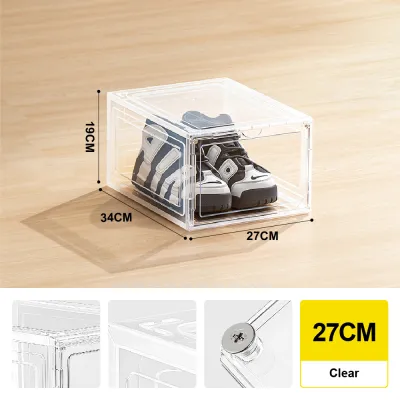
![[SG STOCK] Ultra Clear High Capacity Shoe Box Stackable Magnetic Acrylic Display Storage](https://img.lazcdn.com/g/p/edf83a690b259345d9b59c0c97e18f3e.jpg_400x400q80.jpg_.webp)
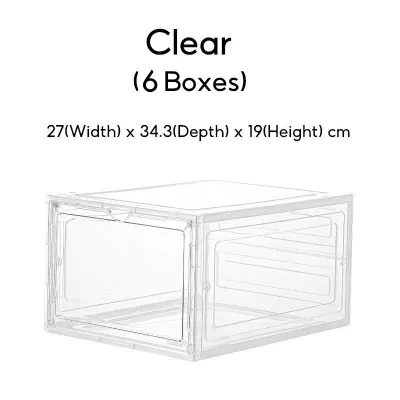
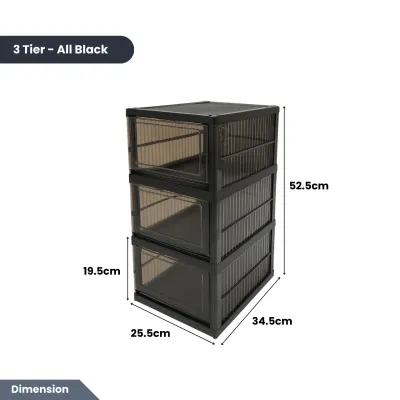
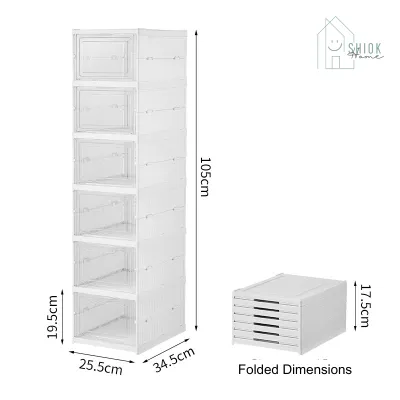
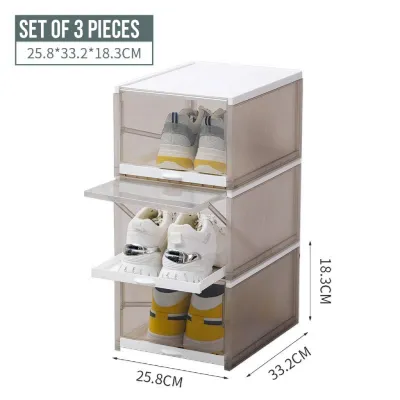
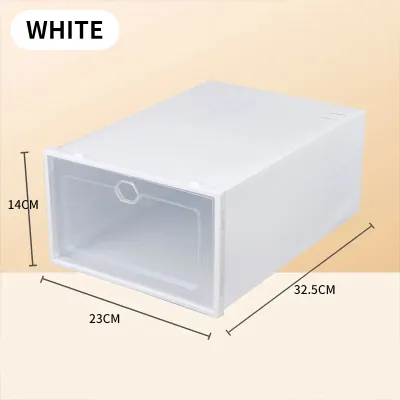
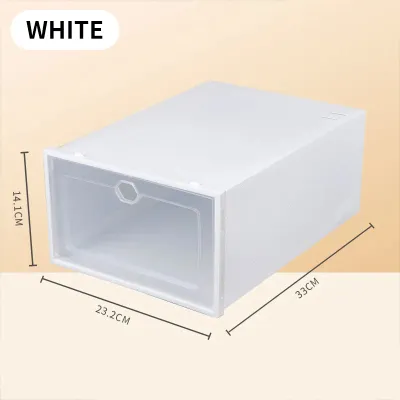
Prices are valid at publication and may change. Please refer to the product page for the latest price.
Measure Your Existing or Planned Shoe Rack
A common pitfall when organizing footwear is relying on the external dimensions of a shoe rack or cabinet. To ensure your selected shoe boxes fit seamlessly, you must measure the internal usable space of each shelf tier. Use a metal measuring tape to record the exact internal height, width, and depth of the shelves. If your rack has adjustable shelves, determine the spacing that maximizes vertical storage without creating awkward, unusable gaps at the top of each tier.

When measuring, look closely for physical obstructions that could interfere with box placement. Many wooden cabinets feature support brackets, shelf lips, hinges, or sliding door tracks that reduce the actual clearance. For example, a shelf might have an internal depth of 35 centimeters, but a protruding door hinge or a decorative front lip might reduce the usable entry clearance to 33 centimeters. If your shoe rack has doors, factor in the door swing or sliding mechanism; boxes that sit too close to the front edge will prevent the cabinet doors from closing completely. Additionally, verify the weight capacity of your shelving. Stacking multiple heavy plastic or acrylic boxes filled with leather boots or heavy-soled sneakers can cause thin plywood or particleboard shelves to sag over time. Check the manufacturer’s specifications for load limits, and distribute the weight evenly across the support beams.
Match Shoe Box Dimensions to Your Space and Footwear
With your footwear categories sorted and your shelf measurements recorded, you can now match the external dimensions of candidate shoe boxes to your available space. Compare the external width and depth of the boxes with the internal width and depth of your shelf. To calculate how many boxes can fit side-by-side on a single shelf, divide the shelf width by the external width of a single box. For instance, if your shelf width is 90 centimeters and the external width of a selected box is 28 centimeters, you can fit exactly three boxes side-by-side, leaving a comfortable 6-centimeter clearance for easy retrieval.
Repeat this calculation for the depth and height of the shelves. When planning vertical stacks, ensure the cumulative height of the stacked boxes remains at least 2 to 3 centimeters below the upper shelf tier to allow you to slide the top box out if necessary. At this stage, you must decide between a uniform storage layout and a mixed-size configuration. A uniform layout uses identical boxes across the entire rack, creating a clean, symmetrical aesthetic. However, this approach can waste space if you store low-profile sandals in boxes designed for high-top sneakers. A mixed-size layout uses larger boxes for boots and heels and smaller boxes for flats and slippers. While this maximizes space efficiency, it requires careful planning to ensure the different box sizes align neatly and do not create unstable, mismatched stacks.
Evaluate Shoe Box Materials and Structural Features
The durability and functionality of your storage setup depend heavily on the materials and design features of the shoe boxes you choose. When browsing options, check the manufacturer’s product labels for structural reinforcement details. Rigid acrylic and heavy-duty polypropylene are excellent choices for stacking, as they resist warping under weight. Look for boxes that feature interlocking mechanisms, such as molded tabs, grooves, or peg-and-hole systems on the top and bottom panels. These features lock the stacked boxes together, preventing them from sliding or tipping over when you open a door or retrieve a pair of shoes.
Ventilation is another critical feature to evaluate, especially in humid environments. Completely airtight plastic boxes can trap ambient moisture, creating a breeding ground for mold and unpleasant odors. Opt for boxes designed with rear ventilation slots, perforated side panels, or breathable mesh backings that promote continuous airflow while still keeping dust out. Finally, consider how you will access your shoes daily. Traditional shoeboxes with removable lids require you to unstack every box above to reach the bottom pair, which quickly becomes tedious. Instead, look for drop-front doors, magnetic closures, or drawer-style pull-out mechanisms. Drop-front doors with magnetic latches are particularly convenient, as they allow you to open the front panel and slide your shoes out with one hand, leaving the rest of the stack completely undisturbed.
Common Sizing Mistakes and How to Avoid Them
Avoiding simple spatial miscalculations can save you the hassle of returning bulky storage items. One of the most frequent mistakes is confusing the internal capacity of a shoe box with its external footprint. A manufacturer might advertise a box as suitable for a specific shoe size, which refers to the internal length. However, the external frame, door hinges, and interlocking tabs add extra centimeters to the outer dimensions. Always use the external dimensions when calculating whether the boxes will fit onto your shoe rack or inside your entryway cabinet.
Another common error is ignoring the cumulative height of stacked boxes. While a single box might easily clear a shelf tier, stacking three or four boxes can exceed the vertical limit. Remember to account for the extra height added by interlocking feet or top ridges, which can add several millimeters per box. Lastly, avoid purchasing rigid, single-size boxes in bulk before testing them. Buying a large set of identical boxes without verifying the fit of your tallest heels or widest sneakers often results in wasted space or forced, damaging storage angles. Purchase a single sample box first to test the fit of your largest shoes and verify that the box sits securely on your rack before committing to a complete storage system.
Frequently Asked Questions (FAQ)
Can I mix different shoe box sizes on the same rack shelf?
Yes, you can mix different shoe box sizes on a single shelf, but you must plan the layout carefully to maintain stability and visual order. To prevent tipping, always place the widest and heaviest boxes at the bottom of the stack to establish a low center of gravity. Group boxes of identical widths into vertical columns; do not stack a wide box on top of a narrow one, as this creates uneven weight distribution. If you are mixing heights, keep the columns uniform in width to ensure they align neatly side-by-side, which preserves a clean aesthetic while accommodating different footwear profiles.
How do I store tall boots in standard shoe boxes?
Standard shoe boxes do not have the vertical clearance required for tall boots, and folding or bending the shafts can cause permanent creases, cracks, or structural damage to the material. Instead of forcing them into standard containers, check manufacturer specifications for specialized tall boot boxes or drop-front boot organizers. If vertical space on your rack is limited, consider storing boots horizontally in wide, shallow boxes designed for under-bed storage, or use boot shapers and hang them from a dedicated rail inside your wardrobe. Always verify the internal height limits of any specialized container before purchasing to ensure your boots can sit comfortably without compression.

Community discussion
Share your experience or ask a question. Comments are reviewed before publication.