
Selecting the right capacity for a rotating shoe cabinet requires balancing your actual footwear inventory with the physical constraints of your home’s entryway. Unlike traditional static cabinets, a rotating model relies on a central axis and a circular footprint, meaning its advertised capacity often differs from its real-world usability. To find the ideal fit, you must audit your current collection, account for the physical dimensions of different shoe styles, and measure your available floor space—including the crucial clearance zone required for the unit to spin freely without striking walls or doors.
Assess Your Shoe Collection Size and Footwear Types
Start by laying out every pair of shoes you own to establish an accurate baseline. It is easy to underestimate your inventory until you see it compiled, so count every pair of flats, running shoes, formal heels, and boots. When calculating this number, remember to factor in a buffer of about ten to twenty percent for future purchases or guest footwear to prevent your new cabinet from reaching maximum capacity on day one.
Next, group your shoes by their physical profiles rather than just their usage. Flat shoes like sandals, loafers, and low-profile sneakers require very little vertical clearance, allowing you to pack them more densely. Conversely, high-top sneakers, platform heels, and ankle boots demand significantly more vertical space and can quickly disrupt standard tier spacing.
Products mentioned in this guide
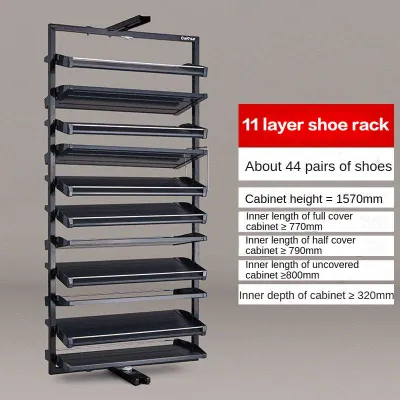
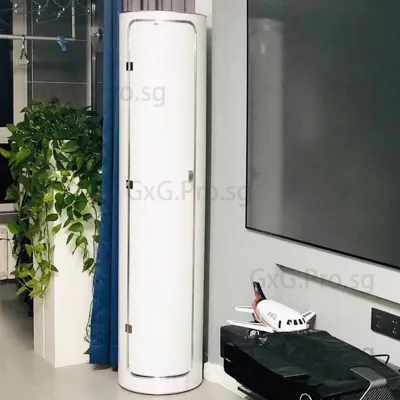
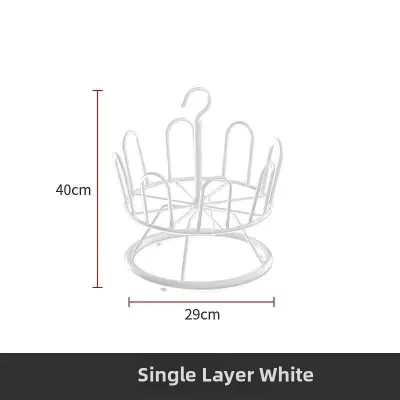

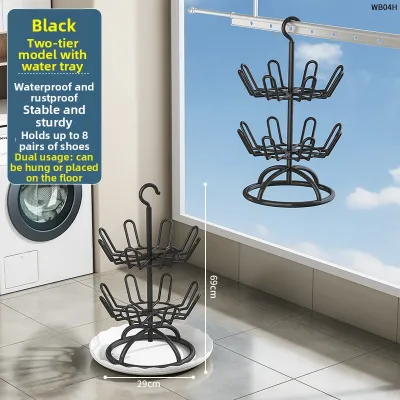
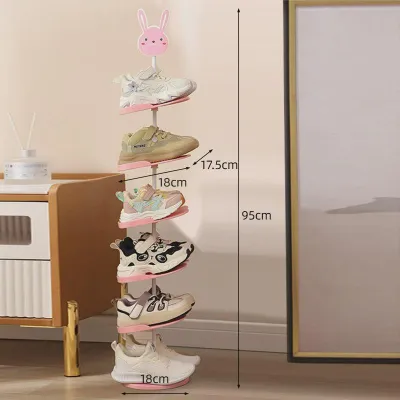
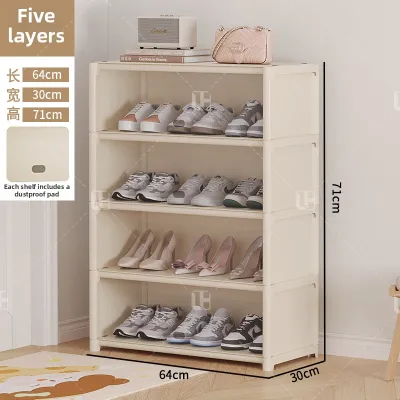
Prices are valid at publication and may change. Please refer to the product page for the latest price.
Bulkiness is another critical factor that dictates how many pairs can fit side-by-side on a single curved shelf. Chunky running shoes or wide-soled trainers occupy more horizontal surface area than slim leather dress shoes or canvas slip-ons. If your collection consists mostly of wide, structured footwear, you will need to plan for a lower actual pair capacity per tier than what might be advertised for standard shoes.
Finally, evaluate whether your collection is uniform or highly diverse. A mixed collection of high heels, boots, and flat sandals will almost certainly require adjustable shelving. Look for cabinets that offer customizable peg positions or removable dividers, which allow you to reconfigure the internal layout as your footwear collection evolves over time.
Decode Rotating Shoe Cabinet Capacity Metrics
When browsing rotating shoe cabinets online or in showrooms, you will frequently see capacity ratings such as “holds up to 36 pairs.” It is vital to understand that these manufacturer estimates are typically based on standard, low-profile, slim shoes, such as women’s flats or men’s dress shoes in average sizes. Larger shoe sizes, wide soles, and high-top designs will inevitably reduce this maximum number, meaning your practical capacity may be lower than the advertised figure.

The internal geometry of a rotating cabinet is unique because of its central rotating spindle. This central pole runs vertically through the middle of the shelves, dividing the circular space and reducing the usable depth at the center. Consequently, longer shoes may need to be angled slightly outward or placed along the outer edges of the shelf, which can limit the number of pairs you can fit on a single tier.
Before purchasing, check the exact depth of the shelves from the outer edge to the central column. If you or family members wear larger shoe sizes, verify that the shelf depth can accommodate the physical length of those shoes without them overhanging the edge, which would block the cabinet from rotating smoothly.
Tier height is another metric that requires careful verification. Fixed-tier rotating cabinets often have a standard height of 15 to 20 centimeters per shelf. While this is fully adequate for flats and standard sneakers, it will not accommodate taller footwear without bending the shafts of your boots or laying heels on their sides, which can damage the materials over time.
Measure Your Space and Rotation Clearance
A rotating shoe cabinet is an excellent space-saving solution for compact entryways, such as those in Singapore’s HDB flats or condominiums, but it requires a dedicated clearance zone to function. Begin by measuring the exact floor area where you plan to place the cabinet. You must measure the diameter of the unit, not just a flat width, and add a buffer of at least 5 to 10 centimeters around the entire circumference to ensure your hands can grip the cabinet to spin it without scraping against adjacent walls.
Ceiling height is equally important, especially if you are considering a tall, column-style rotating cabinet that maximizes vertical space. Measure from your floor to the ceiling, taking note of any low-hanging beams, light fixtures, or entryway false ceilings that could obstruct the installation. If the cabinet features a decorative top cap, a lazy Susan base, or an integrated handle, ensure these elements are included in your total height calculations.
Do not forget to assess the surrounding pathway and architectural details. Verify the swing clearance of your main entrance door, nearby room doors, and any adjacent closet doors to ensure they will not collide with the cabinet when opened. Additionally, check for the presence of skirting boards along the wall; if the skirting boards prevent the cabinet base from sitting flush against the wall, you will need to account for that extra gap when calculating your rotation clearance.
Match Cabinet Dimensions to Your Storage Needs
Once you have your shoe count and spatial measurements, you can match these requirements to the physical dimensions of the cabinet. For a modest collection of 15 to 20 pairs, a low-to-medium height cabinet with 3 to 5 tiers is usually sufficient and keeps the entryway feeling open and airy. Larger collections of 30 to 50 pairs will require a taller vertical column, typically featuring 7 to 10 tiers, which makes efficient use of vertical space without expanding the floor footprint.
Balancing vertical height against your floor footprint is a key design decision for tight entryways. If floor space is limited, going taller is the most logical path, but this introduces structural considerations. High-capacity, tall rotating cabinets have a higher center of gravity, which can make them prone to wobbling or tipping if they are not properly balanced or anchored.
Prioritize models that feature a heavy, stable base plate—often made of solid metal or weighted engineered wood—to anchor the unit’s rotation. For exceptionally tall models, check if the manufacturer provides wall-anchoring brackets or stabilizing hardware designed to secure the central spindle while still allowing the outer shell or inner shelves to rotate safely. This is particularly important if you have a busy household where the cabinet will be spun frequently.
Common Sizing and Placement Mistakes to Avoid
One of the most frequent mistakes is placing a rotating shoe cabinet too close to a corner or a door frame. While the static footprint might fit neatly into a tight corner, the actual spinning motion requires a clear circular path; ignoring this swing radius can lead to scratched walls, chipped cabinet edges, and jammed rotation.
Another common error is uneven weight distribution during loading. Placing heavy work boots, thick leather shoes, or heavy storage boxes on the topmost tiers compromises the cabinet’s center of gravity, making it top-heavy and unstable. Always place your heaviest footwear on the bottom tiers to act as a natural anchor, reserving the middle and upper shelves for lighter sneakers, flats, and sandals.
Finally, many homeowners overlook uneven flooring or the thickness of entryway floor mats. If your floor is slightly sloped or if the cabinet sits partially on a thick rug, the rotating mechanism may bind, squeak, or tilt. Ensure the cabinet is placed on a completely level, hard surface, and check that the base has adjustable leveling feet if your entryway floor is uneven.
Frequently Asked Questions (FAQ)
Can I adjust the shelves in a rotating shoe cabinet for tall boots?
Whether you can adjust the shelves depends entirely on the specific model’s design. Many rotating shoe cabinets feature fixed tiers to maintain structural integrity and smooth rotation around the central spindle, but some models offer removable or adjustable shelves. Always check the manufacturer’s specifications before purchasing to confirm if shelves can be repositioned, and keep in mind that removing a shelf to accommodate tall boots will reduce the overall pair capacity of the cabinet.
How much clearance is needed around a rotating shoe cabinet?
To ensure smooth, unobstructed 360-degree rotation, you should maintain a minimum clearance buffer of 5 to 10 centimeters around the entire diameter of the cabinet. This gap prevents the rotating outer shell or shelves from rubbing against walls, door frames, or adjacent furniture. Additionally, make sure to check that nearby doors, drawers, and high-traffic walkways have ample clearance so they do not collide with the cabinet during use.

Community discussion
Share your experience or ask a question. Comments are reviewed before publication.