
Choosing the right outdoor shoe cabinet requires balancing your household’s daily footwear habits with the physical limits of your entryway. To find the perfect fit, you must calculate a realistic baseline of active outdoor shoes, audit the physical dimensions of your footwear, and cross-reference these needs with local building regulations and spatial clearances. Taking these steps ensures your entryway remains organized, safe, and fully compliant with local housing rules.
Quick Formula for Estimating Your Baseline Shoe Capacity
To establish a realistic starting point, you can use a simple mathematical baseline. Multiply the number of active residents in your home by the average number of shoes each person wears outdoors during a typical week. For instance, a household of four where each person regularly rotates between three pairs of outdoor shoes—such as work shoes, running sneakers, and casual sandals—will require a baseline capacity of 12 slots.
Next, adjust this baseline to account for lifestyle variables. If your household frequently hosts guests, you should allocate two to four extra slots near the bottom or top of the cabinet to keep the entryway tidy during social gatherings. Additionally, factor in specialized footwear that remains outdoors, such as heavy hiking boots, cycling cleats, or wet-weather boots, which occupy more physical space than standard footwear.
Products mentioned in this guide
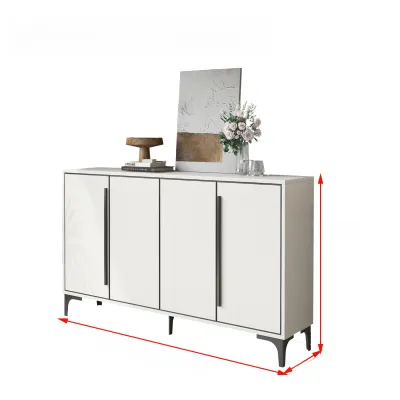
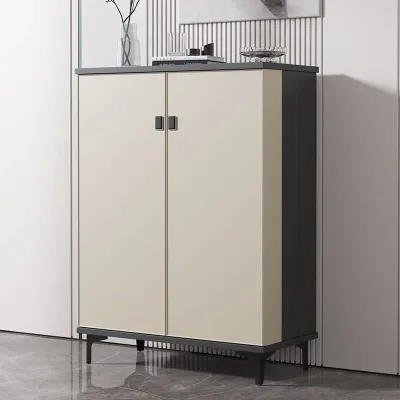
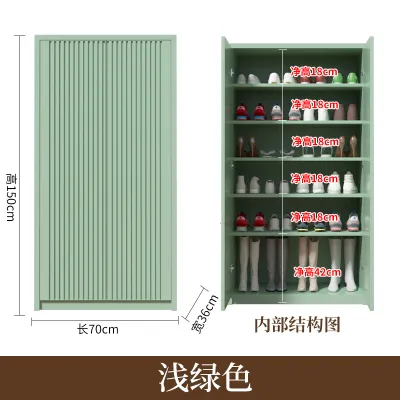
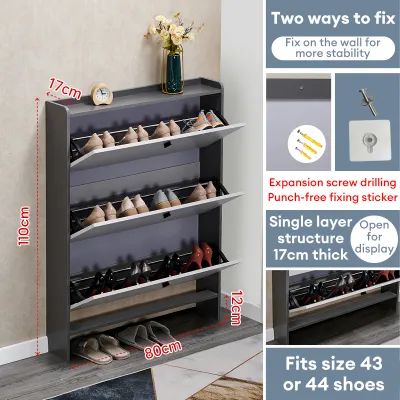
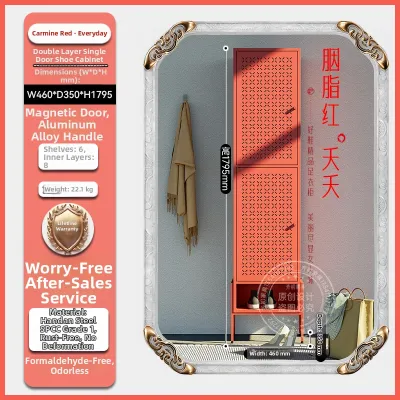
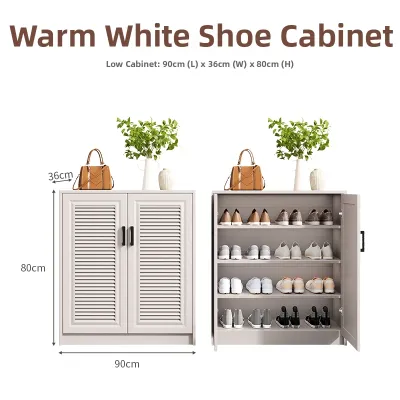
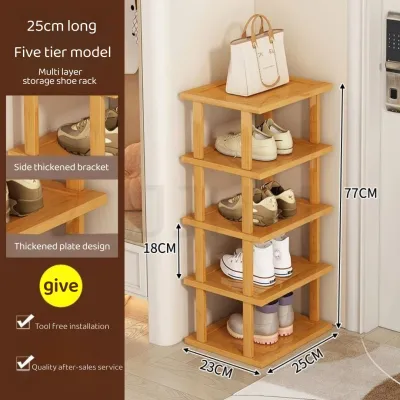
Prices are valid at publication and may change. Please refer to the product page for the latest price.
Finally, apply a buffer percentage to prevent your cabinet from reaching maximum capacity on day one. Adding a 20% buffer to your total estimate accommodates future purchases and prevents shoes from being piled on top of one another. For a calculated need of 15 pairs, a cabinet rated for 18 to 20 pairs provides the necessary breathing room to keep the storage system functional over time.
Auditing Your Footwear to Determine True Storage Needs
Before purchasing any furniture, conduct a physical inventory of the shoes you intend to store outside. Group your footwear by height, width, and overall bulk rather than just counting individual pairs. Flat sandals, flip-flops, and canvas slip-ons require very little vertical clearance, whereas high-top sneakers, leather dress shoes, and work boots demand significantly more height and width per slot.

Clearly separate your strictly outdoor-only shoes from those that can be stored indoors. An outdoor shoe cabinet is most effective when reserved for footwear that accumulates dirt, mud, or moisture, keeping these elements out of your main living areas. Clean indoor slippers, formal shoes worn only on rare occasions, and off-season footwear are better suited for indoor closets, freeing up premium outdoor cabinet space for daily-use items.
Organize your inventory by frequency of use to plan your internal cabinet layout. Daily work shoes and school sneakers should occupy the most accessible middle shelves, which sit at comfortable waist-to-chest height. Less frequently worn items, such as specialized sports shoes or rainy-day boots, can be relegated to the very bottom or top shelves, ensuring your daily routine remains streamlined and efficient.
Measuring Your Entryway and Checking Building Clearances
Physical space constraints and local regulations dictate the maximum external dimensions of your outdoor shoe cabinet. Begin by measuring the exact width, depth, and height of the designated installation area outside your front door. Take note of any architectural features that could restrict placement, such as wall protrusions, water meters, electrical risers, or decorative pillars.
Calculate the necessary clearance zones to ensure safe daily movement and door operation. The cabinet must not obstruct the full swing of your main entrance door or gate, nor should it block access to key utilities. Leave a comfortable margin of space around the cabinet so that family members can stand, bend down, and retrieve shoes without feeling cramped or stepping into common walkways.
In Singapore, strict building management guidelines and fire safety regulations govern what can be placed in shared corridors. For HDB flats, civil defense rules require a minimum clear escape passage of 1.2 meters along the corridor to ensure safe evacuation and emergency medical access. Condominium residents must consult their specific Management Corporation Strata Title (MCST) bylaws, as many private estates prohibit any personal items in common areas or enforce strict aesthetic and dimensional limits.
Translating Your Shoe Count into Cabinet Specifications
Once you have your target shoe capacity and physical space measurements, you can evaluate different cabinet configurations. If your corridor or entryway has a narrow footprint but generous vertical clearance, a tall, narrow cabinet is highly efficient. Conversely, if you have a wide alcove or need to keep the top surface clear for decorative items or keys, a low, wide horizontal cabinet serves as an excellent alternative that can also double as a bench.
Prioritize cabinets that feature adjustable or removable shelving systems. Fixed shelves often lead to wasted vertical space, leaving large gaps above low-profile shoes while failing to accommodate taller boots. Adjustable shelves allow you to customize the height of individual compartments, maximizing the total capacity of the cabinet by matching the physical profile of your specific footwear collection.
For deeper cabinets, look for design features that keep rear-stored shoes accessible. Tiered shelves, pull-out drawers, or sliding mechanisms prevent shoes from getting lost in the dark corners of a deep unit. If you choose a standard deep shelf, ensure you can easily reach the back row without having to remove multiple pairs from the front, which can quickly disrupt the organization of the cabinet.
Common Sizing and Clearance Mistakes to Avoid
One of the most frequent errors when selecting an outdoor shoe cabinet is overlooking the internal depth requirement. Standard shoe cabinets often feature an internal depth designed for average shoe sizes, which may not accommodate larger men’s shoes or bulky hiking boots. Always verify the internal shelf depth against your largest pair of shoes to ensure the cabinet doors can close completely without crushing the footwear.
Another common oversight is ignoring the swing radius of hinged cabinet doors or the extension depth of pull-out drawers. In tight corridors or shared landings, opening a hinged door fully can completely block the walkway or strike adjacent walls and gates. In these restricted spaces, consider cabinets with sliding doors or open-slat shelving designs that do not require extra clearance to access.
Finally, do not assume that a manufacturer’s stated shoe capacity is a universal guarantee. Capacity ratings are typically calculated using standard, low-profile shoes like flats or loafers. If your collection consists primarily of wide sneakers, boots, or high heels, the actual number of pairs you can fit will be lower than the advertised capacity, making a customizable shelf layout essential.
Frequently Asked Questions (FAQ)
Do I need permission to place a shoe cabinet outside my apartment door?
Yes, you must verify local regulations and building bylaws before placing any furniture in common outdoor areas. In Singapore, HDB residents must comply with town council and fire safety rules, which mandate a minimum clear pathway of 1.2 meters for emergency evacuations. If you live in a condominium, you must check with your MCST or condo management office, as individual estates often have strict rules regarding the placement, size, and appearance of corridor furniture.
How do I accommodate tall boots in a standard outdoor shoe cabinet?
To store tall boots without sacrificing overall capacity, look for a cabinet with highly adjustable or removable shelves. Removing a single shelf creates a double-height compartment that can easily accommodate tall boots upright. Alternatively, you can use boot shapers to keep them upright and prevent creasing, or store them horizontally on a deeper shelf if the cabinet’s internal dimensions allow for flat placement.

Community discussion
Share your experience or ask a question. Comments are reviewed before publication.