
Selecting the ideal magazine rack stand size requires balancing your available floor space, daily traffic flow, and the actual volume of reading materials you need to store. By systematically measuring your room and understanding how different footprint types interact with your layout, you can select a stand that offers practical storage without overcrowding your home.
Assess Your Available Space and Traffic Flow
Before browsing designs, establish the physical boundaries of your target area. Start by measuring the exact length, width, and height of the zone where you plan to place the stand. Do not rely on visual estimates; use a physical measuring tape. When measuring, account for architectural features that project from the wall, such as baseboards, skirting boards, electrical outlets, or low-hanging window sills. A stand that sits flush against a wall might be pushed forward by several centimeters if the baseboard is thick, altering how far the unit extends into the room.
Next, evaluate how the magazine rack stand will interact with the daily movement of people in your home. High-traffic pathways require generous clearance to prevent accidental bumps or trips. Ensure the stand does not obstruct walking routes, door swings, cabinet doors, or the pull-out paths of nearby drawers. If you plan to place the stand next to an armchair or sofa, test the clearance by sitting down and standing up to ensure your legs or elbows will not collide with the frame.
Products mentioned in this guide
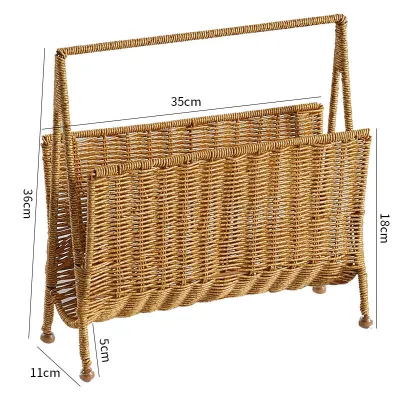
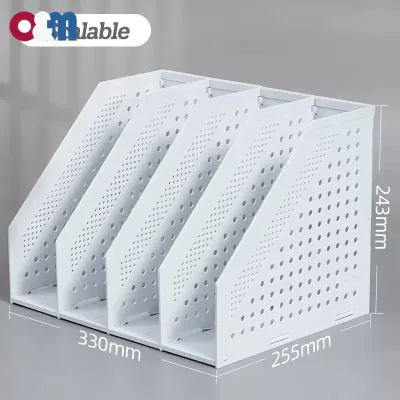
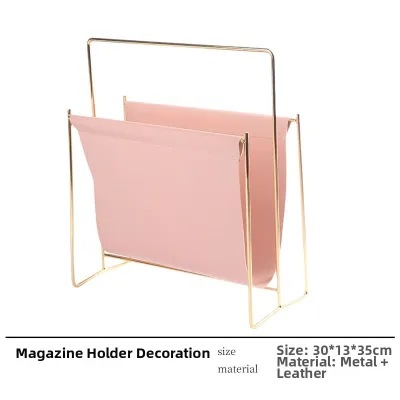
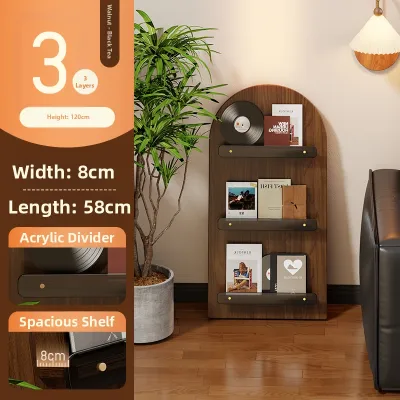
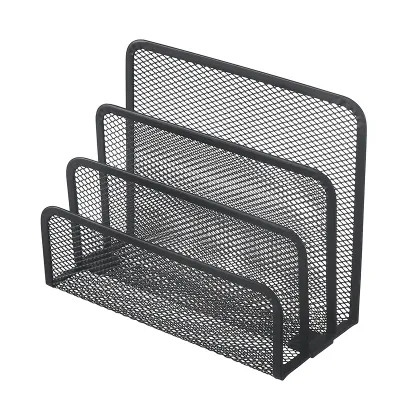
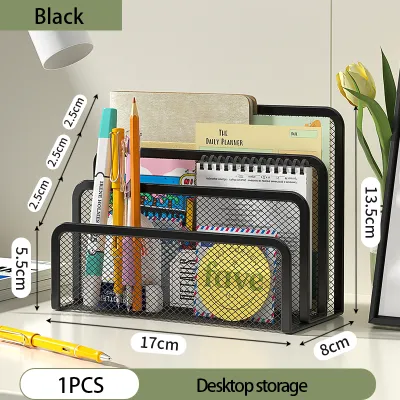

Prices are valid at publication and may change. Please refer to the product page for the latest price.
Finally, consider the visual weight and proportion of the stand relative to adjacent furniture. A tall, bulky metal rack placed next to a delicate, low-profile armchair can look visually jarring. Conversely, a tiny, low-slung sling rack might get lost next to a massive sectional sofa. Aim for a height and width that complement the scale of your existing seating.
Match Stand Dimensions to Your Storage Needs
Once you have defined your spatial limits, align the physical capacity of the rack with your actual reading habits. Estimate the volume of magazines, catalogs, newspapers, or journals you intend to store at any given time. If you only keep the latest two or three issues of a favorite publication, a slim, single-pocket stand is highly efficient. However, if you collect monthly design journals or thick weekend newspapers, you will require a multi-tier stand with deeper compartments or multiple slots to prevent overflow.

It is equally important to check the internal dimensions of individual compartments rather than relying solely on the external dimensions of the stand. Standard magazines typically measure around 21 by 27 centimeters, but oversized art books, thick catalogs, and broadsheet newspapers require significantly more room. Measure your largest regular publications and compare them to the manufacturer’s specified slot width, height, and depth. If the compartments are too narrow or shallow, your reading materials will bend, crease, or spill over the edges.
Balancing your storage desires with your physical footprint limits is key to a successful purchase. While a high-capacity, multi-tier stand might seem appealing, it can easily overwhelm a compact room. If space is limited, adopt a “one-in, one-out” rule for your reading materials, allowing you to choose a smaller, more elegant stand that fits comfortably within your room’s footprint.
Evaluate Footprint Types for Different Room Layouts
The structural format and base geometry of a magazine rack stand dictate how efficiently it utilizes your floor space. Different layouts require distinct structural designs to maximize accessibility while minimizing floor coverage.
Freestanding and Floor Models
Standard freestanding magazine racks are highly versatile but require a flat, level surface to remain stable. Because these models often feature wider bases or dual-sided pockets, you must allow for adequate clearance on all sides. This clearance is essential not only for retrieving reading materials easily from different angles but also for routine household cleaning, such as vacuuming or sweeping around the base.
Freestanding models excel when used as functional room dividers or as companions to reading nooks. For instance, placing a double-sided floor model between an armchair and a side table creates a clear boundary in an open-plan living room. They also serve as excellent alternatives to traditional end tables, offering a flat top surface while storing reading materials neatly underneath.
Corner and Narrow Profile Stands
When floor space is exceptionally tight, specialized footprint designs help you utilize otherwise wasted areas. Wedge-shaped or triangular bases are engineered specifically to fit flush into 90-degree corners. These models maximize storage capacity by utilizing the depth of the corner without protruding into the main walking paths of the room, making them ideal for small home offices or compact entryways.
Alternatively, tall and narrow vertical stands are designed to slide into tight gaps, such as the space between a sofa arm and an adjacent wall. While these slim profiles are incredibly space-efficient, they do introduce stability trade-offs. Because they have a narrow base and a higher center of gravity, they are more prone to tipping if they are overloaded or placed on uneven surfaces. When selecting a narrow vertical stand, prioritize models with weighted bases or those that offer wall-anchoring options.
Check Clearance, Stability, and Safety Margins
Ensuring your magazine rack stand is safe and functional requires looking beyond basic height and width measurements. You must verify the relationship between the stand’s center of gravity and its base width. Paper is surprisingly heavy; a fully loaded rack containing dozens of thick, glossy magazines can easily weigh several kilograms. If the base of the stand is too narrow or lightweight relative to its height, the unit can become top-heavy and tip over when fully loaded. Always check that the base is sturdy enough to support the weight of your specific reading collection.
Environmental placement is another critical factor. Maintain adequate clearance between your magazine rack and heat sources, air vents, radiators, or areas of direct sunlight. Prolonged exposure to heat and UV rays can warp wooden frames, degrade metal finishes, and cause your magazines to yellow, fade, or become brittle. Placing the stand away from these elements preserves both the furniture piece and your reading materials.
Finally, inspect the physical design of the stand for potential safety hazards. In narrow walkways or tight corners, look for rounded edges, recessed hardware, and smooth finishes. Sharp metal corners, protruding screws, or awkward wooden angles can easily catch on loose clothing, scratch passing family members, or pose a hazard to pets. Choosing a design with a smooth, streamlined exterior minimizes these risks in high-traffic zones.
Avoid Common Sizing Mistakes
One of the most frequent errors when choosing a magazine rack stand is measuring only the floor footprint while ignoring vertical clearance. While a stand might fit perfectly on the floor, you must ensure there is enough overhead space to easily slide magazines in and out of the top tiers. If the stand features a hinged lid or a cabinet-style door, verify that you have enough clearance to open these components fully without hitting adjacent walls or furniture.
Another common mistake is assuming all magazine racks are built to a universal standard. Compartment sizes vary wildly across different brands and styles. Always verify the internal slot dimensions against your actual reading materials rather than assuming a standard magazine will fit. This is especially important for international publications, thick catalogs, or newspapers, which often exceed standard dimensions.
Lastly, resist the urge to buy a maximum-capacity unit just because you have a large collection. Overcrowding a small room with a massive, packed magazine rack creates visual clutter and makes the space feel cramped. Instead, select a stand that matches the scale of your room, and use it to display only your current, active reading materials, storing older issues in secondary storage elsewhere.
Frequently Asked Questions (FAQ)
How do I measure a corner space for a magazine rack stand?
To measure a corner space accurately, start at the corner apex where the two walls meet. Measure outward along both walls to the maximum distance you want the stand to extend. Next, measure diagonally across the corner from one outer point to the other to determine the maximum front width of the stand. Finally, check the vertical wall space for any obstructions, such as baseboards, electrical outlets, light switches, or wall trim. If your walls are slightly uneven, take measurements at multiple heights to ensure a flush, stable fit.
What is the standard width for a freestanding magazine rack?
There is no single universal standard width for a freestanding magazine rack, as dimensions vary significantly based on the design and capacity. Single-pocket sling racks are often quite compact, typically ranging from 30 to 40 centimeters in width. Multi-column or multi-tier display stands designed for offices or larger living rooms can easily exceed 60 to 80 centimeters in width. Rather than relying on assumed industry averages, always check the manufacturer’s specific product dimensions and compare them directly to your measured floor space.

Community discussion
Share your experience or ask a question. Comments are reviewed before publication.