
Choosing the right shoe storage solution requires balancing your current footwear collection, potential future purchases, and the physical constraints of your home. A shoe rack that is too small leads to cluttered entryways, while an oversized unit can obstruct walkways and disrupt the flow of your living space. By calculating your household’s specific storage needs and verifying your entryway dimensions, you can select a configuration that keeps your home organized and your footwear well-preserved.
To find your ideal capacity, use this straightforward baseline formula: multiply your current number of shoe pairs by 1.2 to incorporate a 20% growth buffer. For a quick reference, single residents or couples typically require storage for 10 to 15 pairs, small families of three to four people generally need space for 20 to 30 pairs, and larger or multi-generational households should look for units accommodating 40 or more pairs. Before finalizing any purchase, always verify the finished external dimensions of the furniture piece against your available floor area to ensure a seamless fit.
How to Calculate Your Household's Shoe Storage Needs
Determining your actual storage requirements begins with a comprehensive physical audit of every shoe owned by each household member. Gather all footwear from around the home, including daily work shoes, school shoes, casual sneakers, sports footwear, sandals, and formal wear. Grouping these shoes by user and frequency of use provides a clear picture of what needs to be accessed daily at the entryway versus what can be stored in secondary locations like bedroom closets.
Products mentioned in this guide
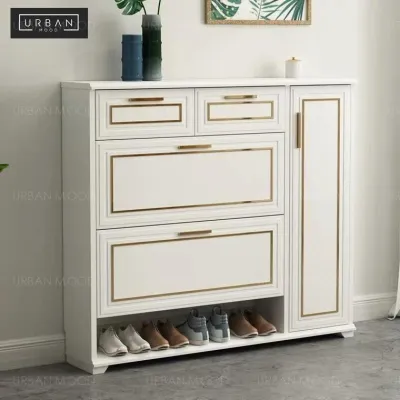
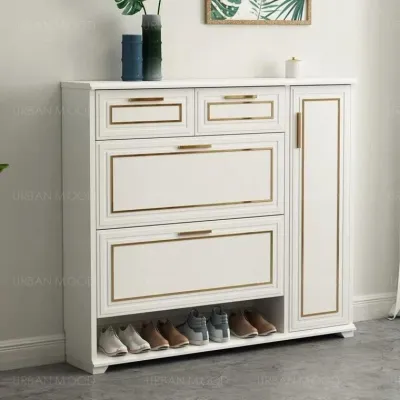
Prices are valid at publication and may change. Please refer to the product page for the latest price.
Not all shoes occupy the same amount of physical space, so counting pairs alone is rarely sufficient. Bulky footwear such as high-top sneakers, basketball shoes, boots, and platform heels requires significantly more vertical and horizontal clearance than flat sandals, slippers, or loafers. When planning your layout, note the proportion of bulky items in your collection; a shelf that comfortably holds four pairs of standard flats might only accommodate three pairs of wide-soled running shoes.
Your preferred storage style also heavily influences the total volume your shoe rack must accommodate. Storing shoes in their original cardboard boxes or plastic organizer cases protects them from dust but easily doubles the physical footprint required on each shelf. If you plan to keep your shoes boxed, measure the average dimensions of your shoe boxes and use those measurements, rather than the shoes themselves, to calculate the necessary shelf depth and vertical clearance.
Matching Grande Shoe Rack Capacities to Family Sizes
When browsing storage options, it is essential to understand how manufacturer capacity ratings translate to real-world usage. Advertised pair capacities are typically calculated using standard, low-profile footwear like women’s flats or men’s dress shoes of average size. If your household collection consists primarily of larger men’s sizes, wide athletic shoes, or high heels, the actual number of pairs you can fit on each shelf will be lower than the maximum advertised capacity.

For singles and couples, a compact unit designed for 10 to 15 pairs is usually sufficient to handle daily-wear shoes and a few seasonal options. These smaller units fit comfortably into narrow corridors or behind main doors, keeping the immediate entryway clear of daily clutter without overwhelming the space.
Small to medium families of three to four people generally find their sweet spot with units rated for 20 to 30 pairs. This capacity allows each family member to store multiple pairs of frequently used shoes, such as school shoes, work shoes, and weekend sneakers, while leaving a small amount of shared space for guest footwear.
Large or multi-generational households with five or more members typically require high-capacity storage solutions rated for 40 or more pairs. For these larger volumes, look for tall utility cabinets or modular systems that maximize vertical wall space, ensuring that everyone’s footwear remains organized and accessible without taking up excessive floor area.
To ensure long-term usability, check the product specifications for adjustable or removable shelves. A unit with customizable shelf heights allows you to adapt the interior layout over time as your footwear collection changes, preventing wasted vertical space above low-profile shoes and accommodating taller boots or high heels when needed.
Measuring Your Space for the Perfect Fit
In space-conscious residential layouts, particularly in apartments and condominiums, measuring your designated entryway area with precision is critical. Use a reliable measuring tape to record the exact width, depth, and height of the floor space where you plan to position the shoe rack. Be sure to account for any architectural features such as baseboards, light switches, electrical outlets, or wall-mounted distribution boards that could prevent the unit from sitting flush against the wall.
Clearance is just as important as the physical footprint of the furniture piece itself. Ensure there is sufficient room for the cabinet doors or drawers to open fully without obstructing main entrance doors, safety gates, or adjacent walkways. As a general rule, maintain a clear walkway of at least 60 to 90 centimeters in front of the unit to allow household members to pass by comfortably, even when the cabinet doors are open.
Before placing an order, verify that the packaged or fully assembled unit can actually reach its destination. Measure the height and width of your building’s elevator doors, stairwells, corridor corners, and your home’s main entrance frame. High-capacity shoe cabinets are often delivered fully assembled or in large, heavy flat-packs, and ensuring adequate delivery access prevents costly delivery failures or damage to your walls and doorways.
Common Capacity and Sizing Mistakes to Avoid
One of the most frequent errors when buying shoe storage is assuming that all shelf tiers within a cabinet are of uniform height and can accommodate any shoe type. Without adjustable shelving, you may find yourself forced to store taller shoes sideways, which can deform the shoe material, or leave them piled on top of the cabinet, defeating the purpose of organized storage. Always check the interior clearance specifications of each shelf tier before purchasing.
Another critical consideration is the structural stability of the unit, especially for tall, narrow, or shallow shoe cabinets. When fully loaded with heavy footwear, these units have a high center of gravity and present a serious tipping risk if they are bumped or pulled. Check the manufacturer’s assembly instructions to confirm if wall-anchoring hardware is included, and ensure your wall material is suitable for secure mounting to prevent accidents.
Finally, do not overlook the importance of proper ventilation, particularly in warm or humid climates. Enclosing damp or worn shoes in a tightly sealed, non-ventilated cabinet traps moisture and sweat, creating an ideal environment for mold growth, material degradation, and unpleasant odors. To maintain a fresh environment, prioritize designs that feature slatted doors, open-back panels, or built-in ventilation grilles that encourage continuous airflow.
Frequently Asked Questions (FAQ)
How much extra capacity should I plan for future shoe purchases?
It is highly recommended to plan for a 15% to 20% capacity buffer beyond your current shoe count. This extra space prevents the cabinet from becoming overcrowded, accommodates new purchases without requiring you to discard older pairs, and provides convenient temporary storage for shoes worn by visiting guests.
Can I mix different shoe types on the same shelf tier?
Yes, you can mix different shoe types, but grouping shoes of similar heights together on the same shelf is much more space-efficient. If you must mix styles, place heavier or wider shoes on the outer edges of the shelf to maintain structural balance, and utilize adjustable shelves to minimize empty vertical space above flatter footwear.

Community discussion
Share your experience or ask a question. Comments are reviewed before publication.