
A cluttered foyer is more than just an eyesore; it creates daily friction in an otherwise welcoming home. Choosing the right entryway cabinet capacity is the key to balancing functional storage with an open, inviting foyer. Finding this balance requires looking beyond aesthetics to calculate your actual storage needs, match those needs to physical furniture dimensions, and ensure the unit fits safely within your home’s layout.
In Singaporean households, where space is highly optimized and high humidity is a constant factor, selecting a shoe storage solution is a precise exercise. A cabinet that is too small leads to overflow and cluttered floors, while an oversized unit can restrict movement in narrow corridors. By taking a systematic approach to calculating your household’s shoe volume and understanding cabinet specifications, you can select a piece of furniture that resolves your storage challenges for years to come.
Calculate Your Household's True Shoe Storage Volume
Determining the ideal capacity for your entryway cabinet begins with an honest audit of your household’s footwear. Rather than guessing, start by establishing a baseline capacity based on the number of residents. A practical rule of thumb is to allocate space for the shoes each person wears regularly. For an active adult, this typically includes daily work shoes, casual sneakers, sandals, and athletic footwear, averaging four to six pairs in active rotation.
Products mentioned in this guide
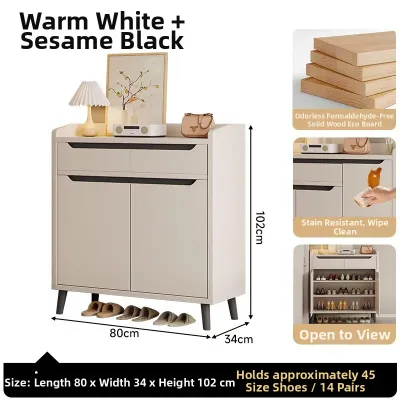
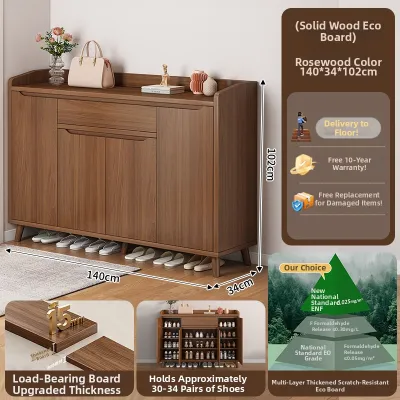
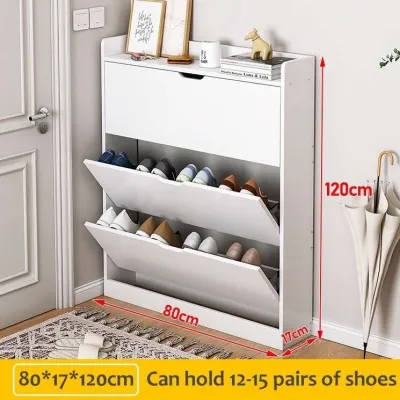
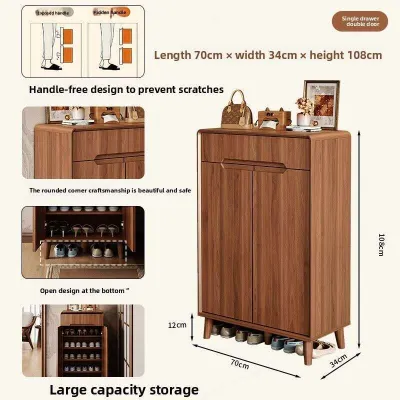
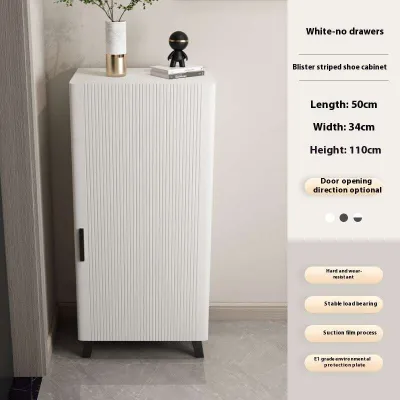
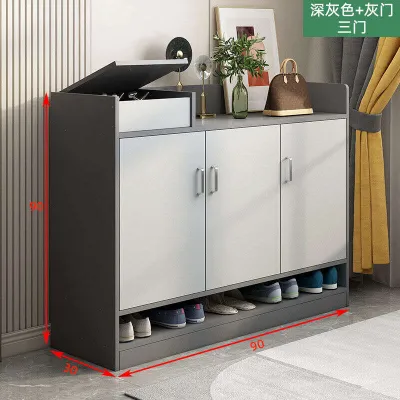
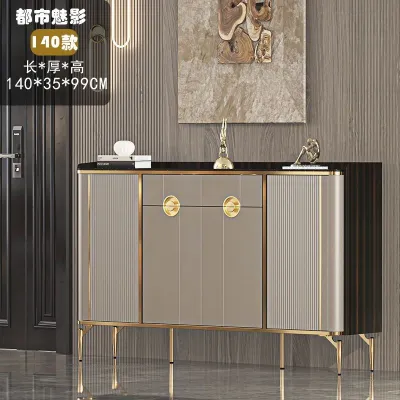
Prices are valid at publication and may change. Please refer to the product page for the latest price.
Multiplying this baseline by the number of household members provides your minimum daily capacity. For a couple, a capacity of 10 to 12 pairs is usually sufficient for daily wear, whereas a family of four will quickly require space for 20 to 24 pairs. This baseline represents only the active rotation and does not account for specialized or occasional footwear.
To prevent immediate overflow, you must factor in variables such as guest footwear and hobby-specific shoes. If you regularly host friends and family, your entryway needs dedicated space to accommodate guest shoes without disrupting your household’s organization. Additionally, sports-specific footwear—such as running shoes, football boots, or golf shoes—often requires more physical space and separate handling due to dirt and odor.
Seasonal variations also play a role in your storage calculations. While Singapore’s tropical climate means year-round warm-weather footwear, many residents keep heavy winter boots, specialized hiking shoes, or formal dress shoes for overseas travel or special occasions. Storing these occasional-use items in prime entryway real estate is inefficient.
To optimize your space, differentiate your storage zones clearly. The entryway cabinet should be reserved primarily for daily and weekly rotation shoes, which require easy, eye-level access. Occasional, seasonal, or out-of-season footwear should be relegated to secondary storage zones, such as the upper shelves of a bedroom wardrobe, under-bed storage boxes, or a dedicated storeroom, keeping your foyer clear and functional.
Match Your Shoe Count to Cabinet Tiers and Dimensions
Once you have a clear estimate of your target shoe count, you can translate that number into concrete cabinet specifications. Understanding how shoe dimensions relate to shelf width is crucial for maximizing internal layout efficiency. On average, a pair of men’s shoes requires 22cm to 25cm of horizontal shelf width, while women’s flats or heels require 18cm to 22cm. Children’s shoes are narrower, typically taking up 12cm to 15cm per pair.

Using these averages, you can estimate the capacity of a single shelf tier. A standard 80cm wide cabinet shelf can comfortably accommodate three pairs of men’s shoes or four pairs of women’s shoes. A wider 100cm shelf can hold four pairs of men’s shoes or five pairs of women’s shoes. When browsing entryway cabinets, use these horizontal measurements to verify whether a manufacturer’s claimed capacity matches your actual footwear dimensions.
Cabinet height and tier configuration also dictate overall storage capacity. Full-height, floor-to-ceiling cabinets maximize vertical space, making them ideal for large families or shoe collectors who need to store 30 to 50 pairs in a single location. Conversely, half-height cabinets or under-console racks keep the entryway feeling open and airy, but they limit storage capacity to around 12 to 18 pairs, making them better suited for smaller households.
To accommodate a diverse footwear collection, look for cabinets featuring adjustable or removable shelves. Standard fixed shelves usually offer a vertical clearance of 15cm, which is ideal for flat shoes, loafers, and low-profile sneakers. However, high-top sneakers, high heels, and ankle boots require 20cm to 25cm of vertical space. Adjustable shelving allows you to customize the height of individual tiers, preventing taller shoes from being bent or damaged.
Cabinet depth is another critical dimension that is frequently overlooked. Standard flat-shelf cabinets require an internal depth of at least 35cm to 38cm to accommodate larger men’s shoes (such as US size 10/EU 44 and above) without the toes pressing against the closed doors. If your entryway space is exceptionally tight, you may need to consider slim-profile cabinets with angled, tipping-bucket compartments. These units reduce the external depth to 17cm to 24cm by storing shoes vertically, though they generally accommodate fewer bulky or high-top shoes.
Measure Your Entryway to Ensure a Safe and Practical Fit
Before purchasing any entryway cabinet, you must measure your physical foyer space to ensure the unit does not obstruct daily movement or violate safety clearances. Walkway clearance is the most critical spatial consideration, particularly in compact HDB flats and condominium layouts. To maintain comfortable passage, aim for a clear walkway width of at least 90cm to 100cm in front of the cabinet, allowing two people to pass each other without squeezing.
Next, carefully analyze the swing radius of all nearby doors. Open your main entrance door and security gate fully to ensure they do not collide with the proposed cabinet location. You must also check the clearance for adjacent doors, such as those leading to a household shelter (bomb shelter) or a powder room. A cabinet that restricts a door from opening to at least 90 degrees will quickly become a daily frustration and a safety hazard.
When dealing with narrow entryways, you will face a direct trade-off between cabinet depth and storage capacity. If your foyer corridor is less than 120cm wide, a standard-depth hinged-door cabinet (35cm to 40cm deep) may restrict the walkway too much when the cabinet doors are open. In these tight spaces, slim-profile pull-out or tipping-bucket cabinets are highly effective, as they minimize floor obstruction while still providing reasonable storage for daily-use footwear.
Do not forget to account for minor structural details that can affect furniture placement. Measure the thickness of your skirting boards, which typically protrude 1.5cm to 2cm from the wall. If the cabinet does not have a base cutout to accommodate the skirting, it will sit away from the wall, creating an unsightly gap where dust and small items can fall. Also, check for wall unevenness, light switches, electrical outlets, and DB box access panels that must remain unobstructed.
Finally, consider the indoor climate of your entryway. Singapore’s high relative humidity can trap moisture inside enclosed furniture, leading to mold, mildew, and unpleasant odors on leather and canvas shoes. To prevent this, prioritize cabinets that feature ventilation details. Louvred doors, mesh back panels, or open-backed designs encourage continuous airflow, keeping your footwear dry and well-preserved.
Avoid Common Capacity and Sizing Mistakes
One of the most common mistakes homeowners make is underestimating their future storage needs. While a 15-pair cabinet may suffice for a couple today, it leaves no room for lifestyle changes, such as a growing family, a new hobby that requires specialized footwear, or a natural expansion of your shoe collection over time. If your entryway space allows, always select a cabinet with 20% more capacity than your current calculated need to accommodate future growth.
Another frequent error is assuming all shoes occupy the same physical volume. Bulky running shoes, platform wedges, and heavy work boots take up significantly more vertical and horizontal space than flat sandals or canvas slip-ons. Failing to account for this variation leads to cramped shelves, which can crush delicate materials, scuff leather, and distort the shape of your shoes. Always measure your bulkiest pairs and ensure the cabinet’s tier heights can accommodate them.
Logistical constraints during delivery and assembly can also cause major issues. Homeowners often measure the final resting spot for the cabinet but forget to check the delivery path. Large, fully assembled cabinets may not fit inside standard HDB passenger lifts, narrow condominium service lifts, or tight stairwell turns. Always verify the packaged dimensions of the furniture and compare them against your building’s lift door clearance (typically 200cm high and 80cm to 90cm wide) before ordering.
Lastly, safety should never be compromised for the sake of capacity. High-capacity cabinets, especially tall or slim-profile models, can become top-heavy when fully loaded with shoes. Placing a heavy cabinet on an uneven tiled floor without proper leveling can cause it to wobble or tilt forward. To prevent dangerous tip-over accidents, especially in homes with children or pets, always anchor any cabinet taller than 100cm securely to the wall using appropriate masonry plugs for concrete walls or heavy-duty cavity anchors for drywall partitions.
Frequently Asked Questions (FAQ)
How do I store tall boots in a standard shoe cabinet?
To store tall boots in a standard cabinet, look for models with removable or adjustable shelves. By removing one or two shelf panels, you can create a double-height compartment that allows boots to stand upright without creasing. If the shelves are fixed, store your boots horizontally in breathable, clear shoe boxes on the top or bottom tiers, or use specialized boot shapers to keep them upright and organized in a separate closet.
What is the best shoe cabinet depth for large men's shoes?
For households with large men’s shoes (US size 10/EU 44 and above), the ideal internal cabinet depth is 35cm to 38cm. This depth allows the shoes to sit straight on flat shelves without the toes or heels pressing against the cabinet doors. If you are restricted to a shallow entryway space, choose a cabinet with angled tilting compartments, which store shoes vertically to save space while still accommodating larger sizes.
Can I use the outdoor corridor for extra shoe storage in Singapore?
In Singapore, placing shoe cabinets in common corridors is strictly regulated. According to HDB fire safety guidelines, you must maintain a clear, unobstructed escape path of at least 1.2 meters along the common corridor. Highly combustible materials are prohibited, and permanent fixtures are not allowed. For private condominiums, you must consult your specific MCST by-laws, as many developments strictly prohibit placing any personal items, including shoe racks, in common areas for safety and aesthetic reasons.

Community discussion
Share your experience or ask a question. Comments are reviewed before publication.