
Choosing the right boltless rack size for your home or office in Singapore requires balancing your physical room dimensions with the specific items you intend to store. To find the perfect fit, you must measure your floor footprint, account for structural obstructions like skirting boards, and verify that the delivery package can navigate your building’s lifts and corridors. Selecting the correct height, width, and depth ensures you maximize vertical storage space while maintaining a safe, accessible environment.
Assess Your Available Space and Clearance
Before purchasing a boltless rack, you must determine the physical boundaries of the room where it will stand. In Singapore, storage space is often concentrated in specific areas such as HDB household shelters, utility rooms, service yards, or balcony alcoves. Begin by measuring the exact floor area where you plan to place the unit. It is best to measure the width and depth at multiple points along the wall, as walls are not always perfectly square, and minor variations can prevent a tightly sized rack from fitting.
Do not forget to account for low-profile obstructions that can alter your measurements. Skirting boards, wall-mounted electrical trunking, water pipes, and light switches can easily reduce your available space by a few centimeters. If you measure only from wall to wall without considering a 2 cm skirting board at the base, your rack may not sit flush, or it might not fit into the designated nook at all. Always subtract the thickness of these obstructions from your maximum allowable dimensions.
Products mentioned in this guide
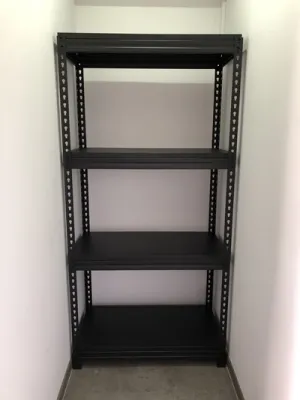
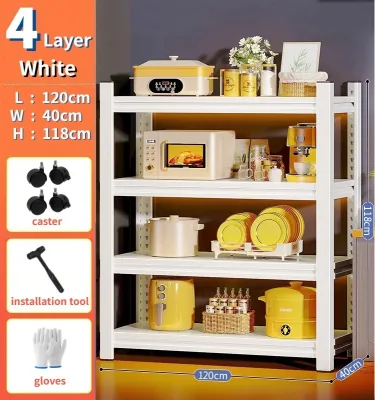
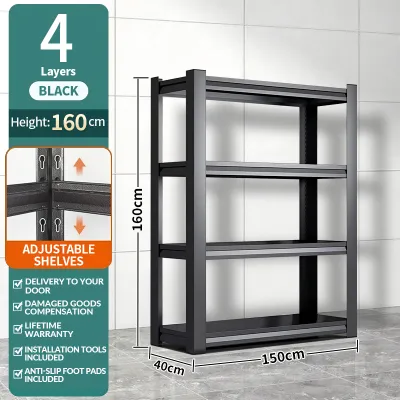
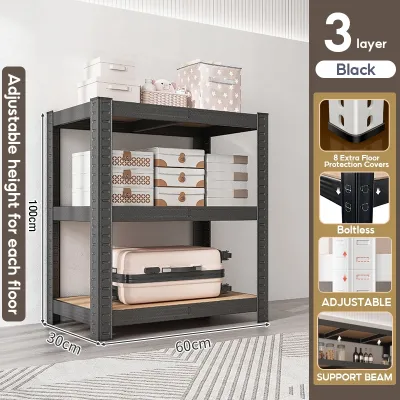
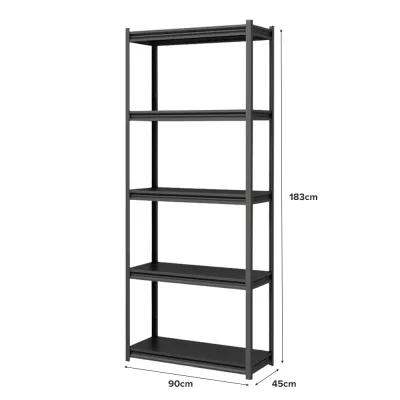
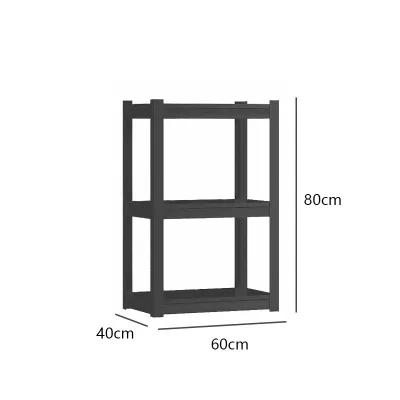
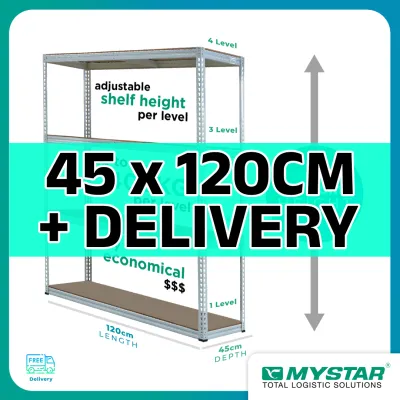
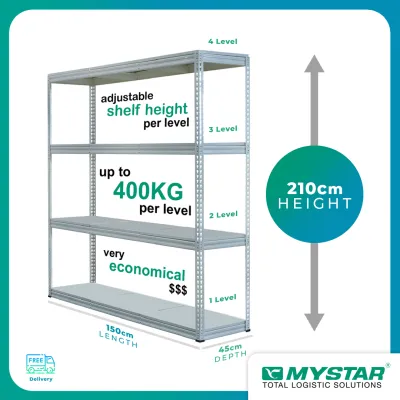
Prices are valid at publication and may change. Please refer to the product page for the latest price.
Vertical clearance is equally important when planning your setup. Measure the height from the floor to the ceiling, taking note of any low-hanging beams, light fixtures, ceiling fans, or sprinkler heads. To ensure you can actually use the top shelf of your boltless rack, leave at least 15 to 20 cm of open space between the top of the rack and the ceiling. This clearance gives you enough room to lift, place, and retrieve items from the highest tier without scraping the ceiling.
Delivery and transport access routes are frequently overlooked but are critical to a successful installation. Boltless racks are delivered in flat packs, but the vertical upright posts are often single, unjointed pieces of steel that can be up to 2.4 meters long. Measure the height and depth of your building’s passenger lift, the width of your corridor, and the clearance of your front door. If you live in an older estate with narrow stairwells or restricted lift access, you must ensure these long metal components can be safely maneuvered into your home.
Finally, plan for operational clearance around the rack once it is assembled. Ensure the unit does not block the swing path of doors, especially the heavy steel doors of HDB bomb shelters, which require complete clearance to open fully. Leave enough walking space in front of the rack so you can stand, bend down, and lift heavy boxes safely. If the rack is placed in a tight corridor or service yard, verify that it does not restrict natural ventilation or block access to windows and clothes drying systems.
Match Rack Dimensions to Your Storage Needs
Selecting the right rack dimensions depends heavily on the size, weight, and shape of the items you plan to store. Standard boltless racks come in various depths, typically ranging from 30 cm to 60 cm. Choosing the wrong depth can lead to inefficient space usage or safety hazards. For instance, a shallow rack of 30 cm to 40 cm is ideal for organizing books, document files, shoes, or small pantry items. These shallower depths keep items visible and prevent things from getting lost at the back of the shelf.

For larger, bulkier items, a deeper shelf is necessary to prevent overhang. If you plan to store large plastic storage tubs, travel luggage, camping gear, or heavy kitchen appliances, opt for a depth of 45 cm to 60 cm. Storing items that overhang the edge of the shelf is a safety hazard, as they can easily be knocked over or destabilize the rack. Measure your largest storage boxes beforehand and select a shelf depth that fully supports their base.
When deciding on the width of your rack, consider both the wall space and the weight distribution of your items. Standard widths usually come in increments such as 90 cm, 120 cm, and 150 cm. If you have a long wall, installing two medium-width racks side-by-side is often more practical than installing one exceptionally wide unit. This configuration provides better structural support and allows you to organize different categories of items more effectively. Always leave a small buffer of 2 to 5 cm on either side of the rack to make assembly and positioning easier.
Maximizing vertical storage is the most effective way to increase capacity in compact Singapore apartments. If your room has a standard ceiling height of 2.6 meters, a rack height of 1.8 meters or 2.1 meters is generally the most versatile choice. This height allows you to utilize four to five tiers of shelving while keeping the top shelf within reach for a person of average height. Reserve the lower shelves for heavy, frequently used items, and use the higher shelves for lightweight, seasonal storage.
One of the main advantages of boltless shelving is the ability to adjust individual shelf heights. The upright posts feature slots spaced at regular intervals, allowing you to position the support beams exactly where you need them. When planning your layout, group items of similar heights together so you can minimize wasted vertical space between shelves. For example, keep a tight spacing for flat storage boxes and a taller spacing for upright vacuum cleaners or golf bags.
Evaluate Load Capacity and Structural Stability
To ensure your storage setup is safe, you must understand how load capacity is calculated and distributed. Manufacturers specify weight limits using Uniform Distributed Load (UDL), which assumes the weight of your items is spread evenly across the entire surface of the shelf. If you concentrate all the weight in the center of a shelf, the board may sag or fail, even if the total weight is well below the maximum limit. Always distribute heavy items evenly from left to right and front to back.
Before purchasing, check the manufacturer’s product specifications or user manual for the exact UDL rating per shelf and the total weight capacity of the entire frame. Do not make assumptions based on the material alone, as steel thickness, beam design, and shelf deck materials (such as fiberboard or metal mesh) greatly affect weight limits. If you plan to store exceptionally heavy items like car spare parts, heavy tools, or large liquid containers, verify that the rack’s rated capacity safely exceeds your estimated load.
Stability is closely tied to the rack’s height-to-depth ratio. A tall, narrow rack has a higher center of gravity and is more susceptible to tipping if it is bumped or loaded incorrectly. As a general safety guideline, if the height of your rack is more than three times its depth, you should secure the unit to a solid wall using anti-tip brackets or wall anchors. This is especially important if you have children or pets in the home, or if the rack is placed in a high-traffic area.
Proper assembly and floor conditions are fundamental to maintaining structural stability. Boltless racks rely on tight, interlocking friction joints rather than screws or bolts. During assembly, use a rubber mallet to tap the horizontal beams firmly into the upright post slots, ensuring they are fully seated. Additionally, verify that your floor is level. Uneven floors, which are common in service yards and balconies, can cause the rack to wobble or lean. Use leveling feet or heavy-duty shims under the posts to ensure the frame stands perfectly upright.
Avoid Common Sizing and Placement Mistakes
One of the most frequent mistakes when buying a boltless rack is failing to account for skirting boards and baseboards. Many homeowners measure the wall-to-wall distance at chest height, only to find that the rack’s metal feet cannot slide all the way back because of the skirting board at the floor level. This leaves an unstable gap behind the rack, preventing it from sitting flush against the wall. Always take your primary measurements at the narrowest point, which is typically at the very bottom of the wall.
Another common error is overestimating the actual usable shelf space. The external dimensions advertised by manufacturers represent the outermost edges of the steel frame. The upright corner posts and horizontal support beams take up several centimeters of space on all sides. Consequently, the actual clear opening width and depth of each shelf will be slightly smaller than the overall external dimensions. If you have storage boxes that match the external dimensions exactly, they will not fit between the upright posts.
Finally, avoid blocking essential utility access points and safety fixtures. In Singapore homes, household shelters often contain electrical distribution boards (DB boxes), fiber termination points, or ventilation sleeves. Never place a large, heavy rack directly in front of these areas. If an electrical emergency occurs or a technician needs to service your internet connection, you must be able to access these panels immediately without having to unload and dismantle a massive shelving unit. Keep a clear path to all switches, meters, and utility valves.
Frequently Asked Questions (FAQ)
Do boltless racks require drilling into the wall?
Standard boltless racks do not require drilling if they are placed on a flat, level floor and loaded correctly with heavier items on the bottom shelves. However, if your rack is exceptionally tall, narrow, or top-heavy, you should secure it to the wall using anti-tip kits or wall anchors to prevent accidental tipping. Always refer to the manufacturer’s guidelines regarding height-to-depth ratios and anchoring requirements.
How much weight can a standard boltless shelf hold?
Weight capacity varies significantly depending on the steel gauge, beam design, and shelf material. You must check the Uniform Distributed Load (UDL) rating printed on the product label or in the manufacturer’s manual for your specific model. Never assume a capacity without verifying, and remember that the weight must be distributed evenly across the shelf surface rather than concentrated in one spot.
Can I add extra shelves to my boltless rack later?
Yes, most boltless racks allow you to add extra shelves if the upright posts have vacant slots and the overall height permits. However, before adding more tiers, you must ensure that the combined weight of all shelves and stored items does not exceed the manufacturer’s maximum total load capacity for the entire frame structure.

Community discussion
Share your experience or ask a question. Comments are reviewed before publication.