
A slim entrance cabinet typically holds between 6 and 18 pairs of shoes, but the actual capacity often falls short of manufacturer estimates. In compact homes where entryway space is at a premium, these narrow storage units are essential for keeping hallways clear. However, because “slim” designs restrict depth to save floor space, the physical dimensions of your footwear—such as sole width, heel height, and overall length—will ultimately dictate how many pairs can fit inside. Understanding how these dimensions interact with different cabinet mechanisms is the key to choosing a unit that actually meets your household’s storage needs.
When shopping for entryway storage, it is easy to be misled by idealized product photos showing rows of neatly aligned, identical shoes. In reality, a typical household possesses a diverse mix of footwear, ranging from flat sandals and low-profile sneakers to bulky running shoes and structured formal wear. To avoid the frustration of buying a cabinet only to find your shoes do not fit, you must look beyond the external dimensions and analyze the internal configuration.
How "Slim" Dimensions Affect What You Can Store
The primary appeal of a slim entrance cabinet is its minimal projection into the hallway, often measuring between 15 cm and 25 cm in external depth. To achieve this ultra-thin profile, manufacturers must depart from traditional flat-shelf designs. Traditional cabinets require a depth of at least 30 cm to 35 cm to store shoes flat and perpendicular to the wall. Slim cabinets, therefore, generally rely on one of two configurations: standard shallow flat shelves where shoes must be placed sideways, or tilt-out (flip-down) compartments where shoes are stored vertically.
Products mentioned in this guide
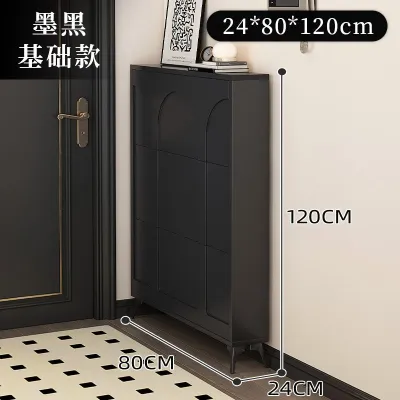
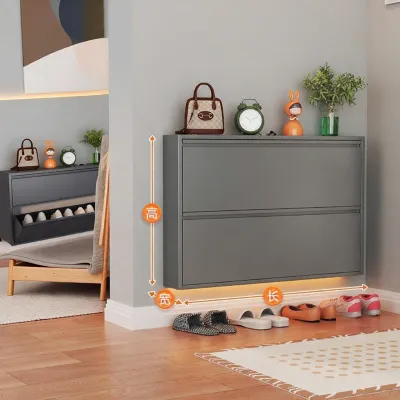
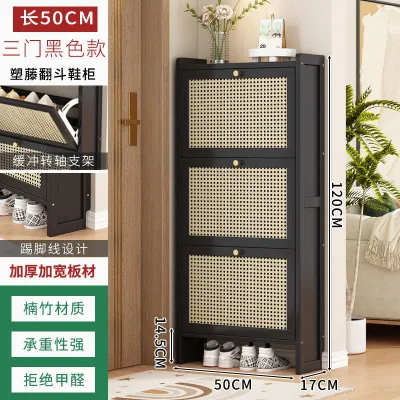
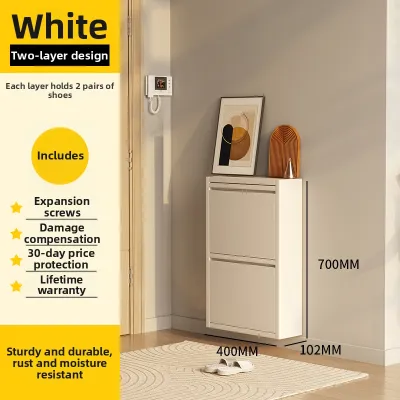
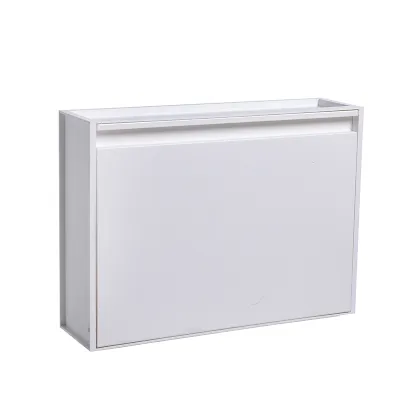
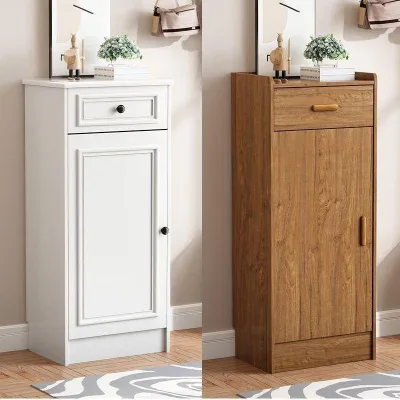
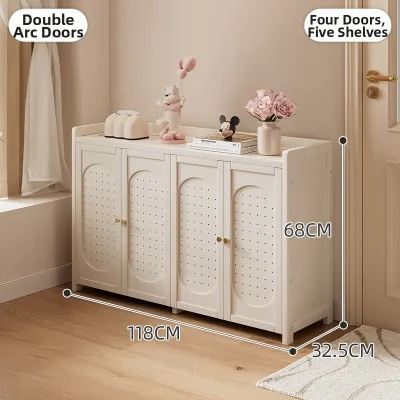
Prices are valid at publication and may change. Please refer to the product page for the latest price.
Tilt-out mechanisms utilize a hinged drawer that rotates outward, allowing shoes to sit at an angle. This design is highly efficient for saving floor space, but it imposes strict limits on the height and thickness of the footwear. High-top sneakers, thick-soled platform shoes, and boots often prevent the tilt-out drawer from closing fully. On the other hand, shallow flat shelves require you to store shoes parallel to the wall. While this accommodates longer shoe sizes, it drastically reduces the number of pairs you can place on each shelf, as a single pair takes up significantly more horizontal width when turned sideways.
Another critical factor is the difference between external depth and internal usable depth. A cabinet advertised with an external depth of 17 cm does not offer 17 cm of storage space. You must subtract the thickness of the back panel, the front door panel, and any internal clearance required for the hinges or tilt-out brackets. This often leaves an actual usable depth of only 13 cm to 14 cm. Before purchasing, always verify these internal measurements against the longest pair of shoes in your household to ensure the doors can close without crushing the heels or toes.
How to Calculate the True Capacity of a Slim Cabinet
To determine how many shoes a slim cabinet will actually hold, you can use a simple calculation method based on your household’s specific footwear. For cabinets utilizing standard flat shelves where shoes are placed normally (perpendicular to the wall, if the depth allows), the horizontal capacity per shelf is determined by dividing the internal usable width by the average width of your shoes.

Let $W_{internal}$ represent the usable internal width of the shelf, and $W_{shoe}$ represent the average width of a single pair of shoes placed side-by-side. The number of pairs per shelf ($P_{shelf}$) can be calculated as:
$$P_{shelf} = \lfloor \frac{W_{internal}}{W_{shoe}} \rfloor$$
For example, if a cabinet has an internal width of 60 cm and your average shoe pair width is 20 cm, you can comfortably fit 3 pairs per shelf. If you must store shoes sideways due to shallow depth, the formula changes. You must divide the internal width by the average length of your shoes ($L_{shoe}$):
$$P_{shelf} = \lfloor \frac{W_{internal}}{L_{shoe}} \rfloor$$
Because shoe length is significantly greater than shoe width, storing shoes sideways on flat shelves drastically reduces your total capacity, often cutting it down to just one or two pairs per tier.
For vertical space on flat shelves, you must calculate the number of tiers that can physically fit. Divide the internal usable height of the cabinet ($H_{internal}$) by the height of your tallest shoes ($H_{shoe}$) plus a minimum clearance of 3 cm to 5 cm ($C$) to allow your hand to reach in and retrieve the shoes:
$$Tiers = \lfloor \frac{H_{internal}}{H_{shoe} + C} \rfloor$$
If the cabinet has fixed shelves, you are bound by the pre-determined tier heights, which may leave wasted vertical space above low-profile flats while failing to accommodate taller sneakers.
For tilt-out drawers, capacity logic is slightly different. These compartments typically feature one or two internal rows per drawer. The capacity depends on whether the drawer has an adjustable internal divider. A single-row tilt-out drawer usually holds 3 to 4 pairs of standard shoes per tier, provided the shoe length does not exceed the diagonal depth of the compartment. If you have larger shoe sizes (such as men’s UK size 9 or above), the shoes may need to be placed at an angle or slightly overlapped, which immediately reduces the advertised capacity by half. Manufacturer claims of “maximum capacity” almost always assume small, flat shoes like ballet flats or children’s shoes, so it is wise to reduce these estimates by 30% to 40% for a realistic household mix.
Essential Space and Clearance Checks Before You Buy
Before finalizing your purchase, you must perform several physical checks in your entryway to ensure the slim cabinet functions properly without creating new obstacles. Start by measuring the exact footprint where the cabinet will stand. Do not forget to account for skirting boards along the base of the wall. If the cabinet does not have a recessed back to accommodate skirting boards, it will not sit flush against the wall, leaving a gap at the top that compromises stability and looks untidy.
Next, consider the clearance required for daily operation. Measure the distance the doors or tilt-out drawers extend into the hallway when fully open. In narrow corridors, an open drawer can completely block foot traffic or collide with adjacent room doors, closet doors, or front entrance gates. Additionally, check for the location of electrical outlets, light switches, and intercom units. A tall, slim cabinet must not block access to these essential wall fixtures.
Because slim cabinets have a very shallow depth and a high center of gravity, they are highly prone to tipping forward when drawers are opened or when heavy shoes are placed inside. Wall anchoring is not optional; it is a critical safety requirement. Before buying, inspect your wall type. If you are mounting to drywall, you will need to locate the wall studs or use heavy-duty hollow-wall anchors. For concrete or brick walls, ensure you have the correct masonry drill bits and wall plugs. If you are renting and cannot drill into the walls, a freestanding slim cabinet may not be a safe option unless it is specifically designed with a wide, weighted base.
Finally, verify the delivery path to your home. Even though the cabinet is slim, the packaging can be long and awkward. Measure your building’s lift doors, elevator interior dimensions, stairwell turns, and your main front door width to ensure the delivery team can safely transport the flat-pack or pre-assembled unit into your home without damaging the walls or the product.
Cabinet Features That Maximize Your Storage Flexibility
To get the most utility out of a restricted slim profile, look for specific design features that offer adaptability. Adjustable or removable internal shelves are highly valuable. As seasons change or your footwear collection evolves, the ability to shift a shelf up or down by a few centimeters can mean the difference between storing a pair of ankle boots inside the cabinet or leaving them cluttered on the floor.
When comparing configurations, consider how you use your entryway. A combination of tilt-out drawers for everyday shoes and a small open bottom shelf for slippers or wet footwear can keep your entryway organized. Open bottom clearances allow you to slide frequently used shoes out of sight quickly without constantly opening and closing cabinet doors.
Ventilation is another crucial but often overlooked feature in shallow, enclosed cabinets. Because slim cabinets tightly enclose the footwear, moisture and odors can quickly accumulate, leading to mold growth and unpleasant smells. Look for cabinets with slatted doors, open back panels, or built-in ventilation grilles. These designs promote continuous airflow, keeping your shoes dry and preserving the indoor air quality of your entryway.
Frequently Asked Questions (FAQ)
Can a slim entrance cabinet hold winter boots or high heels?
Standard slim cabinets with tilt-out drawers generally cannot accommodate tall winter boots or high heels with heels exceeding 8 cm, as the restricted diagonal depth prevents the drawer from closing. However, if the cabinet features adjustable internal dividers or removable shelves, you can customize the space to fit taller footwear. For boots, you may need to store them laying flat on their sides, which significantly reduces the overall capacity of the cabinet. Always check the internal compartment height before purchasing if you plan to store high-heeled shoes or ankle boots.
Do tilt-out shoe cabinets hold more shoes than standard slim shelves?
Yes, tilt-out shoe cabinets typically hold more shoes than standard flat-shelf cabinets of the same shallow depth. Because tilt-out mechanisms store shoes vertically or at an angle, they utilize the cabinet’s height rather than its depth. A standard flat-shelf cabinet with a depth of under 20 cm forces you to store shoes sideways, which wastes horizontal space and limits capacity to just a few pairs. Tilt-out designs maximize every centimeter of width, making them the superior choice for high-capacity storage in ultra-narrow entryways.

Community discussion
Share your experience or ask a question. Comments are reviewed before publication.