
Selecting the right ergonomic chair for a home office in Singapore requires balancing personal physical comfort with the practical realities of residential spaces. The Hinomi H1 Pro V2 has gained attention for its highly adjustable components and space-saving folding design, making it a prominent candidate alongside established ergonomic brands. To determine whether this specific model or an alternative is the best fit for your workspace, you must evaluate how its unique mechanical features, dimensions, and materials align with your daily sitting habits and room layout.
Identifying Your Home Office Ergonomic Requirements
Postural support needs depend heavily on your daily sitting duration and the nature of your tasks. If you spend upwards of eight hours a day at your desk, dynamic support that adapts to micro-movements is essential to prevent fatigue. Conversely, shorter sessions might only require basic height and tilt adjustments. Understanding whether your work involves active typing, creative drawing, or frequent video conferencing will help you identify which parts of your body require the most consistent support throughout the day.
Physical dimensions are the next critical factor to assess before browsing models. You must match your height and weight to the chair’s rated capacity and adjustment ranges. A chair with an unsuitable seat depth can restrict circulation behind your knees or fail to support your thighs, while an incorrect gas lift height range can prevent your feet from resting flat on the floor. Always refer to the manufacturer’s detailed specification sheets to verify these physical limits rather than relying on general size categories.
Products mentioned in this guide
Prices are valid at publication and may change. Please refer to the product page for the latest price.
In Singapore, where home office spaces in HDB flats and condominiums are often compact, measuring your physical environment is just as important as measuring your body. You need to verify the clearance between your desk’s underside and the chair’s armrests to ensure the chair can be tucked away when not in use. Additionally, map out the floor footprint to ensure the caster base has enough room to glide without colliding with nearby walls, wardrobes, or storage units.
Core Comparison Dimensions for Ergonomic Chairs
When comparing ergonomic chairs, the lumbar support mechanism is a primary differentiator. Some chairs feature fixed lumbar curves, while others offer independent, spring-loaded, or height-adjustable lumbar panels. An adjustable system allows you to align the support precisely with your lower back’s natural curve, which is vital for maintaining spinal alignment during long typing sessions. You should check whether the lumbar support moves with you as you recline or remains in a fixed position.

The overall adjustability range determines how well a chair customizes to different tasks. Look for 4D armrests that adjust in height, angle, width, and depth to support your forearms without straining your shoulders. Seat slide adjustments are equally important, allowing you to slide the seat pan forward or backward to accommodate different leg lengths, while backrest recline tension controls how easily the chair tilts back. A wide range of locking positions is beneficial if you prefer to switch between upright focus and relaxed reclining.
Upholstery materials directly impact daily comfort, especially in Singapore’s warm and humid climate. All-mesh chairs offer superior breathability, allowing air to circulate and keep you cool without relying constantly on air conditioning. However, you must check the mesh quality and tension; low-quality mesh can sag over time, whereas high-tension, elastomeric mesh maintains its shape. Fabric-cushioned seats offer a softer, more traditional feel but require regular vacuuming and spot cleaning to manage sweat and dust accumulation.
The base and caster design dictates stability and floor protection. Heavy-duty nylon or aluminum bases provide the structural integrity needed to support high weight capacities. You must also check the caster material; soft polyurethane (PU) casters are ideal for protecting delicate parquet or vinyl flooring from scratches, while hard nylon casters are better suited for carpeted areas. Ensure the caster glide is smooth and quiet to avoid disturbing others in your household.
Evaluating the Hinomi H1 Pro V2 Against Alternatives
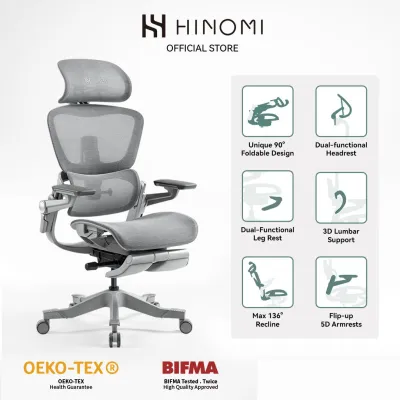
The Hinomi H1 Pro V2 distinguishes itself through specific design choices that you should verify against alternative ergonomic chairs. One of its most notable features is the foldable backrest, which reduces the chair’s vertical profile so it can fit under low desks or in tight storage spaces. If you operate in a multi-purpose room where visual clutter must be minimized, this folding mechanism is a distinct practical advantage that many traditional ergonomic chairs lack.
You should carefully verify the adjustment mechanisms of the H1 Pro V2, including its multi-panel lumbar support system and the specific locking angles of the recline. Compare these specifications with competing models in the same category, noting whether the lumbar tension is self-adjusting or manually customizable. Some users prefer a highly pronounced lumbar push, while others find a gentler, flatter support curve more comfortable over long periods.
Weight capacity and physical footprint are critical points of comparison. Check the manufacturer’s specifications to ensure the chair’s frame and gas lift are rated for your body weight, and compare these figures with alternative heavy-duty office chairs. The H1 Pro V2’s footprint should be measured against your available floor space, keeping in mind that highly adjustable chairs often have wider bases to maintain stability when fully reclined.
Accessories can significantly alter the value proposition of an ergonomic chair. Determine whether features like an integrated leg rest, an adjustable headrest, or specialized armrest pads are included as standard components or require additional purchases. If you plan to use your home office chair for both active work and relaxed reading or viewing, an integrated leg rest can be a valuable addition, provided your room layout allows for the extra clearance when extended.
Finally, review the manufacturer’s warranty terms and the availability of local customer service in Singapore. A long warranty period is only beneficial if the claim process is straightforward and replacement parts are stocked locally. Check if the warranty covers the mesh and moving mechanisms for the entire duration, and verify whether you are responsible for transporting the chair to a service center or if on-site repair options are available.
Practical Considerations for Residential Delivery and Assembly
Before finalizing your purchase, you must plan for the physical delivery of the chair into your home. Singapore high-rise apartments often present logistical challenges, such as narrow passenger lifts, tight corridor corners, and standard door frames. Verify the packaged dimensions of the chair with the retailer to ensure the box can easily clear these pathways without causing damage to your walls or the product itself.
Assembly requirements vary widely between brands and can impact your overall experience. Some ergonomic chairs are delivered fully assembled, while others arrive flat-packed and require self-assembly. If you choose the DIY route, check if the necessary tools are included in the package and verify if the manufacturer provides clear video guides. Alternatively, check if professional assembly services are offered by the local distributor and whether this service incurs an extra fee.
Understanding the return policy is essential when buying a chair online without a physical trial. Look for brands that offer a home trial period, allowing you to test the chair’s comfort in your actual working environment. Be sure to read the fine print regarding return conditions: check if you must retain the original packaging, whether assembled chairs are eligible for return, and if restocking or return transportation fees will be deducted from your refund.
Decision Framework: Choosing the Right Chair
To make your final decision, use a structured framework based on your verified physical and spatial requirements. The Hinomi H1 Pro V2 is highly suitable if you require a space-saving design with a foldable backrest, comprehensive adjustability, and a breathable mesh construction tailored for Singapore’s climate. Its multi-panel lumbar support and integrated accessories make it a strong contender if you value a highly customizable, all-in-one seating solution.
On the other hand, you should consider competing alternatives if you prefer a traditional, thickly cushioned seat pan over a full-mesh design, or if you require a simpler, less pronounced lumbar support system. Additionally, if your body dimensions fall outside the standard adjustment ranges of the H1 Pro V2, a specialized chair designed specifically for very petite or exceptionally tall profiles may offer a more ergonomic fit.
Always prioritize verifying the exact model version, local warranty terms, and return policies before completing your transaction. By matching your personal comfort preferences and home office dimensions against these objective criteria, you can secure an ergonomic chair that supports your health and productivity for years to come.
Frequently Asked Questions (FAQ)
How do I know if an ergonomic chair fits my desk height?
To ensure a proper fit, first measure the distance from your floor to the underside of your desk surface. Next, check the chair’s specifications for its maximum armrest height when fully raised. For optimal ergonomics, your elbows should rest at a 90-degree angle with your forearms supported by the armrests, level with your keyboard. Ensure there is sufficient clearance between the top of your thighs and the underside of the desk or keyboard tray when the seat is adjusted to your ideal height.
What should I check on the chair's warranty before buying?
When reviewing the warranty, identify exactly which components are covered under the stated period, as manufacturers often have different coverage durations for the structural frame, the gas lift, the mesh or fabric, and the caster wheels. Clarify whether self-assembly voids any part of the warranty, or if professional assembly is required to keep the coverage intact. Finally, confirm the local claim process, checking if you are required to pay for shipping parts or if a local distributor handles repairs at your residence.

Community discussion
Share your experience or ask a question. Comments are reviewed before publication.