
Finding a wardrobe brand in Singapore that delivers a full assembled cupboard suitable for HDB bedrooms requires balancing structural integrity with strict spatial limits. While many international retailers focus on flat-pack furniture that you must build yourself, several local furniture brands, custom carpentry firms, and established showrooms across Singapore specialize in delivering fully assembled wardrobes or providing professional on-site assembly that functions identically to a factory-finished unit. Choosing these options ensures you bypass the complexity of self-assembly while securing a structurally stable piece of furniture. However, because HDB bedrooms feature standardized entryways, low ceilings, and tight corridors, selecting the right brand involves verifying delivery logistics, structural joints, and exact clearance dimensions before making a purchase.
Understanding HDB Bedroom Dimensions and Space Constraints
Measuring the floor footprint is the first critical step when planning to install a full assembled cupboard. Do not simply measure wall-to-wall; you must account for skirting boards, which typically protrude 1.5cm to 2cm from the wall, reducing the actual floor width and depth available for the wardrobe. Additionally, look out for wall unevenness and built-in air-conditioning trunking. Air-con trunking often runs along the top or corners of HDB bedroom walls, which can completely block a tall, fully assembled wardrobe from sitting flush against the wall, leaving unsightly and dust-gathering gaps.
Power sockets and light switches are another common obstacle in HDB bedrooms. These outlets are typically positioned along the lower walls, and if a wardrobe covers them, you lose access to essential power sources. Furthermore, the thickness of a plug head can prevent the wardrobe from being pushed back against the wall. Measure the height and depth of these outlets and compare them to the wardrobe’s base design. Some brands offer recessed back panels or elevated plinths that clear these obstacles, while others require you to leave a gap between the wardrobe and the wall.
Products mentioned in this guide
![[INNDESIGN.SG] Rey 3 Doors Wardrobe + Mirror + Drawer (Fully Assembled and Free Delivery)](https://img.lazcdn.com/g/p/5d53f103a5e2f003c5c6c97e2fbd2a21.jpg_400x400q80.jpg_.webp)
![SG Ready stock Free Installation] Metal Cabinet / Steel Full height Swing door cupboard SY204L](https://img.lazcdn.com/g/p/72ec2942701747a429a65b9d4a50016f.jpg_400x400q80.jpg_.webp)
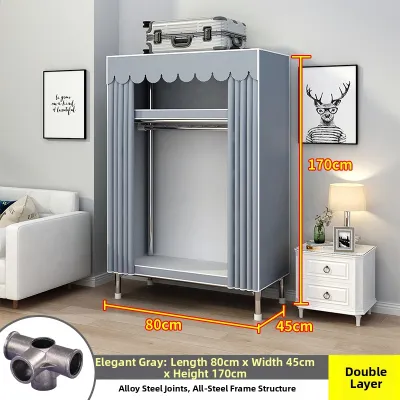
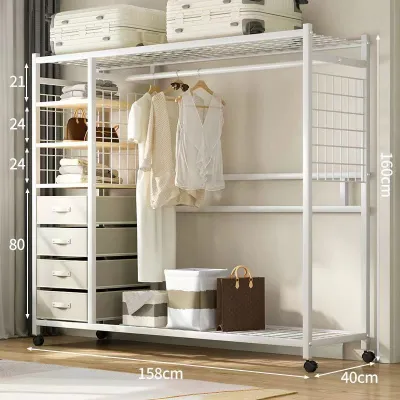
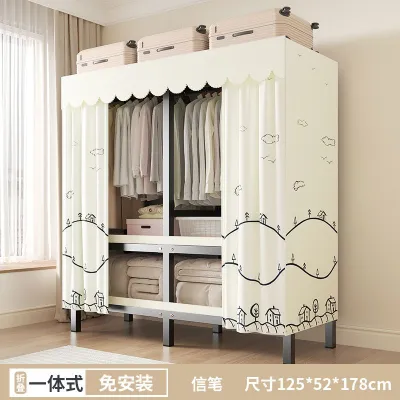

Prices are valid at publication and may change. Please refer to the product page for the latest price.
Door swing and window clearance must also be mapped out carefully. A fully assembled cupboard with hinged doors requires significant clearance in front of it to open fully. Map out the swing radius of the wardrobe doors alongside the bedroom’s entry door and any built-in bathroom doors. Ensure that opening the wardrobe does not block the main pathway or collide with your bed frame. Windows must also be considered; a tall wardrobe placed too close to a window can block natural light or obstruct window handles and safety grilles.
Ceiling height and fixtures are the final spatial constraints to evaluate. Standard HDB ceiling heights generally range from 2.6 meters to 2.8 meters, but false ceilings or structural beams can reduce this clearance significantly. When buying a tall, fully assembled wardrobe, you must ensure there is enough vertical clearance not only for the wardrobe to stand upright but also for the delivery team to lift and position it. Furthermore, check the location of ceiling fans and light fixtures. A wardrobe that is too tall or placed too close to a ceiling fan can create a safety hazard or block light distribution across the room.
The Logistics of Moving Fully Assembled Cupboards into HDB Flats
The journey from the delivery truck to your bedroom is the most critical phase for a fully assembled cupboard. Unlike flat-pack items, a pre-assembled wardrobe cannot be angled around tight corners in pieces. You must measure the HDB lift doors, the interior lift cabin height and depth, and the lift lobby corridors. If your flat is located at the end of a long corridor with a sharp turning radius, a long or bulky wardrobe may get wedged during transport, making delivery impossible.

Once inside the lift lobby, the wardrobe must pass through your flat’s main gate, main door, and the specific bedroom door. Standard HDB bedroom door frames are often narrower than main entrance doors, sometimes measuring as little as 75 to 80 centimeters in clear width. If the wardrobe’s depth or width exceeds this measurement, it cannot enter the room. Measure the clear opening width, which is the distance from the inner edge of the door frame to the face of the open door leaf, as the door itself can restrict the passage space.
Understanding retailer delivery policies and fees is essential to avoid unexpected costs. In Singapore, many furniture brands charge a standard delivery fee, but this often assumes seamless lift access. If the fully assembled wardrobe cannot fit into the lift and must be carried up the stairs, retailers typically impose a stair-carry charge, often calculated per item per floor (such as S$10 to S$20 per floor). You must clarify these rates beforehand to avoid disputes on delivery day.
It is equally important to establish who bears the financial responsibility if the wardrobe cannot fit into your home. Some retailers charge a hefty restocking fee—sometimes up to 20% to 30% of the purchase price—plus non-refundable delivery charges if an item must be returned due to access issues. Always ask the brand for their specific policy on failed deliveries caused by spatial constraints, and secure these terms in writing on your invoice or order confirmation.
Key Criteria for Evaluating Wardrobe Brands and Retailers
When searching for wardrobe brands in Singapore, prioritize those that provide highly detailed, transparent technical specifications. A reliable brand should offer comprehensive dimension diagrams on their product pages or in-store catalogs, showing not just the overall height, width, and depth, but also the internal clearances, plinth heights, and door panel thicknesses. This level of detail allows you to plan your room layout with millimeter-level accuracy.
Visiting physical showrooms is highly recommended when purchasing a fully assembled cupboard. Online photos can easily mask structural weaknesses, poor door alignment, or cheap hardware. In a showroom, you can physically test the wardrobe: open and close the doors to check the smoothness of the hinges or sliding tracks, apply gentle pressure to the sides to assess lateral stability, and inspect the quality of the internal joints. Look for brands that use robust joining mechanisms rather than simple glue and staples.
Examine the materials and construction methods used by the brand. Fully assembled wardrobes are subject to significant stress during transport, so they require sturdy frames. Look for brands that utilize high-density engineered wood, solid wood, or reinforced plywood with durable edge banding. The back panel should be securely grooved or screwed into the frame, rather than tacked on with thin nails, as a sturdy back panel prevents the wardrobe from racking or warping over time.
Finally, scrutinize the brand’s return, exchange, and warranty policies. A reputable retailer should offer a clear warranty period covering structural defects, door alignment issues, and hardware failures (such as drawer runners and door hinges). Be cautious of brands that offer no return policy or charge exorbitant fees for exchanges. Understanding these terms protects your investment and ensures that you can resolve any structural issues that arise after the wardrobe is placed in your HDB bedroom.
Design and Functional Features for HDB Environments
The choice between sliding doors and hinged doors is a critical design decision for compact HDB bedrooms. Sliding doors are highly space-efficient because they do not require any clearance in front of the wardrobe to open, making them ideal for narrow rooms where the bed is placed close to the cupboard. However, sliding door mechanisms take up about 5cm to 10cm of the wardrobe’s internal depth. Hinged doors, on the other hand, offer full access to the wardrobe’s interior simultaneously but require a clear swing zone, which can restrict traffic flow in a small room.
Internal storage configurations must be highly functional to maximize the limited footprint of an HDB bedroom. Look for wardrobes that offer adjustable shelving and customizable hanging rails. This flexibility allows you to adapt the interior layout as your wardrobe needs change, whether you need more hanging space for long dresses or extra shelves for folded items. Deep drawers are also useful, but ensure they can pull out fully without hitting nearby furniture like bedside tables.
Singapore’s humid tropical climate poses unique challenges for wooden furniture, making material selection and surface treatments vital. High humidity can lead to mold growth, warping, and the swelling of untreated engineered wood. When evaluating wardrobes, check the manufacturer’s labels for moisture-resistant finishes, such as melamine laminates or protective lacquers. Ensure that all exposed edges, including the back and bottom of the wardrobe, are fully sealed with edge banding to prevent moisture from penetrating the core material.
Your Pre-Purchase Verification Checklist
To ensure a seamless purchase and delivery process, compile a comprehensive pre-purchase verification checklist. Start by re-measuring your designated bedroom space and comparing it against the wardrobe’s official specification sheet. Do not rely on memory or rough estimates; use a metal measuring tape and measure at multiple points (top, middle, and bottom of the wall) to account for any wall curvature or uneven flooring.
Next, map out the entire delivery pathway from the unloading bay to your bedroom. Walk the route with a tape measure, checking the narrowest points of the corridors, lift doors, main gate, and bedroom doors. Remove any temporary obstacles in your home, such as shoe racks, console tables, or wall decorations, that could obstruct the delivery team or risk being damaged during the carry.
Finally, obtain written confirmation of the delivery scope from the retailer before finalizing your order. Ensure the invoice explicitly states that the delivery includes transporting the fully assembled wardrobe into your specific bedroom, positioning it in its final spot, and removing all packaging materials. Clarify any potential additional charges, such as weekend delivery surcharges or disposal fees for old furniture, so there are no surprises when the delivery team arrives.
Frequently Asked Questions (FAQ)
What happens if a fully assembled wardrobe cannot fit through my HDB door?
If a fully assembled wardrobe cannot fit through your HDB door, the delivery team will typically reject the delivery and return the item to the warehouse. Depending on the retailer’s terms and conditions, you may forfeit your delivery fee and be subject to a restocking fee, which can range from 10% to 30% of the wardrobe’s purchase price. In some cases, if the wardrobe is custom-made or non-refundable, you may not receive a refund at all. To avoid these costly outcomes, it is imperative to perform rigorous pathway measurements and consult with the brand’s customer service team regarding clearance requirements before placing your order.
Are fully assembled wardrobes generally more durable than flat-pack options?
Fully assembled wardrobes often exhibit greater structural durability than flat-pack options, primarily due to their construction methods. Factory-assembled units are typically put together using specialized machinery, industrial-grade adhesives, and heavy-duty dowels or joints that provide superior lateral stability and resistance to warping. Flat-pack furniture, which relies on cam-locks and screws tightened by hand, can loosen over time or suffer damage during disassembly and reassembly. However, the ultimate durability of any wardrobe depends on the quality of the base materials, the thickness of the panels, and how well the unit is protected from local humidity and physical strain.

Community discussion
Share your experience or ask a question. Comments are reviewed before publication.