
Foldable utility carts offer an exceptionally versatile storage solution for small Housing & Development Board (HDB) flats in Singapore. As living spaces become more compact, maximizing floor area requires organizational tools that can adapt to changing daily needs. These mobile, multi-tiered trolleys provide immediate, accessible storage when unfolded, yet they can easily collapse into a slim profile to be tucked away when not in use. Finding the ideal cart involves evaluating how its physical dimensions, folding mechanism, and structural build align with your specific household layout. By focusing on practical design features rather than generic material labels, you can select a durable organizer that keeps your home tidy and your walkways clear.
Key Selection Criteria for Space-Constrained HDB Flats
When living in a compact HDB flat, every square centimeter of floor space must be managed carefully to maintain a comfortable living environment. Before purchasing a foldable utility cart, compare its fully unfolded footprint against the available floor area in your target room. Walkways in high-traffic zones, such as the kitchen or service yard, should ideally maintain a clear width of at least 90 centimeters to allow residents to pass without bumping into furniture. A cart that is too wide or deep will quickly become a physical obstacle, disrupting the flow of your daily household routines.
The physical weight of the utility cart itself is another critical factor that directly influences how often you will utilize its folding capabilities. If a cart is excessively heavy, lifting and collapsing it becomes a chore, which often results in the cart being left permanently unfolded in a crowded corner. Look for lightweight frames that you can comfortably lift, carry, and fold with one hand. Aluminum frames or lightweight steel alloys offer a practical balance of structural strength and manageable weight for daily handling.
Products mentioned in this guide
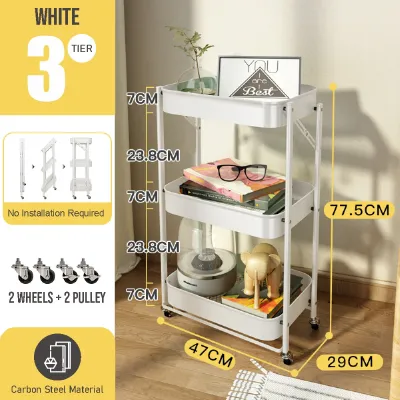
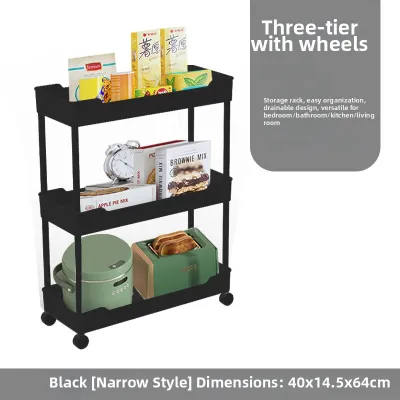
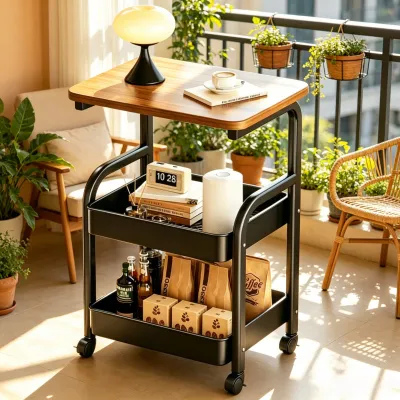
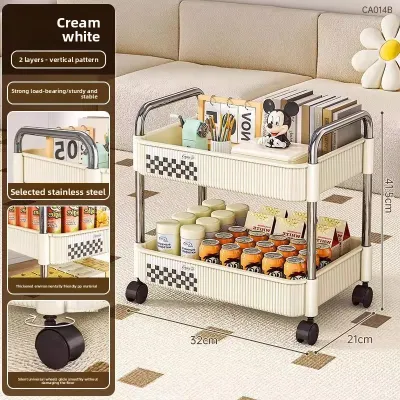
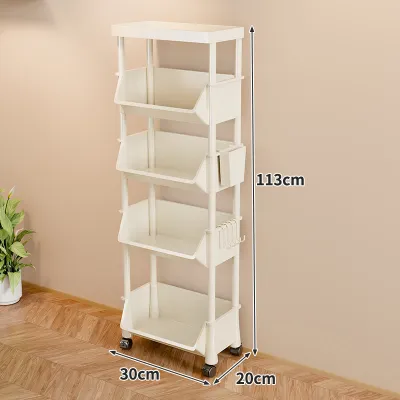
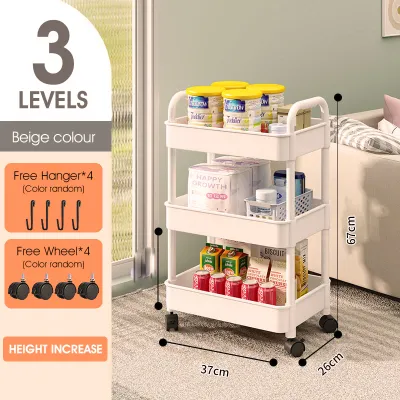
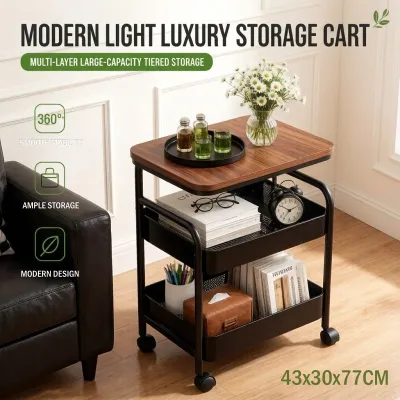
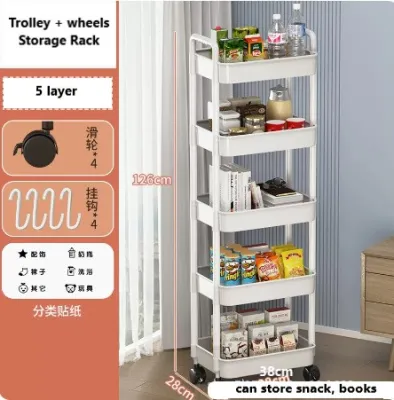
Prices are valid at publication and may change. Please refer to the product page for the latest price.
Tier configurations and shelf designs determine how effectively you can organize your belongings. Most standard utility carts feature three tiers, which provide a good balance of vertical storage without becoming top-heavy or difficult to steer. Some models offer adjustable shelves or removable baskets, allowing you to customize the height clearance between tiers to accommodate taller items like laundry detergent bottles, kitchen appliances, or pantry canisters. If you choose a model with fixed tiers, measure your tallest items beforehand to ensure they will fit comfortably on the lower shelves.
Rather than relying on generic material names like carbon steel or heavy-duty plastic as a guarantee of durability, evaluate the actual surface treatments and joint construction. In Singapore’s humid climate, metal components are highly susceptible to rust, especially when used in damp areas like the bathroom or service yard. Look for carts with thick powder-coated finishes or epoxy coatings that seal the underlying metal from moisture. Inspect the joints, hinges, and rivets; they should feel solid and operate smoothly without excessive play or wobbling, which indicates a robust build capable of surviving hundreds of folding cycles.
Evaluating Folding Mechanisms and Collapsed Dimensions
The efficiency of a foldable utility cart depends heavily on its folding style and how tightly it collapses. The two primary designs available on the market are panel-fold and accordion-fold mechanisms. Panel-fold carts typically collapse from side to side, reducing the width of the cart to a mere few centimeters while keeping the original height and depth intact. This flat, board-like shape is exceptionally well-suited for sliding into narrow vertical gaps, such as the space between a refrigerator and a kitchen wall, or behind a bedroom door.

In contrast, accordion-fold designs collapse inward from all four corners toward the center, resulting in a compact, square column. While these models often require slightly more floor space when collapsed compared to flat-folding panels, they are highly stable when folded and can easily stand upright on their own. This makes them ideal for storage inside deep utility closets, under-sink cabinets, or the bottom of a wardrobe. Consider where you plan to hide the cart when it is idle, and choose the folding style that matches the geometry of that specific storage spot.
A practical folding cart must feature an intuitive, user-friendly collapsing mechanism that does not require complex tools or excessive physical strength. Look for models equipped with a central pull-ring, a single-release button, or a simple slide-latch that allows you to collapse the entire frame in one smooth motion. Once the cart is collapsed, a secure locking mechanism—such as a heavy-duty plastic clip, a magnetic latch, or a physical hook—is essential to keep the frame tightly bound. Without a reliable lock, the cart may spring open unexpectedly while you are carrying it or sliding it into a tight gap.
Before making a purchase, measure the exact clearance of your intended storage gaps and compare them to the cart’s collapsed dimensions. A gap that is exactly ten centimeters wide will not comfortably accommodate a cart with a collapsed thickness of ten centimeters; you need at least two to three centimeters of extra clearance to slide the cart in and out without scratching your walls or neighboring appliances. Additionally, pay close attention to potential pinch points along the folding joints. High-quality designs incorporate safety guards or covered hinges to protect your fingers from getting caught during the folding and unfolding process.
Assessing Load Capacity, Stability, and Mobility
Balancing storage capacity with structural safety is crucial when using a mobile cart in a busy household. Always check the manufacturer’s specified weight limits, which are typically detailed as a maximum load capacity per tier as well as an overall weight limit for the entire cart. Exceeding these limits can warp the frame, misalign the folding hinges, and make the cart incredibly difficult to steer. To maintain structural integrity, distribute your items evenly across all tiers, placing the heaviest items on the bottom shelf to keep the center of gravity low and prevent tipping.
The quality and material of the caster wheels play a major role in both the mobility of the cart and the preservation of your home’s flooring. HDB flats commonly feature ceramic tiles, vinyl planks, or polished concrete floors, all of which can be easily scratched or scuffed by cheap, hard plastic wheels. Look for carts equipped with non-marking rubber, polyurethane, or thermoplastic elastomer (TPE) wheels. These materials provide excellent shock absorption, glide quietly over tile grout lines, and grip the floor securely without leaving unsightly black marks.
A reliable braking system is a non-negotiable safety feature for any utility cart, especially when it is loaded with heavy or fragile items. Ensure that at least two of the four caster wheels are equipped with independent, foot-operated brakes. The brakes should lock both the rotation of the wheel and the swivel mechanism of the caster fork. This dual-locking action ensures that the cart remains completely stationary when parked, preventing it from drifting on slightly uneven floors or rolling away if accidentally bumped by children or pets.
The overall stability of the cart is determined by its base width relative to its height and center of gravity. Tall, narrow carts are highly susceptible to tipping over when they encounter floor transitions, such as the metal thresholds between rooms or the drainage grates in service yards. A wider wheel base provides a more stable foundation, reducing the risk of accidental tipping. When maneuvering a fully loaded cart, always push it slowly from the middle frame rather than pulling it from the top shelf, as pulling from the top can easily destabilize a tall cart.
Practical Storage and Organization Strategies
To get the most out of your foldable utility cart, establish a clear organization system based on how frequently you use your stored items. Grouping items into distinct zones makes daily tasks much more efficient. For example, if you use the cart as a mobile kitchen prep station, place your daily cooking oils, salt, and frequently used spices on the top tier for immediate access. The middle tier can hold moderate-use items like mixing bowls or measuring cups, while the bottom tier is best reserved for heavy, bulky items like bags of rice, potatoes, or small kitchen appliances.
When the cart is deployed, you can easily expand its storage capacity by utilizing its vertical sides. Many utility carts feature mesh or wire-grid shelves, which are perfect for attaching S-hooks, clip-on plastic cups, or magnetic spice tins. Hanging items like dish towels, oven mitts, scissors, or cleaning brushes on the exterior of the cart frees up valuable shelf space for larger items. This strategy is particularly effective in small HDB bathrooms or service yards, where wall space is limited and vertical organization is key.
Maintaining the longevity of your foldable cart requires establishing a safe and gentle routine for folding and unfolding. Never force a stiff folding mechanism; if the frame resists collapsing, stop immediately and check for trapped debris, loose screws, or misaligned joints. Regularly wipe down the folding tracks and hinges with a damp cloth to remove dust and lint, and apply a small amount of silicone-based lubricant to the pivot points if the action begins to feel rough or squeaky.
Finally, plan a designated parking spot for your cart when it is in use to ensure it does not block essential pathways. In Singapore, keeping common corridors and internal walkways clear is not just a matter of convenience, but also a critical fire safety requirement. The cart should never be parked in front of the main entrance, narrow hallways, or the doorway of your household shelter. When the cart is not actively needed, collapse it immediately and store it in its designated gap to keep your living areas open, spacious, and safe.
Pre-Purchase Checklist and Space Measurement
Before ordering a foldable utility cart from an online marketplace, complete a thorough physical measurement of your home to avoid sizing mismatches. Do not rely on visual estimates; use a metal tape measure to record the exact height, width, and depth of the gap where you plan to store the collapsed cart. Remember to account for hidden obstructions such as wall baseboards, electrical outlets, water pipes, or door hinges, which can reduce the actual usable width of a storage gap by several centimeters.
Next, verify the clearance of your delivery route to ensure the package can easily reach your flat. Measure the width of your HDB main door, outer metal gate, and the lift entrance. While most foldable carts are shipped flat-packed in relatively slim boxes, verifying these dimensions ensures that you will not face any unexpected handling difficulties upon delivery. If you live in an older HDB estate with narrower lift doors, double-checking these measurements is especially important.
When shopping on e-commerce platforms, pay close attention to the retailer’s return and exchange policies. Sizing mismatches are a common reason for product returns, but some sellers do not accept returns once the product packaging has been opened or assembly has begun. Read the product specifications carefully, paying close attention to both the fully unfolded dimensions and the collapsed dimensions. If the listing does not clearly state the collapsed thickness of the cart, contact the seller directly to confirm this measurement before placing your order.
Lastly, confirm the assembly requirements of the cart before it arrives. Some foldable carts are delivered fully assembled and only require you to pop the wheels into place, while others require complete self-assembly of the frame, shelves, and folding joints. If assembly is required, check whether the package includes the necessary basic tools, such as a small wrench or an Allen key. Ensuring you have the correct tools on hand allows you to tighten all screws and bolts securely, which is vital for maintaining the structural alignment and safety of the folding mechanism.
Frequently Asked Questions (FAQ)
Can I leave a foldable utility cart permanently unfolded in a small HDB kitchen?
Yes, you can leave a foldable utility cart permanently unfolded if you have a dedicated spot for it, but doing so defeats the primary space-saving benefit of its collapsible design. If you choose to keep it deployed, ensure that the wheel brakes are securely locked to prevent the cart from rolling during meal preparation. However, if you find that you never actually fold the cart and it remains stationary in a single corner, a traditional, non-folding static shelf unit might offer greater structural rigidity and a higher weight capacity at a similar price point.
Are fabric-sided foldable carts suitable for storing heavy pantry items?
Fabric-sided foldable carts are generally not recommended for storing heavy, dense pantry items like canned goods, large bottles of cooking oil, or heavy bags of rice. The soft fabric tiers tend to sag under heavy loads, which can pull the folding frame inward, destabilize the cart, and make it highly prone to tipping. For heavy pantry storage, opt for a rigid-tier cart made of powder-coated steel or reinforced plastic, which distributes weight evenly across the frame and maintains its structural shape under heavy loads.

Community discussion
Share your experience or ask a question. Comments are reviewed before publication.