
Finding a three-seater fabric sofa that fits a Singapore Housing & Development Board (HDB) living room requires balancing seating capacity with strict spatial constraints. While standard international three-seaters often overwhelm typical Build-To-Order (BTO) or resale layouts, several local and regional furniture brands cater specifically to these compact footprints. The key is identifying brands that offer scaled-down proportions—specifically models with a total length under 2.1 meters and a shallow depth—without sacrificing comfort. By focusing on smart design features like slim armrests, elevated legs, and high-performance fabrics suited for Singapore’s humid climate, you can secure a spacious three-seater that preserves your living room’s flow and visual openness.
Assessing Your HDB Living Room Layout and Clearances
Newer HDB flats, particularly three-room and four-room BTO layouts, often feature living areas with a wall-to-wall width of 3.0 to 3.4 meters. In these compact spaces, every centimeter of floor area directly impacts daily comfort and movement. To maintain a natural traffic flow, a primary walkway should ideally measure between 60 and 75 centimeters in width. If a sofa is too deep or too long, it can easily encroach on these pathways, making the room feel cramped and obstructing access to adjacent areas like the dining zone, balcony, or household shelter door.
Standard global three-seater sofas frequently range from 2.2 to 2.4 meters in length, with depths often exceeding 95 centimeters. In a typical HDB living room, a sofa of this scale leaves very little room for side tables or comfortable clearance on either side. Conversely, an HDB-scaled three-seater typically keeps its overall length between 1.8 and 2.0 meters, with a streamlined depth of 80 to 88 centimeters. This subtle reduction in footprint preserves precious floor space while still comfortably accommodating three adults.
Products mentioned in this guide
![[SG SELLER] Premium High Quality 3 Seater Sofa Fabric Sofa Scandinavian Inspired Design | High Quality | Bedroom | Compact | Living Room | Fabric Sofa Bed | High-End | Comfortable | Durable | Designer | Luxury | HomeAndStyle | Home And Style](https://img.lazcdn.com/g/p/8af34f1e28bb4bb5e36a9c766e2a1895.jpg_400x400q80.jpg_.webp)
![[SG OPEN BOX SALE] Premium Quality 3 Seater Sofa Fabric Sofa Scandinavian Inspired Design | High Quality | Bedroom | Compact | Living Room | Fabric Sofa Bed | High-End | Comfortable | Durable | Designer | Luxury | HomeAndStyle | Home And Style](https://img.lazcdn.com/g/p/043e37ddaf58a118eb332e2d01ec2eeb.jpg_400x400q80.jpg_.webp)
![[SG Seller] Fabric Sofa Bed 3 Seater Sofabed Fast Delivery From Singapore. Free Assembly. High Quality Sofas and Sofabeds. 1 Year Warranty. Fast Delivery from Singapore.](https://img.lazcdn.com/g/p/348901f321b96fa2ba1866c7a1619f40.jpg_400x400q80.jpg_.webp)
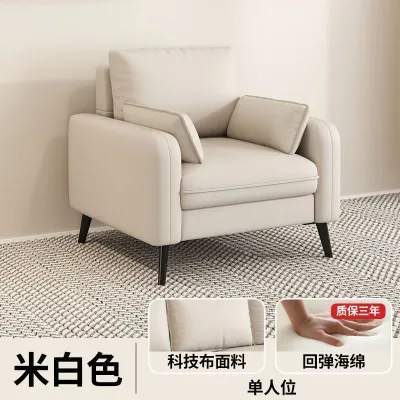
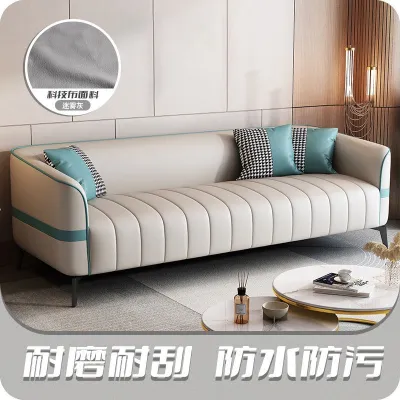
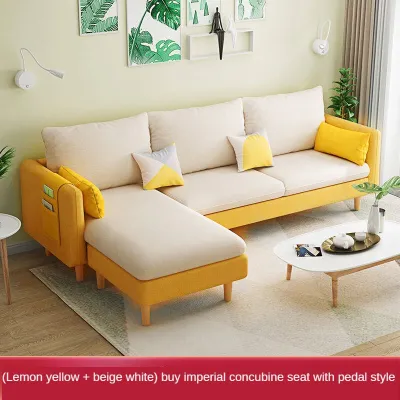
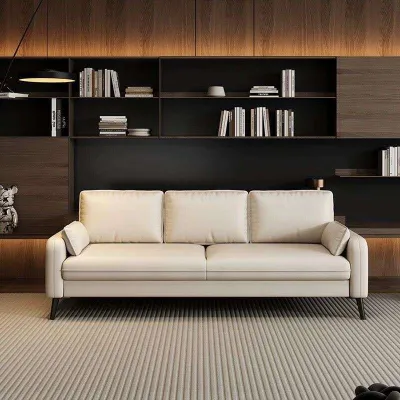
Prices are valid at publication and may change. Please refer to the product page for the latest price.
Beyond physical dimensions, the visual weight of a sofa heavily influences how spacious a room feels. A bulky, block-style sofa that sits directly on the floor absorbs light and blocks sightlines, making a compact living room feel significantly smaller. Choosing a model with a shallower depth and a more streamlined silhouette ensures that the sofa does not dominate the room visually, maintaining an airy and balanced aesthetic.
Key Dimensions to Check for a Compact 3-Seater
When shopping for a three-seater in Singapore, the total length is the first filter to apply. For most modern HDB layouts, a maximum length threshold of 2.0 to 2.1 meters is highly recommended. Keeping the sofa within this limit ensures you have sufficient clearance on at least one side to access balconies, corridors, or dining areas without having to squeeze past the furniture. It also allows for the placement of a small side table or a floor lamp to enhance the room’s functionality.

When measuring the wall where the sofa will sit, do not just measure the total wall length. Take note of any structural pillars, electrical outlets, light switches, or the DB box (distribution board) door. If your sofa is too long, it might block access to these essential features. Additionally, if you plan to place a standing fan, air purifier, or side table next to the sofa, you must subtract their widths from the available wall space before determining the maximum sofa length. A 1.8-meter sofa is often the sweet spot for 3-room and 4-room flats, leaving about 40 to 60 centimeters of breathing room on either side of a standard 2.4-meter wall.
Overall depth is arguably more critical than length when it comes to maintaining circulation space. If your living room width is around 3 meters, a sofa with a depth of 100 centimeters leaves only 2 meters for the coffee table, walkway, and TV console. To keep this central zone functional, look for sofas with an overall depth of 80 to 90 centimeters. This depth still allows for a comfortable seat depth of 55 to 60 centimeters while leaving ample room for a slim coffee table and comfortable legroom.
The design of the armrests plays a massive role in maximizing the actual usable seating area of a compact sofa. Bulky, rolled, or heavily padded armrests can easily consume 20 to 30 centimeters of the sofa’s total length on each side, leaving less space for sitting. By choosing a model with slim, track, or structured armrests measuring 5 to 10 centimeters in width, you maximize the internal seating width. This allows a 1.8-meter sofa to offer the same seating capacity as a much larger model with thick armrests.
Design Features That Maximize Space and Visual Lightness
One of the most effective design strategies for compact living rooms is choosing a sofa with elevated legs. A clearance of 12 to 15 centimeters off the floor allows light to pass underneath, creating the illusion of more floor space. This design also serves a highly practical purpose in Singaporean households: it provides sufficient clearance for most standard robot vacuums to clean underneath without getting stuck, preventing dust accumulation in hard-to-reach areas.
High-back sofas can act as visual barriers, chopping up the room and blocking natural light from windows or balcony doors. Opting for a low-profile backrest—typically under 85 centimeters in height—keeps sightlines uninterrupted. If you prefer head support, look for models with adjustable headrests that can be folded down when not in use, preserving both comfort and visual openness.
The color and texture of the fabric also play a significant role in the visual weight of the sofa. In compact HDB living rooms, light neutral tones like beige, light grey, cream, or soft pastel shades help reflect natural light, making the space feel larger and more open. Dark colors like charcoal, navy, or black tend to absorb light and can make a small room feel enclosed. If you are concerned about stains on light-colored fabrics, look for performance fabrics that feature stain-resistant technology, allowing you to enjoy a bright, airy aesthetic without worrying about spills or dirt.
The choice of upholstery fabric is crucial for both durability and comfort in Singapore’s warm, humid climate. Heavy, dense fabrics like velvet or thick chenille can feel overly warm and visually heavy. Instead, prioritize tightly woven polyester blends, linen-look synthetics, or specialized performance fabrics. These materials offer excellent breathability, resist sagging, and are often treated to repel stains and moisture, making them highly resilient against daily wear, spills, and high humidity.
Evaluating Brands for HDB-Scaled Fabric Sofas
When researching local and regional furniture brands in Singapore, look for those that explicitly categorize their offerings by size or layout type. Many forward-thinking brands design collections specifically labeled as “compact,” “apartment-sized,” or “HDB-friendly.” These models are engineered from the ground up with narrower depths and slimmer frames, rather than simply being scaled-down versions of larger designs, ensuring that the proportions remain comfortable and ergonomically sound.
Another excellent approach is evaluating brands that offer modular or customizable configurations. Some brands allow you to select individual seating modules, armrest widths, and leg heights. This level of customization enables you to build a three-seater that fits your exact wall dimensions. For instance, you can combine two wider modules with ultra-slim armrests to create a highly efficient three-seater footprint that fits perfectly into a tight alcove or corner.
When evaluating local Singapore brands, pay close attention to customer reviews regarding fabric durability and cushion resilience. In Singapore’s humid climate, low-quality foam cushions can sag quickly, and poorly made fabrics may pill or develop a musty odor. Look for brands that use high-density foam or pocket spring systems in their cushions, as these materials maintain their shape and support over years of daily use. Additionally, check if the brand offers fabric swatches that you can take home. Placing a swatch in your living room helps you see how the color looks under your specific lighting, whether it is natural daylight or warm artificial light.
While online shopping offers convenience, physically testing a sofa before purchase is highly recommended. Look for brands with accessible local showrooms in Singapore—often located in industrial hubs or design districts like Tai Seng, Henderson, Outram, or Toh Guan. Visiting a showroom allows you to personally verify the cushion firmness, assess the true seat depth, and feel the fabric texture. It also provides an opportunity to view physical fabric swatches under different lighting conditions, ensuring the color matches your home’s interior palette.
Pre-Purchase Measurement and Delivery Clearance Checklist
A common and costly mistake is purchasing a sofa that fits the living room but cannot physically reach it. Before finalizing your order, map out the entire delivery path. Measure the height, width, and diagonal clearance of your HDB estate’s lift lobby, the lift car interior, and the common corridors. Pay close attention to tight corners or low-hanging pipes in the corridors that could restrict the turning radius of a long sofa frame.
Next, measure your HDB main door and any safety gates. Standard HDB main doors typically have a clear opening width of 80 to 90 centimeters, but older estates or specific layouts may have narrower entryways. To mitigate delivery risks, look for sofas with removable legs, which can shave off 10 to 15 centimeters of height during transport. Alternatively, consider split-frame designs or modular three-seaters that are delivered in separate, manageable boxes and assembled directly in your living room.
When scheduling your delivery, consider the logistics of your HDB estate. If you live in a mature estate with smaller lifts, or a newly completed BTO development where many residents are moving in simultaneously, lift waiting times can be long. Inform the retailer of any specific lift access constraints or renovation works happening in your home. It is also wise to check if the delivery team provides assembly services on-site. Many compact sofas are delivered flat-packed or partially assembled, and having professional installers handle the assembly ensures the frame is securely put together and positioned correctly in your living room.
Always clarify the retailer’s delivery and return policies before making a payment. Ask whether they offer a measurement guarantee or a trial period, and verify the exact fees associated with returns or exchanges if the sofa fails to fit through your entryway. Additionally, check if there are extra charges for deliveries that require climbing stairs (if your lift does not stop on your floor) or for specific delivery time slots, ensuring there are no unexpected costs on delivery day.
Frequently Asked Questions (FAQ)
Can a standard 3-seater sofa fit through an HDB main door?
Yes, most standard three-seater sofas can fit through a typical HDB main door, provided the door opening is at least 80 centimeters wide and there is sufficient clearance in the hallway outside. Delivery teams often use a diagonal tilting technique, rotating the sofa on its side to navigate the frame through the opening. However, if your entryway has a tight turning angle immediately inside or outside the door, or if the sofa has a fixed, high-back frame with non-removable legs, entry can be extremely difficult. In such cases, choosing a model with removable legs or a split-frame design is highly recommended to prevent damage to both the sofa and your door frame.
Is a modular 3-seater better than a fixed frame for HDBs?
A modular three-seater offers distinct advantages for HDB living, particularly regarding delivery ease and layout flexibility. Because modular sofas are transported in smaller, individual sections, they easily navigate tight lifts, narrow corridors, and standard doorways. They also allow you to reconfigure your seating arrangement or add modules if you move to a larger space in the future. However, fixed-frame sofas generally offer superior structural rigidity and a seamless aesthetic, as there are no gaps between cushions where dust and debris can collect. If you prioritize maximum stability and a cohesive look, a well-proportioned fixed frame is excellent; if you prioritize easy transport and adaptability, a modular design is often the better choice.

Community discussion
Share your experience or ask a question. Comments are reviewed before publication.