
Selecting the ideal 4ft sliding wardrobe for a compact HDB bedroom in Singapore requires looking beyond aesthetic appeal to evaluate structural integrity, spatial compatibility, and hardware durability. In a limited bedroom layout, a 4-foot (approximately 120 cm) wardrobe offers a highly efficient footprint, but finding the right brand involves assessing how well their products withstand local humidity and fit within tight physical clearances. Rather than relying on generic brand rankings, the most reliable approach is to evaluate manufacturers based on their material transparency, hardware warranties, and installation standards. This guide provides a comprehensive framework to help you analyze local wardrobe options, verify critical room dimensions, and select a system that maximizes your storage without compromising your living space.
Space Benefits of 4ft Sliding Wardrobes in HDB Layouts
Standard HDB bedrooms, particularly in newer Build-To-Order (BTO) flats, present tight spatial constraints that make traditional hinged doors highly impractical. A 4ft sliding wardrobe, which translates to a standard width of roughly 120 centimeters, serves as an optimal spatial compromise for these compact rooms. By utilizing a sliding mechanism, the wardrobe eliminates the swing radius required by hinged doors, allowing you to place the unit in close proximity to your bed frame, side tables, or walkways without blocking traffic.
This compact footprint fits comfortably along shorter bedroom walls or within designated wardrobe recesses without dominating the visual landscape of the room. In a typical common bedroom of approximately 9 to 10 square meters, a 120-centimeter width provides sufficient hanging and shelving space for one to two occupants while leaving ample floor area for other essential furniture.
Products mentioned in this guide
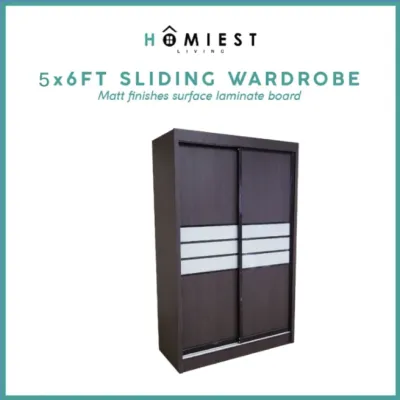
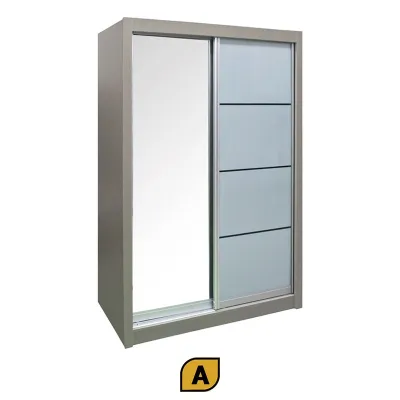
![[HOMIEST] TIA Melamine Half mirror Sliding Wardrobe in 4ft / 5ft](https://img.lazcdn.com/g/p/1776dd130c23b379885663629e56b0c8.jpg_400x400q80.jpg_.webp)
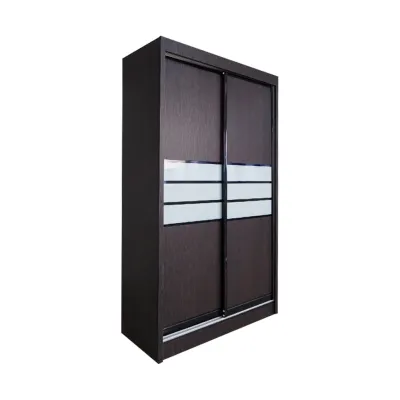
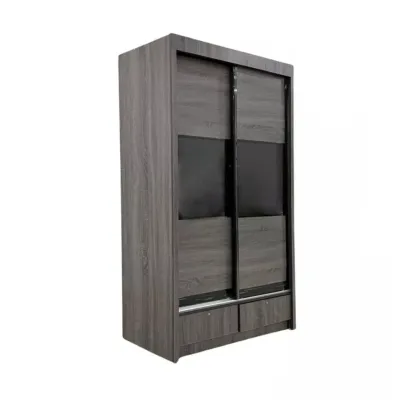
![[SG Seller] Twentyone 4FT Solid Plywood Sliding Door Wardrobe (Free Installation)](https://img.lazcdn.com/g/p/5a5c8a31500d580438ca2c4211197a4d.jpg_400x400q80.jpg_.webp)
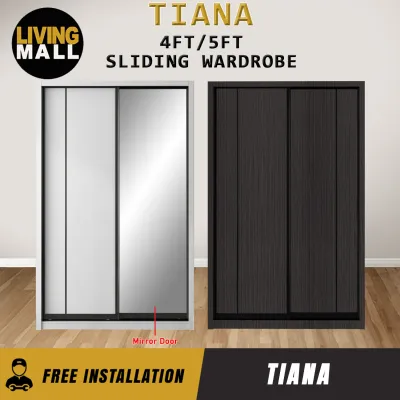
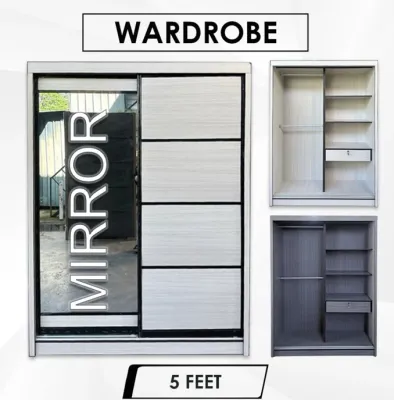
Prices are valid at publication and may change. Please refer to the product page for the latest price.
However, choosing a sliding system introduces specific operational trade-offs that you must consider during your planning phase. Because the doors slide over one another, you can only access one half of the wardrobe interior at any given time. This reduces the active opening width to slightly less than two feet (approximately 60 centimeters), which can make retrieving large storage boxes or organizing bulky bedding more challenging than it would be with fully opening hinged doors.
How to Evaluate Wardrobe Brands for Reliability
When comparing furniture brands and retailers in Singapore, you should look past marketing claims and focus on concrete indicators of manufacturing quality and service reliability. A primary differentiator among brands is the scope and duration of their product warranties. Reliable manufacturers typically offer distinct warranty terms, separating the coverage for static structural panels from that of moving mechanical parts. Ensure you verify whether the warranty covers track alignment, roller wear, and soft-close dampers, as these components experience the highest daily physical stress and are the most likely to fail over time.

Material transparency is another critical hallmark of a reputable wardrobe brand. Look for manufacturers that explicitly state the core materials used in their carcasses and doors, such as high-density fiberboard (HDF), medium-density fiberboard (MDF), or solid plywood. Furthermore, ask brands for documentation regarding their formaldehyde emission ratings, prioritizing products that meet low-emission standards like E1 or E0 to safeguard your indoor air quality.
After-sales support is equally vital, especially for sliding door systems that may require calibration after installation. Inquire about the brand’s policy on post-purchase services, including track realignment, roller replacement, and hardware repairs. A brand with dedicated local technicians and a ready stock of replacement parts will save you from the frustration of dealing with a jammed door or a derailed track years down the road.
Finally, evaluate the flexibility of the brand’s internal configurations. The best wardrobe systems are not entirely rigid; they offer modular shelves, adjustable hanging rods, and retrofittable drawers. This adaptability allows you to customize the interior layout to match your changing storage needs, whether you need more vertical hanging space for formal wear or additional shelving for folded garments.
Essential Space and Layout Checks Before Buying
Before finalizing your purchase from any brand, you must conduct precise physical measurements within your HDB bedroom to prevent costly installation errors. The most critical measurement is the clearance depth in front of the wardrobe. While you do not need to account for a door swing, you must maintain a minimum clearance of 60 to 70 centimeters between the face of the wardrobe and the edge of your bed or adjacent furniture to allow a person to stand, open the door, and browse their clothes comfortably.
Next, perform a thorough interference check along the wall where the wardrobe will stand. Look upward to ensure the wardrobe’s height and door movement will not interfere with ceiling fans, air-conditioning units, or wall-mounted light fixtures. Pay close attention to the path of air-con trunking, curtain tracks, and the placement of electrical wall sockets, as blocking these features can lead to expensive relocation work or render your outlets completely inaccessible.
You must also account for architectural irregularities common in residential units. Measure the wall width and ceiling height at multiple points—left, center, and right—to identify any sloping or unevenness in your flooring and walls. Standard skirting boards along the base of your walls will prevent a ready-made wardrobe from sitting completely flush against the wall, creating a small gap where dust can accumulate unless the brand offers custom skirting cutouts or filler panels.
Lastly, verify that the 4ft width does not encroach on natural walkways or block access to windows. In many HDB layouts, placing a wardrobe too close to the window can restrict natural light, impede ventilation, or make it difficult to operate window handles and grilles safely.
Hardware and Material Checks for Humid Climates
Singapore’s tropical climate, characterized by high relative humidity and ambient warmth, places severe stress on wardrobe materials and moving hardware. When evaluating sliding door systems, pay close attention to the track design. Top-hung systems, where the doors suspend from an upper track, generally offer smoother operation and are less prone to trapping dust, hair, and debris. Bottom-rolling systems, while often more budget-friendly, rely on a floor track that acts as a natural collection point for dust, requiring regular cleaning to prevent the rollers from jumping or wearing out prematurely.
Safety features are non-negotiable for heavy sliding doors. Ensure the wardrobe brand utilizes robust anti-jump mechanisms that prevent the doors from derailing if they are slid open with excessive force. Additionally, look for integrated soft-close buffers or dampers; these components slow the door down as it approaches the side panel, preventing loud slams, reducing structural wear, and protecting fingers from getting pinched.
To combat moisture-related damage, look for verified moisture-resistant specifications rather than relying on generic material descriptions. High-pressure laminate (HPL) or melamine-faced boards offer excellent surface resistance to moisture and scratches, but the weakest points are always the edges. Inspect the quality of the edge banding on the panels; it should be applied using hot-melt adhesives or laser technology to create a seamless, watertight seal that prevents humid air from penetrating the inner wood core and causing swelling or warping.
Avoid wardrobes with exposed, unbanded edges or poorly applied paper edge banding, as these will quickly degrade in Singapore’s humid environment. If you plan to place the wardrobe against an external wall—which tends to run cooler and accumulate condensation—ensure there is a small ventilation gap behind the back panel to prevent mold growth.
Ready-Made vs. Custom-Built: Choosing the Right Route
Deciding between a ready-made 4ft sliding wardrobe and a custom-built carpentry solution depends on your budget, timeline, and the specific quirks of your HDB bedroom layout. Ready-made wardrobes are highly cost-effective and offer predictable pricing, with the added benefit of rapid delivery and installation times. These off-the-shelf units are ideal if you are on a tight schedule or renting, as they can often be disassembled and moved to a new location if necessary.
However, ready-made units come with structural limitations. They are built to standard heights—typically ranging from 2.0 to 2.4 meters—which leaves an open gap between the top of the wardrobe and your ceiling. This unused space quickly becomes a dust trap and represents lost storage potential in a small room.
Custom-built carpentry, on the other hand, allows you to maximize every vertical inch of your bedroom by extending the wardrobe fully from floor to ceiling. This approach offers unparalleled flexibility in internal configurations, material selection, and seamless integration around structural beams, air-con trunking, or uneven walls. The trade-offs are significantly higher upfront costs, longer lead times for fabrication, and the permanent nature of the installation, which cannot be relocated.
For many HDB homeowners, semi-custom modular systems offered by specialized brands provide the ideal middle ground. These systems utilize standardized, mass-produced carcass sizes (like a standard 4ft width) but allow you to select your preferred door styles, internal organizers, and filler panels to achieve a built-in look at a fraction of the cost of full custom carpentry.
Delivery and Installation Logistics for HDB Flats
The success of your wardrobe purchase relies heavily on smooth delivery and installation logistics, which can be challenging in HDB estates. Before scheduling delivery, verify the dimensions of your building’s passenger or cargo lift, as well as the turning radiuses of the stairwells and corridors. A 4ft wardrobe carcass, even when flat-packed, contains long side panels and large door slabs that must fit safely into the lift to avoid manual carrying charges or delivery failures.
Once the delivery team arrives, they will require sufficient clear floor space inside your bedroom to assemble the unit safely. Clear out existing furniture and lay down protective coverings, such as cardboard sheets or drop cloths, to prevent the heavy wooden panels and metal tracks from scratching your vinyl, laminate, or parquet flooring during the assembly process.
Stability is a critical safety consideration for any tall furniture piece. Ensure the installation team anchors the wardrobe securely to the wall to prevent tip-over accidents, especially if you select a model with heavy glass or mirrored sliding doors. In Singapore, you must comply with HDB regulations regarding drilling; ensure the installers identify and avoid structural columns or shear walls, anchoring only into non-structural partition walls or using approved fixing methods.
After the installation is complete, perform a thorough hands-on inspection before the assembly team leaves. Slide both doors back and forth multiple times to verify they glide smoothly without grinding, squeaking, or catching. Check that the doors align perfectly flush with the side panels when closed, that the soft-close mechanisms engage gently, and that all internal shelves and hanging rods are securely seated and level.
Frequently Asked Questions (FAQ)
Can I convert an existing hinged wardrobe to sliding doors?
Converting an existing hinged wardrobe to sliding doors is theoretically possible but often structurally impractical and costly. Sliding door systems require a dedicated track depth of at least 8 to 10 centimeters at the front of the wardrobe frame. Most standard hinged wardrobes do not have this extra depth built into their carcasses, meaning you would have to extend the frame outward. Additionally, the existing door panels are rarely suitable for conversion, as sliding doors require precise structural rigidity, specific weight distributions, and specialized routing to accommodate rollers and guide tracks. In most cases, replacing the unit or opting for a modular sliding wardrobe is more cost-effective.
How do I clean and maintain the bottom track?
Maintaining the bottom track of your sliding wardrobe is essential to ensure smooth, quiet operation and prolong the lifespan of the roller mechanism. Use a vacuum cleaner with a narrow crevice tool attachment once a week to remove accumulated dust, lint, and hair from the track grooves. After vacuuming, wipe the tracks with a microfiber cloth slightly dampened with plain water or a mild, non-abrasive soapy solution. Avoid using harsh chemical cleaners, WD-40, or heavy grease lubricants, as these substances leave a sticky residue that actively attracts dust and grit, creating a grinding paste that will quickly destroy the plastic or metal rollers.

Community discussion
Share your experience or ask a question. Comments are reviewed before publication.