
Finding the right foldable office chair for daily home use requires looking beyond marketing buzzwords and brand names. While many brands claim to offer the ultimate space-saving ergonomic solution, no single brand universally wins the top spot. The most reliable option for your home workspace depends entirely on verifying specific ergonomic adjustments, inspecting the physical folding mechanisms, and measuring your individual space constraints. By focusing on observable design features and manufacturer-provided specifications, you can select a chair that supports your posture without compromising your living space.
Key Ergonomic Features to Evaluate in Foldable Chairs
When evaluating foldable office chairs, the primary challenge is distinguishing genuine ergonomic support from superficial design elements. Because folding chairs must collapse into compact profiles, manufacturers often simplify structural components, which can directly impact your physical comfort during long working hours.
Lumbar support is the foundation of any ergonomic chair, yet its execution varies wildly in foldable models. Some brands rely on fixed plastic contours molded directly into the backrest frame, which rarely align perfectly with every user’s spinal curve. A more supportive option is an adjustable lumbar pad that can be shifted vertically to sit directly in the curve of your lower back. When researching brands, check the product specifications to see if the lumbar support is adjustable or fixed, as a misaligned support pad can cause more discomfort than no support at all.
Products mentioned in this guide
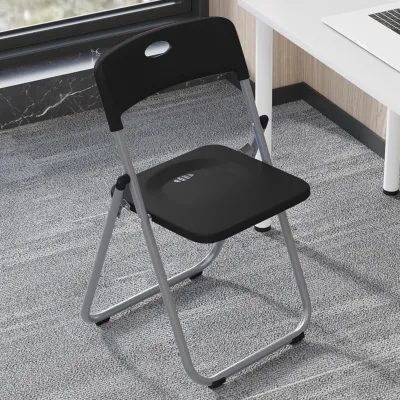
![[NEW]Foldable Chair With Cushion Office Meeting Conference Chair Study Folding Chair Fancy Chair kerusi lipat Folding chair](https://img.lazcdn.com/g/p/915096b5caa7f36fdd2650cee839b2a9.jpg_webp_400x400q80.jpg_.webp)
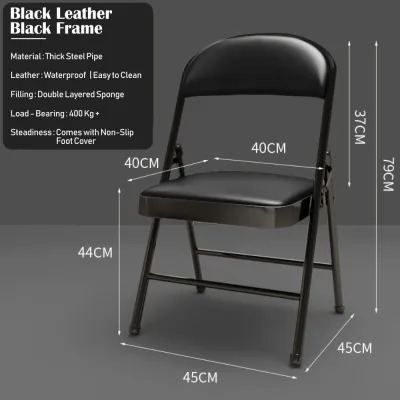
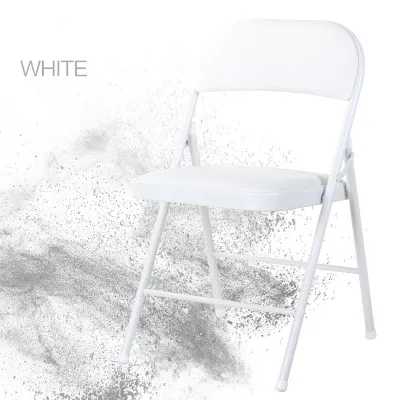
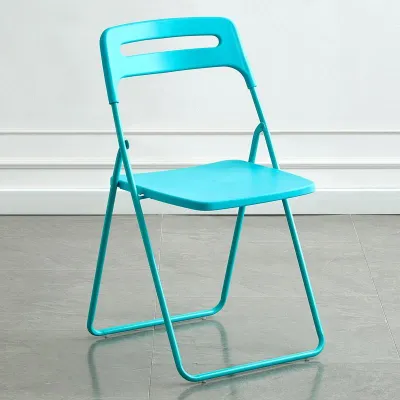
Prices are valid at publication and may change. Please refer to the product page for the latest price.
Seat design is another critical factor that influences lower-body circulation and comfort. Look closely at the seat depth and the shape of the front edge; a waterfall edge, which slopes gently downward, helps reduce pressure on the back of your thighs. Additionally, inquire about the padding density, often measured in kilograms per cubic meter. High-density foam retains its shape and supportive qualities over years of daily use, whereas low-density, soft foam quickly bottoms out, leaving you sitting against the hard folding frame beneath.
Armrests on foldable chairs must balance upper-body support with space-saving utility. Some models feature fixed armrests that can block the chair from sliding fully under your desk when not in use, while others offer height-adjustable or fold-away designs. Fold-away armrests are particularly useful for tight home offices, as they allow you to tuck the chair completely under the desk surface to maximize floor space. Ensure you measure your desk’s underside clearance and compare it to the armrest height options listed by the manufacturer.
Finally, examine the backrest recline limits and tension control mechanisms. Standard task chairs often feature complex synchro-tilt mechanisms, but foldable designs usually rely on simpler pivot points. Verify whether a candidate chair allows you to lock the backrest at different angles or adjust the recline tension. A backrest that lacks tension control may either feel too stiff or collapse backward too easily under your weight, compromising both safety and comfort.
Assessing Build Quality and Material Durability
A foldable office chair must withstand both the static load of daily sitting and the dynamic stress of being repeatedly folded, unfolded, and moved. Assessing build quality requires looking closely at the moving parts and structural materials rather than relying on brand reputation alone.

The hinges, joints, and locking pins are the most critical failure points on any folding chair. Inspect the product diagrams or user manuals to identify the materials used in these high-stress areas. High-quality models utilize reinforced steel brackets and positive-locking pins that click securely into place when the chair is deployed. Avoid designs that rely solely on friction fits or thin plastic locking tabs, as these can wear down over time and lead to accidental folding during use.
Frame materials dictate both the weight of the chair and its long-term stability. Steel and aluminum frames offer the best balance of strength and durability, but they require proper surface treatments to prevent wear. Look for powder-coated or anodized finishes, which resist scratches and protect the metal from moisture-induced rust, especially in humid home environments. If a brand does not specify the frame material or finish, contact their customer support to verify these details before purchasing.
Upholstery and cushioning materials directly affect both comfort and durability. Mesh backrests are highly popular for home offices due to their breathability, but the mesh must be tightly woven and securely anchored to the frame to prevent sagging. If you prefer fabric or faux-leather upholstery, check for reinforced double-stitching along the seams. These seams bear significant tension when the chair is occupied, and weak stitching is a common indicator of premature wear and foam degradation.
To ensure the chair can safely support your body weight, always locate and verify the manufacturer-stated weight capacity labels. Reliable brands prominently display these limits in their official documentation and on physical labels attached to the underside of the seat. Additionally, look for recognized safety and durability certifications, such as BIFMA (Business and Institutional Furniture Manufacturers Association) standards, which indicate the design has undergone rigorous mechanical testing.
Space and Setup Considerations for Home Offices
The primary appeal of a foldable office chair is its ability to disappear when the workday ends. However, a chair is only practical if it fits seamlessly into your physical home environment during both active use and storage.
Before purchasing, measure your intended storage area—whether it is a closet, a gap beside a wardrobe, or the space beneath your bed. Compare these dimensions to the manufacturer’s official folded measurements, paying close attention to the folded depth and height. Some chairs fold completely flat, while others retain a slight curve or require the armrests to be removed, which can complicate storage in tight spaces.
Equally important is the deployed footprint of the chair. Ensure you have adequate clearance behind your desk to push the chair back and stand up comfortably. A chair with a wide five-star base offers excellent stability but requires more floor space than a compact four-legged folding frame. Mark out the deployed dimensions on your floor using painter’s tape to visualize how much movement space remains in your room.
Do not overlook the logistics of initial delivery and assembly. Verify the dimensions of your doorways, hallways, and elevator cabins to ensure the shipping box can easily reach your home. While many foldable chairs arrive fully assembled, some require minor setup, such as attaching the casters or armrests. Review the assembly instructions on the manufacturer’s website to confirm you have the necessary tools and space to complete the setup safely.
Finally, assess the base design and casters relative to your flooring. Hard nylon casters can scratch hardwood or vinyl floors, while soft polyurethane casters glide smoothly and quietly without causing damage. If your home office is carpeted, you will need specialized carpet casters or a protective chair mat to prevent the wheels from sinking and restricting your movement.
Specification Checklist: Comparing Brand Offerings
To make an objective decision, avoid relying on subjective reviews and instead compile a structured comparison of different brand offerings. Use the template below to organize the technical specifications of the models you are considering, gathering the data directly from official product manuals or by contacting customer service.
| Specification Category | Model A Details | Model B Details | Verification Checkpoint |
|---|---|---|---|
| Folding Mechanism | Check for positive-locking pins or manual latches. | ||
| Adjustable Features | Note lumbar height, armrest height, and tilt lock. | ||
| Frame Material | Verify metal type (e.g., steel, aluminum) and finish. | ||
| Weight Capacity | Locate the official certified weight limit. | ||
| Folded Dimensions | Measure height, width, and depth when fully collapsed. | ||
| Caster Type | Confirm compatibility with hard floors or carpets. | ||
| Warranty & Returns | Check the warranty duration and return shipping policy. | ||
| Replacement Parts | Ask if individual casters, pads, or joints can be ordered. |
When filling out this checklist, prioritize brands that provide clear, transparent answers to these technical questions. A manufacturer that openly shares detailed engineering specifications, warranty terms, and replacement part availability is generally more reliable than one that relies on vague marketing claims.
Decision Framework: Choosing the Right Foldable Chair for Your Needs
Choosing the right foldable office chair is a matter of balancing your daily work habits against your physical space limitations. There is no one-size-fits-all solution, and the best choice depends on how you plan to use the chair.
If you work full-time from home and require sustained support, prioritize a heavy-duty adjustable model. These chairs typically feature robust steel frames, high-density foam seats, and adjustable lumbar pads. While they may be slightly bulkier when folded and carry a higher price point, the long-term benefits to your posture and spinal health far outweigh the minor inconvenience of a larger storage footprint.
Conversely, if you only use the chair for occasional tasks, household admin, or short study sessions, a lightweight and highly compact model may be the most practical choice. These designs prioritize rapid deployment and an ultra-slim folded profile, allowing them to be tucked away effortlessly in small apartments. While they offer fewer adjustable ergonomic features, they are perfectly adequate for short periods of sitting.
However, it is important to recognize the limitations of folding furniture. If you require specialized medical seating, bariatric support, or have pre-existing spinal or mobility conditions, a folding chair may not provide the necessary stability or customization. In these scenarios, a standard, non-folding ergonomic task chair is highly recommended. Always consult with a healthcare professional or physical therapist before committing to a folding design if you have chronic back pain or mobility challenges.
Frequently Asked Questions (FAQ)
Can a foldable office chair provide the same ergonomic support as a standard task chair?
Foldable office chairs generally cannot match the comprehensive ergonomic support of high-end, standard task chairs due to inherent structural trade-offs. To allow the chair to fold, manufacturers must introduce hinges and pivot points, which limits the integration of complex, multi-axis adjustment mechanisms like synchro-tilt or seat-slider systems. Additionally, folding frames often have simplified backrests and thinner seat cushions to maintain a compact profile. While high-quality foldable models offer excellent basic support for moderate use, standard task chairs remain the superior choice for maximum ergonomic customization during prolonged, full-time sitting.
How do I check the weight capacity and stability of a folding mechanism?
To verify the safety of a folding chair, start by locating the official weight capacity label, which is typically printed on a sticker underneath the seat pan or listed in the user manual. Once the chair is delivered, perform a low-risk stability check before sitting. Fully deploy the chair on a level surface and ensure all locking pins, latches, or tension rings are completely engaged. Gently apply downward pressure on the seat with your hands to check for any wobbling, slipping, or unusual clicking sounds. If you observe any uneven folding, loose joints, or mechanical play, immediately stop using the chair and contact the manufacturer for assistance.

Community discussion
Share your experience or ask a question. Comments are reviewed before publication.