
Finding the ideal mirror clothes rack for a compact Singapore bedroom is not about chasing a single, universally acclaimed brand. Instead, the best option is one that precisely matches your room’s physical footprint, your daily storage requirements, and the spatial limits of your home. In typical HDB flats and condominiums where floor area is at a premium, a successful purchase hinges on balancing a functional full-length mirror with a highly efficient hanging rail. By focusing on verifiable product specifications, clearance measurements, and structural stability, you can select a dual-purpose furniture piece that enhances your morning routine without making your personal sanctuary feel cramped or cluttered.
Assessing Your Bedroom Space and Traffic Flow
Before browsing online marketplaces or local furniture showrooms, you must establish the exact physical boundaries of your available floor space. Use a measuring tape to map out the maximum width and depth your bedroom can spare for a new floor accessory. A common oversight is measuring only the bare floor area while ignoring how the rack will interact with surrounding furniture. You must ensure the base of the rack does not impede the swing path of bedroom doors, built-in wardrobe doors, or nearby vanity drawers.
Traffic flow is another critical factor in compact Singapore bedrooms, where walkways are often narrow. A mirror clothes rack should never be placed where it forces you to squeeze past or alter your natural path through the room. Additionally, consider the placement of your wall-mounted air conditioning unit and windows. Positioning a tall rack directly in the path of aircon airflow can cause lightweight garments to sway constantly, while blocking natural light sources can make a small room feel instantly darker and smaller. Aim for a dedicated, low-traffic corner that allows you to stand back at least one to two meters to utilize the mirror comfortably.
Products mentioned in this guide
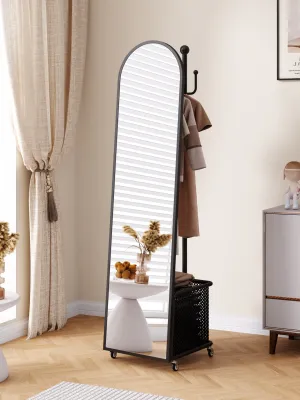



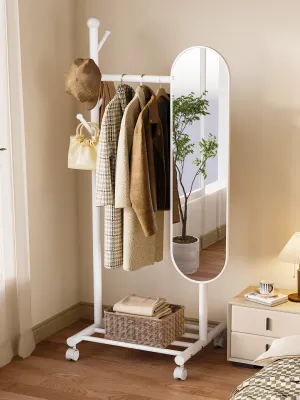


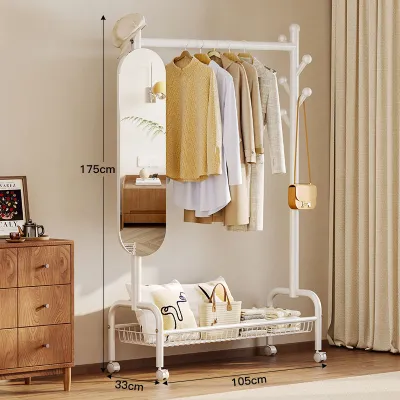
Prices are valid at publication and may change. Please refer to the product page for the latest price.
Matching Rack Dimensions to Your Storage Needs
Balancing the hanging rail capacity with the physical size of the mirror requires a realistic assessment of your daily wardrobe. When evaluating the rail length, do not simply look at the metal bar itself. You must account for the extra width added by hangers, thick sleeves, and bulky jackets, which typically extend five to ten centimeters beyond the frame on either side. If you plan to hang structured office wear or long dresses, verify the vertical clearance between the hanging rail and the bottom shelf to prevent your clothes from bunching up on the floor.

The integrated mirror must also meet specific dimensional thresholds to be genuinely useful as a full-length dressing aid. For most adults, a mirror needs to be at least 120 centimeters tall and positioned at an appropriate height from the floor to capture a complete head-to-toe reflection. If the mirror is too small or angled poorly, you will find yourself constantly stepping backward—a luxury that tight HDB bedrooms rarely allow. Furthermore, pay close attention to the visual weight of the frame. Thick, dark wooden frames can dominate a small room visually, whereas thin metal frames or frameless designs help maintain an open, airy aesthetic.
Evaluating Freestanding and Foldable Configurations
The structural design of your mirror clothes rack dictates how well it integrates into your daily routine and room layout. Freestanding designs, such as A-frame or T-base structures, offer excellent everyday stability and are ideal if you have a permanent spot designated for the unit. A-frame models naturally distribute weight over a wider footprint, making them less prone to wobbling when you hang heavier items. T-base designs often occupy less floor space but require a heavier, more robust base to maintain their balance.
While foldable or collapsible models might seem like the ultimate space-saving solution, they are only practical if you are genuinely willing to perform the daily setup and teardown. In reality, most users leave these racks permanently open, meaning a foldable mechanism simply adds unnecessary joint wear without providing long-term benefits. If you value flexibility, look for models equipped with caster wheels. Ensure these wheels feature reliable locking mechanisms to prevent the rack from shifting when you use the mirror, and check that the wheel material is safe for your specific flooring, whether it is sensitive parquet, luxury vinyl tiles, or polished marble.
Checking Stability, Materials, and Weight Limits
Because these units combine a heavy glass mirror with a hanging rail, structural safety is paramount to prevent tipping hazards. Always verify the manufacturer’s stated maximum weight capacity and load distribution guidelines before making a purchase. A high-quality rack will specify separate weight limits for the main hanging rail, side hooks, and lower shelves. Avoid units that do not clearly state these limits, as overloading a weak rail can cause the entire structure to bow or collapse, risking serious damage to the integrated glass.
When inspecting potential purchases, look closely at the physical security of the mirror mounting brackets and the overall weight of the base. A bottom-heavy design is inherently safer because it lowers the center of gravity, making the rack much harder to knock over accidentally. Rather than relying on generic material names like “hardwood” or “alloy,” check the product labels for specific details on joint connections, screw types, and care instructions. Welded metal joints or heavy-duty steel bolts generally offer superior long-term stability compared to simple push-fit plastic connectors, especially when subjected to the daily weight of a full wardrobe.
Common Space-Matching Mistakes to Avoid
One of the most frequent errors when buying a mirror clothes rack is failing to account for the physical bulk of hanging garments. A rack that looks sleek and minimalist in online product photos can quickly become a massive visual and physical obstacle once it is loaded with colorful shirts, jackets, and bags. Always visualize the rack at maximum capacity, remembering that clothes will protrude outward and upward, potentially blocking nearby light switches or wall outlets.
Another common mistake is ignoring the environmental reflections and lighting conditions around the mirror. Placing the rack directly opposite a cluttered open shelf or a messy desk will double the visual noise in your bedroom, making the space feel chaotic. Similarly, positioning the mirror directly facing a bright window or a harsh overhead light bulb can create intense glare, rendering the mirror virtually unusable during certain times of the day. Finally, never underestimate the depth of the base; a base that extends even a few centimeters too far into a narrow walkway can easily become a constant tripping hazard in the dark.
Frequently Asked Questions (FAQ)
Can a mirror clothes rack replace a built-in wardrobe?
A mirror clothes rack is best viewed as a supplementary or transitional storage solution rather than a complete replacement for a built-in wardrobe. Because it features an open design, your clothes are constantly exposed to dust, cooking odors, and ambient humidity, which can be challenging in Singapore’s tropical climate. Additionally, open storage can quickly create visual clutter if not kept meticulously organized. It is ideal for organizing your daily essentials, planning outfits for the week, or holding transitional garments, but it lacks the dust protection and high-volume capacity of a closed wardrobe.
How do I prevent a freestanding mirror rack from tipping over?
To ensure your freestanding rack remains stable, always practice even weight distribution by placing heavier items, such as bags or storage boxes, on the bottom shelf to lower the center of gravity. Avoid hanging heavy coats or bags exclusively on one side of the rail or on outer accessory hooks, as this uneven load can easily cause the frame to tilt. Finally, position the rack away from high-traffic zones where it could be bumped by opening doors or active household members, and periodically check and tighten all joint screws to maintain structural integrity.

Community discussion
Share your experience or ask a question. Comments are reviewed before publication.