
Finding a reliable extendable kids’ bed in Singapore requires looking past marketing claims and focusing on verifiable safety standards, robust extension mechanisms, and local structural support. Because these beds are designed to grow with your child—typically expanding from a toddler-sized bed to a single or super-single bed—they undergo unique mechanical stresses at their joint interfaces. To secure a truly reliable option, parents must evaluate the locking hardware, the load-bearing capacity of the extended frame, and the availability of local warranties that cover moving parts.
In Singapore’s humid climate, material choice and construction quality become even more critical. Solid hardwoods like beech, birch, or oak tend to handle the moisture and repeated adjustments better than low-grade particleboard, which can swell or strip at the screw holes over time. By understanding how to audit these products, you can confidently navigate local showrooms and select a bed that remains safe, stable, and comfortable throughout your child’s developmental years.
Core Safety and Build Checks for Extendable Kids Beds
Evaluating the safety of an extendable bed requires a close inspection of its physical dimensions and structural design. Guardrails are the first line of defense for younger children transitioning from a crib. When the bed is in its fully extended configuration, you must verify that the guardrails remain continuous or that any gaps between the rails and the headboard or footboard do not exceed safety limits. Standard safety guidelines recommend that gaps between vertical slats or guardrail openings remain between 50mm and 75mm to prevent a child’s head or limbs from becoming trapped.
Products mentioned in this guide
Prices are valid at publication and may change. Please refer to the product page for the latest price.
Furthermore, the height of the guardrail must be assessed in relation to the mattress. A safe guardrail should stand at least 160mm above the top of the mattress. This means you must factor in the thickness of your chosen mattress; a mattress that is too thick will compromise the protective height of the guardrail, increasing the risk of accidental falls during sleep.
Mattress support systems require equal scrutiny, especially at the transition points where the bed frame expands. Look for interlocking wooden slats or a telescoping metal support grid that provides uniform coverage across the entire length of the bed. If the support system leaves large gaps when extended, the mattress may sag, leading to discomfort and premature wear. Always verify the manufacturer’s stated weight capacity for both the retracted and fully extended states. A reliable kids’ bed should support at least 100kg to 120kg, ensuring it can safely accommodate a parent sitting bedside for storytime.
Finally, examine the locking mechanisms and joint reinforcements that secure the extension frame. High-quality extendable beds utilize heavy-duty steel bolts, barrel nuts, or dedicated locking pins to hold the sliding sections firmly in place. Avoid frames that rely solely on wood screws or simple friction joints to maintain their extended position. Over time, the vibrations from a child tossing, turning, or climbing onto the bed can loosen weak fasteners, leading to structural shifting, squeaking, or sudden joint failure.
Verifying Brand Reliability and Safety Compliance in Singapore
When shortlisting brands in Singapore, look for those that demonstrate compliance with recognized international safety standards. Because Singapore imports a wide variety of children’s furniture, reliable brands should readily provide test reports or compliance certificates for standards such as EN 747 (the European standard for children’s high beds and bunk beds, which often informs general kids’ bed safety) or ASTM standards. These certifications ensure that the paints, varnishes, and materials used are non-toxic, free of heavy metals, and structurally sound under rigorous testing conditions.

Warranty terms offer a clear window into a brand’s confidence in its product durability. A standard one-year furniture warranty is often insufficient for an extendable bed, which is expected to perform mechanically for a decade or more. Prioritize brands that offer extended warranties of three to five years, and read the fine print to ensure that the sliding mechanisms, extension joints, and load-bearing hardware are explicitly covered. Be sure to clarify whether self-assembly voids any part of this warranty, as some brands require professional installation to honor their structural guarantees.
While online research is convenient, visiting a physical showroom in Singapore is irreplaceable when evaluating build quality. A hands-on inspection allows you to test the bed’s lateral stability. Apply firm pressure to the headboard and footboard when the bed is fully extended; there should be no noticeable sway, wobble, or creaking. Run your hands along the underside of the frame, the edges of the slats, and the extension joints to check for rough spots, splinters, or sharp hardware edges that could snag bedding or scratch a child.
Showroom visits also allow you to interact with the brand’s sales representatives and gauge their technical knowledge. A reputable retailer should be able to explain the exact sourcing of their timber, the type of finishes used, and the availability of replacement parts. If a brand cannot provide clear answers regarding safety certifications or structural materials, it is best to remove them from your shortlist.
Evaluating the Extension Mechanism and Room Fit
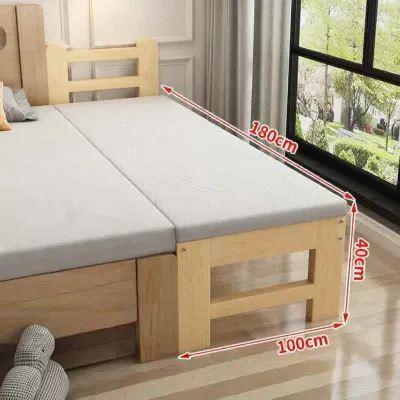
Before purchasing an extendable bed, you must carefully map out your child’s bedroom layout to ensure a proper fit. Singaporean bedrooms, particularly in newer HDB flats and condominiums, often feature compact footprints where every centimeter counts. Measure the room’s dimensions not just for the bed’s retracted state, but for its fully extended length, which typically ranges from 140cm to over 200cm. Ensure that the extension path does not obstruct wardrobe doors, study desks, or walkways.
Additionally, take note of architectural features such as skirting boards, electrical outlets, and light switches. Skirting boards can prevent a bed frame from sitting completely flush against the wall. If the bed frame has a gap behind it, this can create a hazard where toys, pillows, or even a child’s limb could slip down. Ensure that the bed’s headboard design accounts for skirting boards or that you have a plan to secure the gap safely. Access to power outlets must also remain clear and unblocked by the extended frame to prevent fire hazards and ensure easy access.
When comparing extension mechanisms, you will generally encounter manual pull-out frames and guided rail systems. Manual pull-out frames require you to physically pull the footboard outward, sliding the extension frame along the floor. While simple and durable, these require careful alignment to ensure the frame extends evenly without binding. Guided rail systems utilize built-in tracks or metal runners to guide the extension smoothly. While easier to operate, these systems have more moving parts that require periodic inspection to ensure they remain free of dust, lint, and debris.
Mattress compatibility is another critical factor that influences both cost and convenience. Extendable beds often require specialized mattresses designed to grow with the frame. These typically consist of a main mattress section (often around 130cm to 140cm in length) and one or two additional mattress inserts (usually 30cm each) that are added to the foot of the bed as it extends. Verify the availability, material quality, and pricing of these specialized mattresses before committing to a frame, as using non-standard mattress configurations can compromise both comfort and safety.
Building Your Shortlist: Essential Questions for Retailers
To finalize your decision and choose the safest possible extendable bed, prepare a targeted list of questions for local retailers. This proactive approach ensures you understand the long-term operational requirements and safety limits of the furniture before making a financial commitment.
First, ask about the maximum recommended age, height, and weight limits for the bed in its fully extended configuration. Some extendable beds are designed strictly for early childhood and may have lower weight limits that prevent them from being used through the teenage years. Knowing these limits helps you calculate the true cost-per-year of the investment.
Second, confirm the delivery and assembly terms. Professional assembly is highly recommended for extendable beds, as a minor error in aligning the sliding rails or securing the locking bolts can compromise the bed’s structural integrity. Ask if the delivery team is trained specifically in assembling extendable models, and inquire whether the bed requires wall anchoring. Taller frames or those with high headboards may require anchoring to prevent tip-over accidents if a child attempts to climb the frame.
Finally, clarify the retailer’s return, exchange, and repair policies. Ask what recourse you have if the extension mechanism fails to operate smoothly upon delivery, or if you discover structural defects after assembly. A reliable retailer should offer a clear exchange window and have a local customer service team capable of sending technicians to your home to resolve mechanical issues or replace faulty hardware promptly.
Frequently Asked Questions (FAQ)
Do extendable beds require a special mattress?
Yes, most extendable beds require a specialized mattress system to function correctly. These systems typically feature a main mattress section used when the bed is in its shortest toddler configuration, along with one or two matching mattress inserts. As you extend the bed frame, you place these inserts at the head or foot of the bed to fill the gap. It is crucial to use mattresses specifically designed for the frame to ensure a tight, seamless fit without dangerous gaps. Additionally, always check the manufacturer’s maximum mattress thickness recommendation to ensure the guardrails maintain their protective height.
At what age is it safe to remove guardrails from an extended bed?
There is no single chronological age that dictates when it is safe to remove guardrails, as children develop physical coordination and sleep habits at different rates. Instead of relying on age, look for observable readiness signals. A child may be ready to sleep without guardrails if they consistently wake up in the same position they fell asleep in, show minimal tossing and turning, and can safely navigate getting in and out of bed in the dark. If you are transitioning away from guardrails, consider starting with a partial guardrail that leaves a safe opening at the foot of the bed, or temporarily placing a soft rug or foam mat on the floor beside the bed.
Can an extendable bed be converted into two separate beds later?
No, standard extendable beds are engineered as single, integrated units that expand along a single axis. The frame, sliding rails, and support slats are structurally dependent on each other to maintain stability. Attempting to separate or disassemble the extension mechanism to create two independent beds will compromise the structural integrity of both sections and void any manufacturer warranties. If you anticipate needing two separate beds in the future, it is better to invest in a modular bunk bed system that is explicitly designed to be split into two standalone single beds later on.

Community discussion
Share your experience or ask a question. Comments are reviewed before publication.