
To find the best sliding wardrobe cabinet for a Singapore HDB bedroom, you must look for brands that design specifically for compact spaces, offer modular configurations, and use hardware capable of handling daily wear. Because HDB bedrooms often feature structural beams, tight corners, and high humidity, the ideal brand is one that provides precise sizing options, robust track systems, and moisture-resistant materials. Rather than focusing on a single universal brand name, the selection process requires evaluating how different manufacturers handle local delivery constraints, installation tolerances, and custom configurations.
Selecting a wardrobe is a long-term investment in your home’s organization and flow. A poorly fitted cabinet can make a small bedroom feel cramped, block natural light, or restrict movement around the bed. By understanding the technical standards of high-quality wardrobe construction, you can confidently assess any retail or custom brand available in the local market.
Key Evaluation Criteria for HDB-Friendly Wardrobe Brands
When evaluating different furniture brands, the quality of the sliding track and roller mechanism should be your primary focus. Sliding doors are heavy, and cheap plastic rollers on thin tracks will quickly degrade, leading to sticky doors, misalignment, or complete derailment. Look for brands that utilize heavy-duty aluminum or steel tracks paired with ball-bearing rollers. High-quality systems often feature anti-jump mechanisms that keep the rollers securely locked within the track, as well as soft-close dampers that prevent the doors from slamming against the side panels.
Products mentioned in this guide
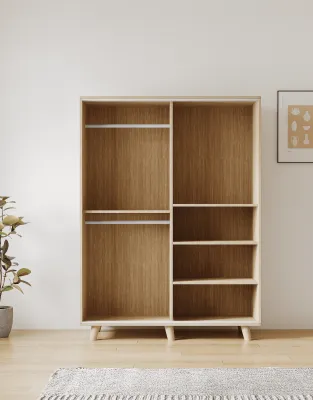
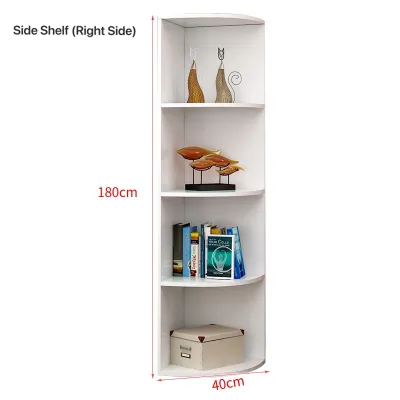
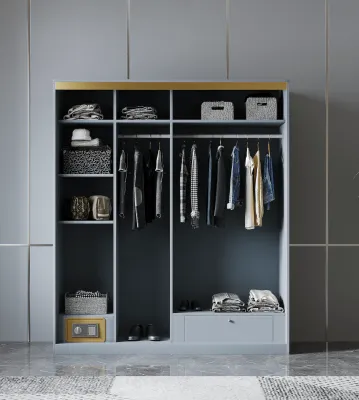
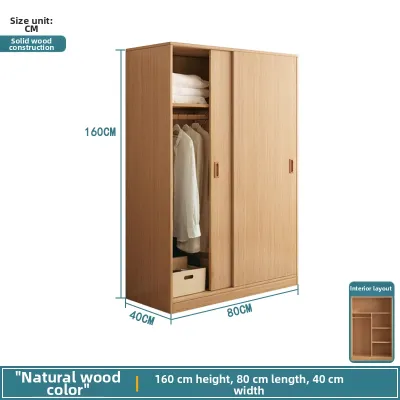
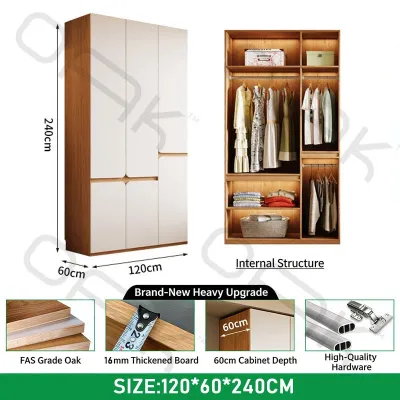
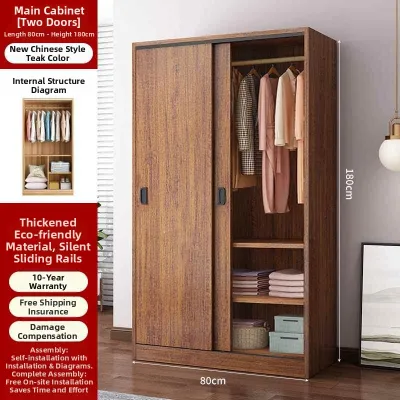
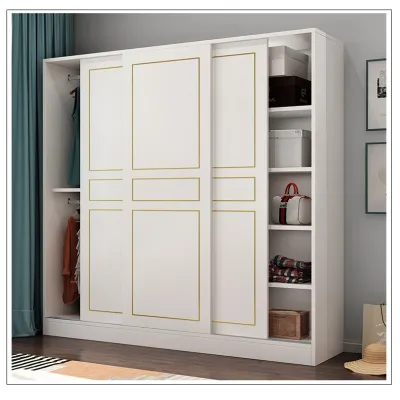
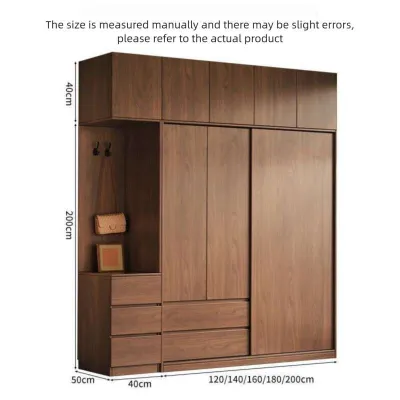
Prices are valid at publication and may change. Please refer to the product page for the latest price.
Another critical factor is the internal modularity of the wardrobe system. Compact HDB bedrooms require you to maximize every cubic centimeter of vertical space. Brands that offer adjustable shelving systems with pre-drilled holes spaced closely together allow you to reconfigure the interior as your storage needs change. Look for brands that provide a wide range of internal accessories, such as pull-out trouser racks, shallow jewelry drawers, and adjustable hanging rods, which help keep the interior organized without wasting vertical clearance.
Given Singapore’s high relative humidity, the stability of the board materials and the quality of the edge banding are paramount. Low-grade particle boards easily absorb moisture from the air, leading to swelling, warping, and mold growth. Prioritize brands that use high-density engineered wood, moisture-resistant medium-density fibreboard (MDF), or solid plywood. Furthermore, inspect the edge banding; it should be thick, smooth, and machine-applied using hot-melt or laser technology to seal the board edges completely against moisture penetration.
Finally, assess the brand’s design flexibility regarding standard HDB architectural features. Most HDB flats have ceiling heights between 2.6 and 2.8 meters, often punctuated by concrete structural beams or columns. A brand that offers modular top-filler panels, height-reduction services, or multiple height options will allow you to achieve a semi-built-in look that leaves no awkward, dust-collecting gaps at the top of the wardrobe.
Comparing Custom Built-In vs. Freestanding Sliding Wardrobes
Deciding between a custom built-in wardrobe and a freestanding modular unit depends on your budget, timeline, and how long you plan to stay in your current flat. Custom built-in wardrobes, typically fabricated by local carpentry brands, offer an absolute precision of fit. They can be built to wrap seamlessly around structural columns, hide unsightly air-conditioning trunking, and run fully from wall to wall and floor to ceiling. This eliminates wasted space and prevents dust from accumulating in hard-to-reach gaps.

However, custom built-in wardrobes come with higher upfront costs and significantly longer lead times. The fabrication process requires detailed on-site measurements, 3D design drawings, and several weeks of manufacturing before installation can take place. The installation process itself is highly intrusive, involving dust, noise, and assembly work inside your home. Additionally, built-in wardrobes are permanent fixtures; they cannot be moved if you decide to reconfigure the room or relocate to a new home.
Freestanding sliding wardrobe cabinets, on the other hand, offer excellent flexibility and speed. Retail brands stock pre-fabricated modular units that can be delivered and assembled within a few days. These units are highly cost-effective and can be dismantled and transported if you move. If you enjoy rearranging your bedroom layout or plan to sell your HDB flat in the near future, a freestanding wardrobe is often the more practical and economical choice.
The trade-off with freestanding units is the aesthetic integration and space utilization. Because they come in standard widths and heights, they rarely fit perfectly from wall to wall or floor to ceiling. You will likely have gaps at the top and sides, which can make a small bedroom look visually cluttered. To mitigate this, some modular brands offer customizable filler strips that can be installed on-site to bridge the gaps between the wardrobe frame and your bedroom walls.
Essential Measurements and Space Checks Before Buying
Before purchasing any sliding wardrobe cabinet, you must conduct a thorough physical assessment of your bedroom. Never assume that your walls are perfectly plumb or that your floor is completely level. Use a spirit level to check the floor screed and the vertical alignment of the walls. If a floor slopes significantly, a sliding door may roll open on its own or bind against the track. Knowing these variances beforehand allows you to select a wardrobe with adjustable leveling feet or plan for corrective carpentry work.
Next, map out all potential spatial conflicts within the room. Take precise measurements of the location of skirting boards, ceiling cornices, wall-mounted air-conditioning units, copper piping, and electrical sockets. A sliding wardrobe must not block access to light switches or power outlets unless you plan to have an electrician relocate them. If the wardrobe is positioned near a window, ensure that the sliding doors do not interfere with curtain tracks, blinds, or the opening mechanism of the window panels.
Delivery logistics are a frequently overlooked bottleneck in Singapore’s high-rise housing. Measure the height, width, and diagonal depth of your HDB block’s passenger lift, as well as the width of the corridors and your front door frame. Large sliding wardrobe doors are often delivered as single, massive panels that cannot be bent or disassembled. If a panel is too tall to fit into the lift, it must be carried up the stairwell, which can result in heavy manual handling surcharges or, in some cases, a canceled delivery.
Finally, calculate the net usable internal depth of the wardrobe rather than relying solely on the external dimensions. Sliding door track systems typically consume between 8 cm and 12 cm of the wardrobe’s total depth. If a wardrobe has an external depth of 60 cm, the actual internal storage depth may only be 48 cm to 52 cm. Ensure this net depth is sufficient to hang your widest winter coats or suit jackets without the sleeves rubbing against the back of the sliding doors, which creates friction and can damage your clothing over time.
What to Verify in Brand Warranties and After-Sales Service
When purchasing a sliding wardrobe cabinet, the warranty terms serve as a strong indicator of the brand’s confidence in its product’s durability. It is crucial to read the fine print and verify if the warranty covers moving mechanical parts separately from the static wooden structure. While a brand may advertise a lengthy warranty period, this often applies only to the wooden carcass, while the sliding tracks, rollers, soft-close dampers, and handles may carry a much shorter coverage period.
Specifically, look for coverage against structural issues that are common in humid climates. This includes the sagging of horizontal shelves under normal load, the warping of the sliding door panels, and the delamination of the edge banding or surface laminates. A warranty that explicitly covers these issues protects your investment against premature material failure. Be sure to clarify whether the warranty includes both the cost of replacement parts and the labor charges required to perform the repair.
Inquire about the brand’s service level agreements regarding response times and the long-term availability of spare parts. If a sliding door roller breaks, the door can become stuck, blocking access to your clothing. A reliable brand should have a local service team capable of responding to repair requests within a reasonable timeframe. Furthermore, choose established brands that maintain a consistent inventory of compatible tracks and rollers, ensuring you can source replacement parts years down the road.
Lastly, understand the specific conditions that will void your warranty. Most brands will void the warranty if the wardrobe is disassembled, moved, or reinstalled by anyone other than their authorized technicians. Overloading shelves beyond their rated weight capacity, making DIY modifications to the internal frame, or exposing the wardrobe to direct water contact (such as during floor mopping) are also common reasons for warranty claims to be rejected. Keeping these guidelines in mind ensures your wardrobe remains functional and protected for years to come.
Frequently Asked Questions (FAQ)
Can a sliding wardrobe be installed in a room with a ceiling fan?
Yes, a sliding wardrobe can be installed in a room with a ceiling fan, but you must maintain a strict safety clearance. There should be a minimum clearance of at least 30 cm between the outermost tip of the ceiling fan blades and the front face of the sliding wardrobe doors. This safety margin prevents air turbulence from causing the wardrobe doors to vibrate and eliminates any risk of physical contact when the doors are being opened or closed. If your bedroom has a low ceiling or a large fan, you may need to opt for a lower wardrobe height or replace the fan with a low-profile, hugger-style model.
How much clearance is needed for the sliding track mechanism?
A standard double-track system for a two-door sliding wardrobe typically requires between 8 cm and 10 cm of dedicated depth within the wardrobe frame. If you select a three-door configuration that utilizes a triple-track system, the required depth can increase to 12 cm or more. When planning your bedroom layout, always add this track clearance to the required internal hanging depth (which is generally 50 cm to 55 cm for adult clothing) to determine the minimum external depth of the cabinet. Failing to account for this track clearance will result in a wardrobe that juts out further into your walking path than expected.

Community discussion
Share your experience or ask a question. Comments are reviewed before publication.