
Finding the right wardrobe for a Singapore Housing & Development Board (HDB) flat requires balancing tight bedroom layouts with practical storage needs. A single door wardrobe is an exceptional solution for optimizing small spaces, guest rooms, or awkward alcoves where standard double-door units cannot fit. The best wardrobe brands for HDB flats are those that provide dimensional flexibility, robust moisture-resistant materials suitable for Singapore’s humid climate, and seamless delivery and assembly services that navigate narrow HDB corridors and lifts.
To make an informed decision, homeowners must evaluate different wardrobe brand categories—ranging from bespoke local carpentry to flexible modular systems and budget-friendly ready-made units. Understanding how to measure your space, assess material quality, and configure internal storage will ensure you select a single door wardrobe that maximizes utility without cluttering your room.
Maximizing Space: Why Single Door Wardrobes Fit HDB Bedrooms
Singapore’s HDB flats, particularly newer Build-To-Order (BTO) units, feature compact bedroom layouts that demand smart space planning. A typical BTO common bedroom offers a modest footprint, often measuring around 9 to 10 square metres. Once a queen-sized bed, bedside tables, and a study desk are placed, very little floor space remains for traditional, bulky storage units. Placing a standard two-door or three-door wardrobe in these rooms can severely restrict movement and make the environment feel cramped.
Products mentioned in this guide
![[ASTAR] DANNY SINGLE DOOR WARDROBE CABINET WALNUT WHITEWASH CHERRY 2TONE (NEW!)](https://img.lazcdn.com/g/p/4173215194984da203c5af2299f5e9b2.jpg_400x400q80.jpg_.webp)
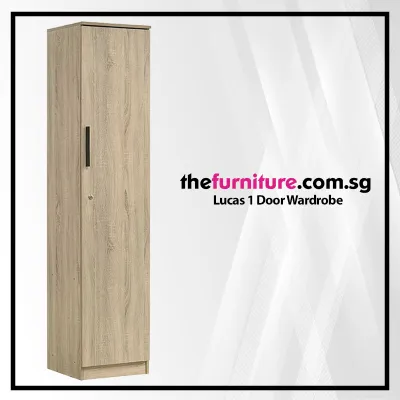
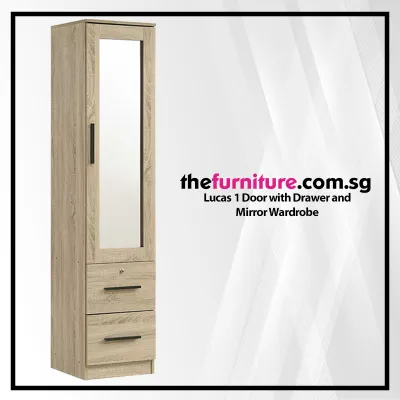
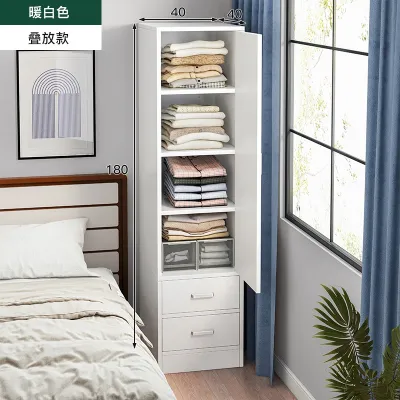
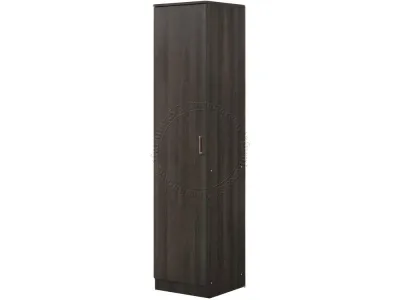
Prices are valid at publication and may change. Please refer to the product page for the latest price.
A single door wardrobe, typically measuring between 40cm and 60cm in width, offers a highly efficient alternative. This narrow footprint allows homeowners to utilize vertical space up to the ceiling without encroaching on vital walkway clearances. By occupying a minimal amount of floor area, these units keep walkways clear and maintain an open, airy feel in the bedroom. They are particularly useful for single occupants who do not require massive storage systems, or for couples who want to supplement their primary wardrobe with a dedicated secondary unit.
Beyond their space-saving physical dimensions, single door wardrobes help minimize visual bulk. Large, expansive wardrobes can dominate a small room, making it feel dark and enclosed. A single, tall, narrow cabinet breaks up heavy blocks of cabinetry, allowing more natural light to circulate from bedroom windows. This configuration also offers excellent placement flexibility, fitting neatly into tight corners, narrow wall alcoves, or the small gap between a bedroom door frame and an adjacent wall.
How to Evaluate Wardrobe Brands for Singapore Homes
When searching for a single door wardrobe, it is easy to focus solely on aesthetics. However, Singapore’s unique housing structures and tropical climate require a more practical evaluation framework. To ensure a wardrobe is durable, functional, and safe, you should assess any furniture brand against four key performance areas before making a purchase.

Dimensional Flexibility
HDB flats often feature varied ceiling heights, structural wall beams, and uneven alcoves. A high-quality wardrobe brand should offer dimensional flexibility to help you maximize every centimetre of available space. Look for brands that provide multiple height options—such as standard 200cm units and taller 236cm options—or those that offer custom height-trimming services. A wardrobe that reaches close to your ceiling prevents dust accumulation on top and maximizes vertical storage for seasonal bedding or less frequently used items.
Internal Configuration Options
A single door wardrobe must work twice as hard to organize your belongings due to its limited width. Evaluate whether a brand offers highly adjustable internal fittings rather than fixed shelves. Look for systems that allow you to reposition hanging rails, add shallow accessory drawers, or integrate pull-out wire baskets. The ability to customize the interior means you can configure the wardrobe specifically for long dresses, folded t-shirts, or heavy winter wear, adapting the layout as your storage needs change over time.
Material Durability and Moisture Resistance
Singapore’s high relative humidity, which frequently exceeds 80%, poses a significant threat to wooden furniture. Low-grade engineered wood, such as basic particleboard without proper sealing, easily absorbs airborne moisture, leading to swelling, warping, and structural sagging. When evaluating brands, check the quality of their base materials and edge banding. Look for brands utilizing high-density fiberboard (HDF), marine plywood, or moisture-resistant medium-density fiberboard (MDF). Ensure all visible edges are sealed with thick, high-quality thermoplastic edge banding to protect the inner core from humidity and prevent premature peeling.
Delivery and Assembly Logistics
The logistics of bringing furniture into an HDB flat can be challenging. Standard passenger lifts in HDB estates have strict height and depth clearances, and narrow corridors can make maneuvering large boxes difficult. Before purchasing, verify if the brand’s delivery team is experienced with HDB lift constraints and whether they charge extra fees for walk-up staircases. Additionally, ask about their assembly process; professional installers should use protective floor mats during assembly to prevent scratching your vinyl, parquet, or tile flooring, and they must safely anchor tall, narrow wardrobes to the wall to eliminate tip-over hazards.
Which Wardrobe Brand Type Matches Your HDB Needs?
The Singapore furniture market offers three distinct brand categories, each catering to different budgets, timelines, and spatial constraints. Understanding the trade-offs of each category will help you narrow down your search to the option that best aligns with your home renovation goals.
Custom Built-in Wardrobe Specialists
Local carpentry firms and interior design studios specialize in custom built-in wardrobes tailored to your exact room dimensions. This brand type is the premier choice if your bedroom features awkward structural pillars, low-hanging air-conditioning trunking, or sloped walls.
- Best Use Cases: Perfect for maximizing awkward niches, building around structural beams, and achieving a seamless, floor-to-ceiling built-in look that leaves zero gaps for dust to accumulate.
- Considerations: Custom carpentry represents the highest financial investment, with prices typically calculated per foot run (often ranging from S$200 to S$350 or more). It also requires a longer lead time of several weeks for fabrication and installation. Because these units are permanently anchored to the walls and floor, they cannot be relocated if you move or decide to reconfigure your bedroom layout in the future.
Modular and System Furniture Brands
Modular furniture brands offer pre-engineered wardrobe components that you can mix, match, and configure to fit your space. These brands bridge the gap between high-end custom carpentry and rigid ready-made furniture.
- Best Use Cases: Ideal for homeowners who want a tailored, highly organized interior layout without the premium price tag of custom carpentry. Modular systems are highly adaptable, allowing you to add, remove, or reconfigure shelves, drawers, and lighting accessories over time. They are also an excellent choice for renters or those who plan to move, as the modular frames can often be disassembled and reassembled in a new home.
- Considerations: While modular brands offer various frame widths (typically starting at 50cm), they rely on standardized sizes. This means you may end up with small gaps between the wardrobe frame and your bedroom wall or ceiling. To achieve a clean, built-in appearance, you may need to purchase separate filler panels or trim to seal these gaps.
Ready-Made Freestanding Furniture Retailers
Ready-made freestanding furniture brands provide off-the-shelf single door wardrobes through large physical showrooms and online catalogs. These units are fully designed and manufactured before purchase.
- Best Use Cases: Excellent for budget-conscious buyers, guest bedrooms, temporary rental setups, or situations where immediate storage is required. Ready-made wardrobes are highly portable, allowing you to move them around the room whenever you desire a change in layout.
- Considerations: These units come with fixed dimensions and pre-determined internal layouts, offering little to no customization. Because they are freestanding, they are often shorter than modular or custom units, leaving unused space at the top that can attract dust. Before ordering, you must carefully verify that the assembled unit can clear your bedroom door frame, as these items are often delivered fully assembled or in large, rigid flat-pack boxes.
Pre-Purchase Checklist: Measuring Your HDB Space and Clearances
To avoid delivery failures, installation delays, or a wardrobe that obstructs your daily movement, you must perform precise on-site measurements before committing to a purchase. Use this checklist to verify that your chosen single door wardrobe will fit perfectly into your HDB bedroom.
Step 1: Verify the Path of Travel
Before the wardrobe reaches your bedroom, it must travel through several communal and private entryways. Measure these transition points to ensure the delivery team can navigate them safely:
- HDB Lift Entrance: Measure the height and width of your estate's lift door, as well as the interior cabin depth. Standard HDB passenger lifts typically accommodate heights up to 200cm, but taller wardrobe boxes may require a larger service lift or manual staircase portage.
- Corridor and Turning Corners: Check for narrow corridor turns or low-hanging pipes outside your flat entrance that could block long flat-packs.
- Main Door and Bedroom Door Frames: Measure the clear width and height of your front door and bedroom door frames. Ensure there is enough clearance for the wardrobe to pass through, especially if the unit is delivered pre-assembled.
Step 2: Account for Room Obstructions and Clearances
Never assume a wall is completely flat or free of obstructions. Inspect the specific spot where you plan to place the wardrobe and account for the following elements:
- Skirting Boards: Skirting boards at the base of your walls add 1cm to 2cm of thickness. This prevents the back of a standard wardrobe from sitting completely flush against the wall unless the wardrobe base features a pre-cut skirting recess.
- Power Sockets and Switches: Ensure the wardrobe will not cover active electrical outlets, light switches, or internet data points that you need to access regularly.
- Air-Conditioning Trunking: In many HDB flats, air-con copper pipes and drainage trunking run along the upper portion of bedroom walls. Measure the height of this trunking from the floor to ensure your wardrobe frame does not collide with it.
- Window Frames and Curtains: Check that the depth of the wardrobe will not block window frames, obstruct window opening mechanisms, or pinch your curtains.
Step 3: Calculate the Door Swing Radius
A single hinged wardrobe door requires dedicated clear space in front of the cabinet to open fully. To ensure comfortable daily use, perform these spatial checks:
- Hinged Door Clearance: A standard single door measuring 40cm to 60cm wide requires an equivalent 40cm to 60cm of clear floor space directly in front of it to swing open 90 degrees.
- Walkway Maintenance: Ensure that when the wardrobe door is fully open, it does not collide with your bed frame, bedside table, or bedroom entry door. There should still be enough remaining space for you to stand comfortably in front of the open wardrobe to access your clothes.
- Wall Anchoring Requirements: Because single door wardrobes have a narrow footprint and a high center of gravity, they are highly susceptible to tipping over when the door is pulled open or if heavy items are placed on upper shelves. Always check the manufacturer's instructions regarding wall anchoring. Ensure your bedroom wall material (such as concrete or drywall) is suitable for secure screw mounting.
Frequently Asked Questions (FAQ)
Is a sliding single door better than a hinged door for small HDB rooms?
For exceptionally narrow footprints, a hinged single door is almost always the standard and most practical choice. True single door sliding wardrobes do not exist in standard configurations because a sliding mechanism physically requires at least two door panels to slide past one another. Consequently, sliding door wardrobes generally require a minimum overall frame width of 100cm to 120cm to function.
If you have less than 80cm of wall width available, you will need to choose a hinged door. If the clearance in front of the wardrobe is too tight to accommodate a hinged door’s swing radius, alternative solutions include choosing an open-concept single-frame wardrobe (which has no doors) or installing a simple fabric curtain track across the front of a doorless frame to protect your clothing from dust.
How do I prevent mould inside a wardrobe in a humid climate?
To prevent mould growth inside your wardrobe in Singapore’s humid climate, you must prioritize air circulation and moisture control. When positioning your wardrobe, leave a small gap of 2cm to 5cm between the back panel of the cabinet and the bedroom wall. This gap allows trapped air to circulate, preventing condensation from building up behind the furniture. Additionally, avoid placing your wardrobe directly against external walls that receive heavy rain exposure or walls that share a border with a bathroom, as these structures can transfer dampness.
Inside the wardrobe, avoid overpacking your clothes; tightly compressed garments trap stagnant air, creating an ideal breeding ground for fungal spores. Place disposable moisture absorber tubs or hanging silica gel packets on your shelves, and replace them promptly once they fill with water. For routine maintenance, follow the manufacturer’s care instructions: wipe down the interior shelves periodically with a dry or slightly damp microfiber cloth, and avoid using harsh chemical cleaners that could damage the protective laminate or veneer seals.

Community discussion
Share your experience or ask a question. Comments are reviewed before publication.