
Finding the right 3-door wardrobe for a Housing & Development Board (HDB) flat in Singapore requires balancing storage capacity, room layout, and tropical climate durability. Because HDB bedrooms have evolved in size over the decades—with older flats offering generous square footage and newer Build-To-Order (BTO) units featuring highly optimized, compact footprints—your choice of wardrobe brand must align with your specific spatial constraints. Freestanding modular options, custom carpentry, and premium designer brands each offer distinct advantages depending on whether you prioritize immediate convenience, budget, or absolute space maximization. Selecting the ideal brand involves evaluating how well their designs accommodate local structural elements, resist high humidity, and fit into your daily routine.
Is a 3-Door Wardrobe Right for Your HDB Bedroom?
Evaluating the spatial dynamics of your bedroom is the first step before committing to any furniture purchase. Typical HDB common rooms generally range from 9 to 11 square meters, while master bedrooms in newer BTO flats average around 12 to 14 square meters. In these compact layouts, floor space is at a premium, making every centimeter count toward both utility and physical movement.
A standard 3-door wardrobe typically spans between 150cm and 180cm in width, with a standard depth of 60cm. This specific configuration represents a highly functional “sweet spot” for many Singaporean households. It provides significantly more storage versatility than a compact 2-door unit—allowing for dedicated sections for hanging clothes, folded items, and drawers—without dominating the entire room the way a massive 4-door wardrobe would.
Products mentioned in this guide
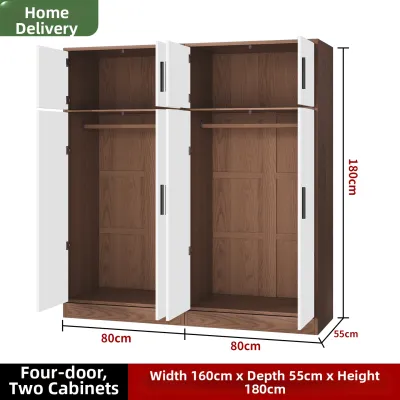
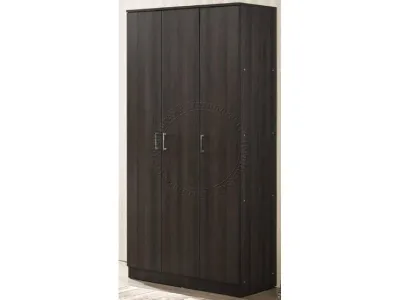
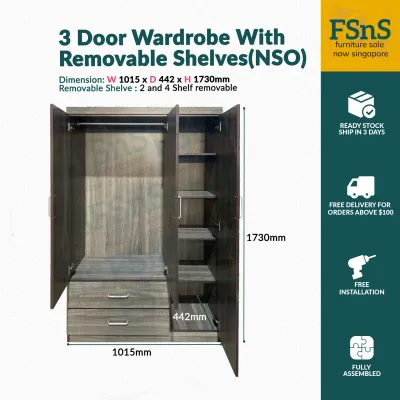
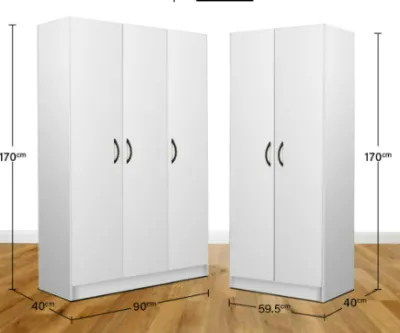
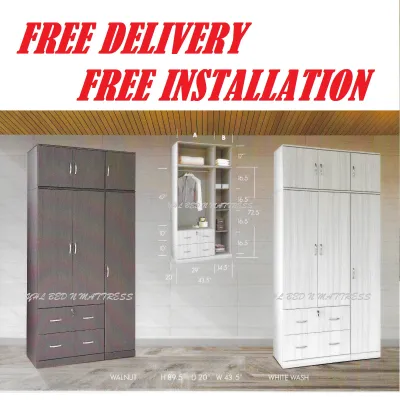
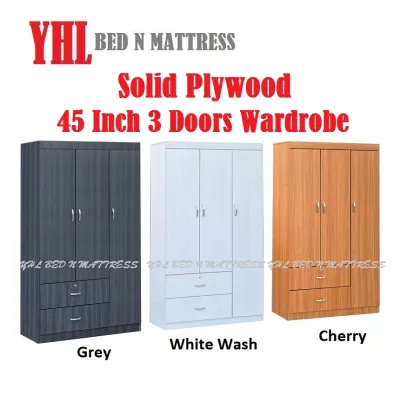
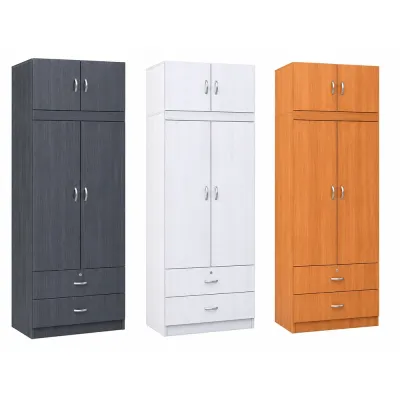
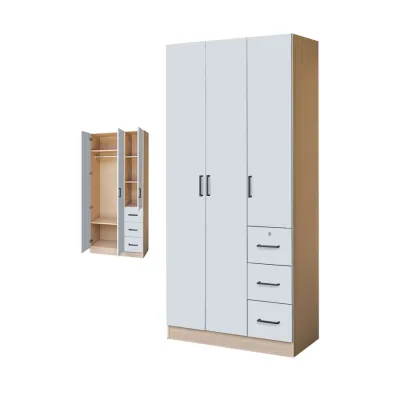
Prices are valid at publication and may change. Please refer to the product page for the latest price.
Visual proportions also play a major role in how spacious your bedroom feels. Standard HDB ceilings sit at a height of approximately 2.6 meters to 2.8 meters. A freestanding 3-door wardrobe, which usually stands between 2.0 and 2.2 meters tall, leaves a visible gap at the top. This gap can keep the room feeling open and airy, though it requires regular dusting. Alternatively, it can be utilized for storing lightweight, infrequently used items like travel luggage.
Key Criteria for Choosing a Wardrobe Brand in Singapore
When shopping for a wardrobe brand in Singapore, generic product descriptions are rarely enough. You must evaluate brands based on specific criteria tailored to local housing designs, environmental conditions, and logistical realities.

Dimensional Flexibility
HDB flats are known for unique architectural features such as structural columns, ceiling beams, and pre-installed air-conditioner trunking. A good wardrobe brand should offer dimensional flexibility. This means providing modular systems that can be adjusted in height or width, or offering custom-tailored solutions that can be scribed directly around awkward wall protrusions and low-hanging concrete beams.
Climate Resilience
Singapore’s tropical climate, characterized by relative humidity levels that frequently exceed 80%, presents a severe challenge for wooden furniture. Low-grade materials easily absorb moisture, leading to mold growth, warping, and structural sagging. You should look for brands that explicitly state the use of moisture-resistant substrates and apply protective laminates or sealed finishes to all exposed surfaces.
Space Optimization
The internal layout of your wardrobe must match your lifestyle and local wardrobe habits. Because Singapore’s weather is warm year-round, most residents store lightweight clothing, which benefits more from hanging rails and shallow drawers than deep, bulky shelving designed for heavy winter wear. Brands that offer customizable internal configurations—such as adjustable shelves, pull-out trouser racks, and double-hanging rods—allow you to maximize every cubic centimeter of storage.
Service Reliability
The purchase process does not end at the checkout counter. Because a 3-door wardrobe is a large, heavy item, a brand’s logistical capabilities are critical. Evaluate the reliability of their delivery teams, the expertise of their on-site assembly technicians, and the clarity of their local warranty terms. A brand with a robust local presence can quickly resolve assembly errors, replace damaged panels, and honor structural warranties without long shipping delays.
Which Type of Wardrobe Brand Suits Your Space and Budget?
To simplify your decision, wardrobe brands in Singapore can be broadly categorized into three main types. Each category serves different spatial needs, aesthetic preferences, and budget ranges.
| Brand Type | Best Use Case | Cost Expectation | Space Utilization | Lead Time |
|---|---|---|---|---|
| Mass-Market & Modular | Standard layouts, tight budgets, and immediate move-in needs | S$300 – S$1,200 | Moderate (leaves gaps above and beside the unit) | 3 – 10 Days |
| Local Custom Carpentry | Maximizing odd spaces, concealing beams, and seamless built-in designs | S$1,500 – S$4,000+ | Maximum (floor-to-ceiling and wall-to-wall fit) | 3 – 6 Weeks |
| Premium Freestanding | High-end materials, heirloom quality, and future home relocation | S$1,500 – S$3,500 | Moderate (requires clear ceiling and floor space) | 2 – 8 Weeks |
Mass-Market and Modular Furniture Brands
Mass-market and modular brands are highly popular among HDB dwellers due to their accessibility and predictable pricing structures. These brands offer standardized wardrobe frames that can be customized internally using online planning tools. This allows you to mix and match hanging rails, drawers, and shelves to suit your specific storage needs.
- Pros: Highly transparent pricing with no hidden design fees, rapid delivery timelines, and the ability to easily purchase replacement parts or additional internal organizers later.
- Cons: Fixed external dimensions mean these wardrobes rarely fit perfectly from wall to wall or floor to ceiling. You will likely end up with awkward gaps that collect dust, and these units cannot be modified to fit around structural beams or wall protrusions.
Local Custom and Built-in Carpentry Brands
Local custom carpentry brands and specialized interior design firms offer tailor-made solutions built specifically for your bedroom’s exact dimensions. Carpenters measure your space down to the millimeter, constructing the wardrobe on-site or in a local workshop to ensure a flawless, seamless fit.
- Pros: Maximum space utilization with zero wasted gaps, complete freedom over materials and finishes, and the ability to fully conceal air-conditioner trunking, electrical wiring, and structural concrete beams.
- Cons: Significantly higher upfront costs, longer lead times due to the design and fabrication process, and the permanent nature of the installation, meaning you cannot take the wardrobe with you if you move house.
Premium Freestanding and Designer Brands
Premium freestanding brands focus on high-quality craftsmanship, utilizing solid woods like teak, oak, or walnut, along with designer hardware. These wardrobes are treated as statement furniture pieces rather than just functional storage boxes, offering distinct aesthetics ranging from mid-century modern to minimalist contemporary.
- Pros: Exceptional material durability, high aesthetic value, and the flexibility to relocate the entire wardrobe to a new room or a future home.
- Cons: High retail prices, significant physical weight that makes rearranging difficult, and fixed heights that leave substantial unused vertical space near the ceiling.
How to Measure and Plan Your HDB Bedroom Space
Before finalizing your purchase or signing a carpentry contract, you must perform precise physical checks of your bedroom. Relying on floor plans alone can lead to costly installation errors, as actual built dimensions often vary slightly from architectural drawings.
Accurate Measuring
Measure the available wall width at three different heights: near the floor, in the middle, and near the ceiling. HDB walls are not always perfectly plumb, and a variance of even one centimeter can prevent a pre-fabricated 150cm wardrobe from fitting into a 150cm alcove. Measure the height from the finished floor to the ceiling, and subtract the thickness of any skirting boards, which can push a freestanding wardrobe away from the wall by 1.5cm to 2cm.
Clearance Checks
A 3-door wardrobe with traditional swing doors requires sufficient clearance to open fully. Ensure there is at least 50cm to 60cm of open space in front of the wardrobe doors so they do not strike your bed frame or bedside tables. To maintain a comfortable, unobstructed walkway through the bedroom, aim for a minimum clearance of 60cm between the fully opened doors and any adjacent furniture. If your floor space is exceptionally tight, prioritize brands that offer sliding doors, which require zero frontal clearance to operate.
Obstacle Identification
Look closely for any potential obstructions along the wall where the wardrobe will stand. Take note of the location of electrical sockets, light switches, and internet ports; blocking these can limit your room’s functionality unless you pay to have them relocated. Additionally, check the path of air-conditioner trunking, the swing radius of bedroom doors, the position of window sills, and the clearance of ceiling fans to ensure no moving parts will collide with your wardrobe.
What to Check for Durability in Singapore's Climate
Because Singapore’s high humidity can rapidly degrade poorly constructed furniture, you must look past attractive laminates and inspect the underlying materials and hardware of any wardrobe you consider.
Board Materials
Freestanding and modular wardrobes are typically constructed from engineered wood substrates. Avoid cheap, low-density particle boards, which act like sponges in humid air, swelling and losing structural integrity over time. Instead, look for brands that use high-density fiberboard (HDF), plywood, or moisture-resistant (MR) medium-density fiberboard (MDF). Always review the manufacturer’s care instructions and product specifications to verify that the core materials are rated for humid environments.
Edge Banding and Finishes
The edges of engineered wood panels are their most vulnerable points. If moisture penetrates these edges, the board core will swell, causing the laminate to peel away. Inspect the wardrobe panels to ensure they feature high-quality edge banding, preferably made of thick ABS (Acrylonitrile Butadiene Styrene) plastic that is seamlessly fused to the board using hot-melt adhesives. Fully sealed edges prevent moisture from entering the core, significantly extending the lifespan of the wardrobe.
Hardware Verification
The moving parts of a 3-door wardrobe endure daily physical stress. Check that the door hinges and drawer runners are made from rust-resistant materials, such as stainless steel or zinc-plated steel, to prevent corrosion in tropical air. High-quality brands often equip their doors with soft-close mechanisms, which reduce physical impact and prevent the structural joints of the wardrobe frame from loosening over years of use.
Delivery, Assembly, and Warranty: What to Ask Before Buying
Logistical and post-purchase factors can vary widely between brands. Asking the right questions before making a payment ensures a smooth delivery process and protects you from unexpected costs.
Logistical Constraints
HDB passenger lifts have strict weight and dimensional limits. Large, single-panel doors or long wardrobe frames may not fit inside standard lift cabins. If the delivery team must carry heavy wardrobe components up the stairwell, most brands charge a manual handling fee, which typically ranges from S$10 to S$20 per floor. Confirm with the brand whether their delivery team has experience navigating HDB lift dimensions and what fees apply if staircase transit is required.
Cost Transparency
Always ask for a complete breakdown of all associated costs. Some brands advertise low retail prices but add substantial charges for delivery, professional assembly, and the disposal of your old wardrobe. Ensure that these services are clearly itemized in your quote. Additionally, check if there are delivery surcharges for specific locations, restricted zones, or deliveries scheduled outside of standard working hours.
Warranty Scope
Read the warranty terms carefully to understand exactly what is covered. A reliable local warranty should cover structural defects, such as sagging shelves, warping frames, and malfunctioning door hinges or sliding tracks, for a period of at least 1 to 5 years. Be aware that standard warranties typically exclude cosmetic wear and tear, damage caused by overloading shelves, and mold growth resulting from poor room ventilation.
Frequently Asked Questions (FAQ)
Can I install a 3-door wardrobe in a standard HDB common room?
Yes, you can install a 3-door wardrobe in a standard HDB common room, but it requires careful spatial planning. Because common rooms typically measure around 9 to 10 square meters, a 150cm to 180cm wide wardrobe will occupy a significant portion of one wall. To preserve floor space, consider placing your bed against the opposite wall or utilizing a single or super-single bed layout. Additionally, choosing a wardrobe with sliding doors instead of swing doors is highly recommended, as it eliminates the need for frontal clearance and keeps your walkways completely clear.
Is it better to buy a freestanding 3-door wardrobe or build a custom one?
This decision depends on your budget, housing tenure, and spatial constraints. If you are renting or plan to move to a new home within a few years, a freestanding 3-door wardrobe is the better option because it is cost-effective, available quickly, and can be disassembled and moved with you. However, if you are a homeowner planning a long-term stay in your HDB flat, a custom built-in wardrobe is generally superior. Custom carpentry maximizes every inch of vertical and horizontal space, leaves no awkward gaps for dust to accumulate, and can be designed to fit seamlessly around structural beams and air-conditioner trunking.

Community discussion
Share your experience or ask a question. Comments are reviewed before publication.