
Quick Diagnosis: Which Mechanism Fits Your HDB Profile?
Selecting the perfect sofa bed for a Housing & Development Board (HDB) flat requires balancing daily living space with hosting needs. In Singapore’s compact apartments, every square meter counts, making the choice of conversion mechanism a critical decision. A mismatch can result in a living room that feels cramped, blocked walkways, or a bed that is too physically demanding to set up.
To make an immediate assessment, look at your flat’s layout and how often you expect to host guests. Pull-out mechanisms are highly suited for larger layouts, such as 4-room or 5-room flats, where you have ample front clearance and want to prioritize long-term sleeping comfort. Conversely, fold-down and click-clack mechanisms shine in compact 2-room or 3-room flats, as well as study-cum-guest rooms, where space is at a premium and quick, effortless conversion is the main priority.
The following sections will guide you through the exact spatial measurements, physical effort considerations, and mechanism comparisons required to make an informed choice for your home.
Products mentioned in this guide
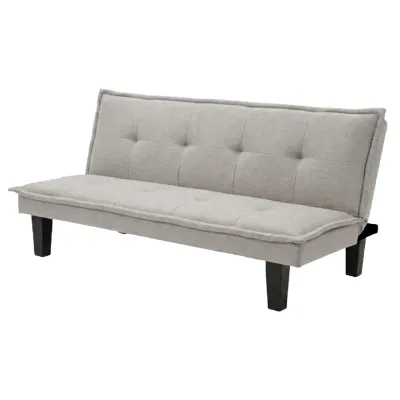
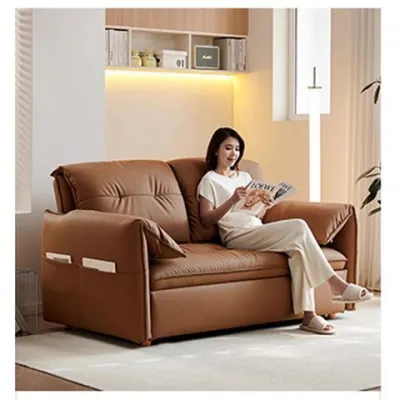
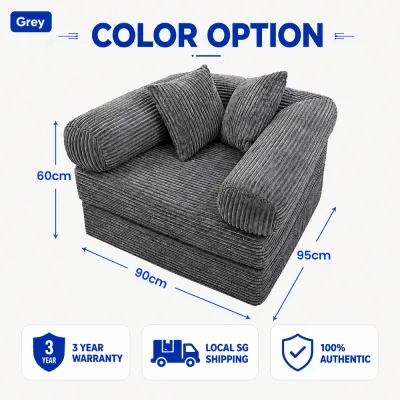
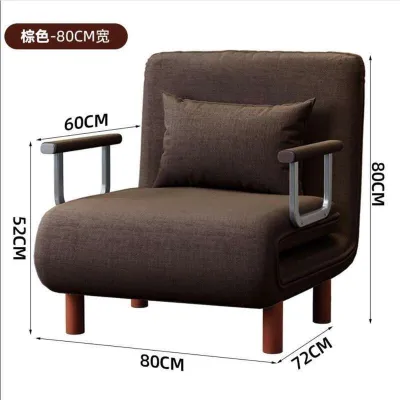
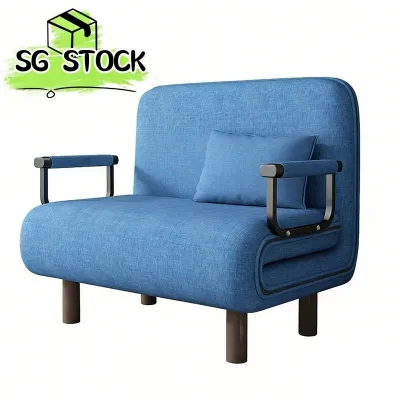
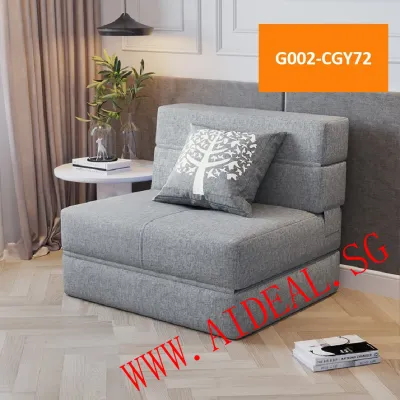
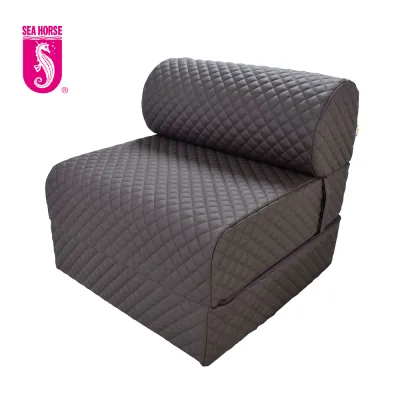
Prices are valid at publication and may change. Please refer to the product page for the latest price.
Assess Your HDB Space and Clearance Constraints
Before browsing showrooms or online catalogs, you must analyze your room’s physical layout. Unlike a standard couch, a sofa bed has a dual identity that requires two completely different sets of dimensions. Failing to account for the fully extended footprint is a common mistake that can leave you unable to walk through your own living room once the bed is deployed.

You must measure the designated area when the sofa is in both its seated and sleeping configurations. The mechanism you choose dictates exactly where this extra space is needed, whether in front of the sofa, behind it, or along the sides.
Measuring Living Room Footprint and Walkways
Pull-out sofa beds demand the most significant amount of front clearance. When fully extended, the mattress and frame roll forward, often extending up to 200 to 220 centimeters from the back wall. You must measure the distance from the sofa’s front edge to your TV console, coffee table, or opposite wall to ensure you have enough space. A functional layout requires at least 60 centimeters of clear walkway space around the extended bed so you can move around without stepping over the sleeping area.
Fold-down and click-clack designs operate on a different spatial axis. These mechanisms typically require rear clearance because the backrest tilts backward to lie flat. If you position a standard click-clack sofa flush against your living room wall, you will have to physically drag the heavy frame forward away from the wall every single time you want to convert it. To avoid this daily hassle, check if the model features a “zero-wall” or “wall-hugger” hinge, or plan to leave a permanent gap of 10 to 20 centimeters behind the sofa.
To visualize these spatial demands before purchasing, use masking tape to outline both the closed and fully extended dimensions directly onto your floor tiles. Walk around the taped boundaries to verify that the open bed will not block access to your balcony doors, household shelter, or main corridor.
Navigating HDB Doorways, Corridors, and Lifts
Buying a sofa bed that fits your living room is only half the battle; it must also be able to reach your living room. Navigating narrow HDB corridors, tight lift doors, and entryways is a major logistical challenge in Singapore estates, especially in older blocks with smaller lift cabins.
Before placing an order, measure the clear width and height of your main entrance door, any internal corridor turns, and the lift landing opening. Pull-out mechanisms are particularly challenging because they often feature heavy, rigid metal frames that are welded together. These frames cannot be bent, compressed, or disassembled during delivery, meaning a tight corner in your entryway can completely block the delivery team.
When shopping, always ask the retailer for the packaged box dimensions rather than just the assembled product dimensions. Look for models designed with detachable armrests, removable back cushions, or legs that screw off. These modular features can significantly reduce the delivery profile, allowing the movers to navigate tight 90-degree turns in your hallway without damaging your walls or the sofa frame.
Evaluate Your Conversion Frequency and Physical Effort
How you plan to use your sofa bed determines how much physical effort you should be willing to tolerate during conversion. A mechanism that feels manageable once a year for a visiting relative can become an exhausting chore if you have to operate it every single night.
Start by diagnosing your actual usage frequency. If the unit is going into a multi-purpose study room and will serve as a daily bed, you need a mechanism that operates smoothly with minimal resistance. If it is purely an emergency option for occasional overnight guests, you might tolerate a slightly heavier mechanism in exchange for a lower price point or a more compact design.
The physical weight of the mechanism is directly tied to its internal construction. Pull-out models with thick, supportive metal frames and real mattresses offer excellent sleep support but require a fair amount of lifting and pulling strength to deploy. If the primary user of the room is an elderly family member, a teenager, or someone with back sensitivities, a heavy pull-out frame can pose a physical risk. For these households, lighter click-clack or spring-assisted fold-down mechanisms are highly recommended.
Another practical factor to consider is bedding storage, which is a premium commodity in HDB flats. Many pull-out designs require you to completely strip the bed, removing all pillows, sheets, and duvets before you can fold the frame back into a sofa. This means you must have dedicated space in your wardrobe or a nearby cabinet to store these bulky bedding items during the day. In contrast, some fold-down futon designs are forgiving enough to allow you to leave a thin mattress protector or fitted sheet in place when folded back, saving you time and storage space.
Comparing Pull-Out, Fold-Down, and Click-Clack for HDB Living
To choose the right mechanism, you must weigh the trade-offs of each design against your specific spatial constraints, budget, and comfort expectations. No single mechanism is perfect for every HDB flat, but each serves a distinct living scenario.
Pull-Out Mechanisms
The pull-out mechanism operates by housing a folded frame and mattress beneath the seat cushions. To convert it, you remove the loose seat cushions and pull a handle, causing the metal frame to roll forward and unfold in two or three sections.
The primary advantage of a pull-out sofa bed is superior sleep quality. Because the mattress is a separate component from the seating cushions, manufacturers can use high-quality pocket springs or high-density foam. This makes it feel like a traditional bed, providing excellent spinal support for multi-night stays. Additionally, when closed, it looks and feels exactly like a standard, plush living room sofa.
However, this mechanism is the heaviest and most demanding option for HDB living. It requires substantial front clearance, making it highly impractical for narrow living rooms or tight study rooms. It also lacks built-in storage and is generally the most expensive option due to the complex metal hardware.
Fold-Down (Futon) Mechanisms
Fold-down mechanisms, often referred to as classic futon styles, operate by releasing a lock on the backrest and lowering it flat so that it aligns perfectly with the seat cushion. The combined surface of the seat and backrest forms the sleeping mattress.
This design is highly valued for its straightforward, reliable operation. Because it has fewer moving mechanical parts than a pull-out, it is generally lighter and less prone to mechanical failure over time. Many modern fold-down designs feature clever hinge systems that minimize the gap needed between the sofa back and the wall, making them highly space-efficient.
The main trade-off is comfort and aesthetic appeal. Because you sit and sleep on the exact same cushions, the surface can feel quite firm, and you may feel the central seam where the two halves meet. Over time, the high-traffic seating areas may compress faster than the backrest, leading to an uneven sleeping surface.
Click-Clack Mechanisms
The click-clack mechanism is a popular variation of the fold-down design. It operates by lifting the seat section upward until you hear an audible “click” from the internal hinges, which unlocks the backrest. You then lower the seat back down, and both sections lay flat together.
For tight HDB spaces and budget-conscious homeowners, click-clack sofa beds are incredibly practical. They are lightweight, highly affordable, and can be converted in less than ten seconds with minimal physical lifting. Their compact, leggy designs often make small rooms feel more open and airy by keeping the floor visible.
The downside is that click-clack mattresses are typically thin and integrated directly into the sofa frame, offering minimal cushioning. The central hinge mechanism can wear out with frequent use, and the sofa must be pulled away from the wall to operate unless it features a specialized wall-saving hinge. This makes it best suited for short-term guest stays rather than daily sleeping.
Essential Pre-Delivery and Fabric Checks for Singapore Homes
Once you have selected your preferred mechanism, you must perform a few final quality and feasibility checks before finalizing your purchase. These steps will save you from delivery-day disasters and ensure your new furniture survives Singapore’s tropical climate.
First, verify the delivery feasibility with your retailer. Provide them with your exact HDB lift dimensions and any tight corridor measurements. Ask explicitly about their “tight corner” or return policies if the sofa bed cannot physically fit through your doorway. Many retailers charge restocking or transport fees if a delivery fails due to spatial constraints, so getting confirmation in writing is highly recommended.
Second, pay close attention to the fabric composition. Because Singapore experiences high year-round humidity, non-breathable fabrics can easily trap sweat, body oils, and ambient moisture, leading to musty odors and mold growth. Always check the applied product’s label and the manufacturer’s care instructions before attempting any deep cleaning. Avoid heavy, tightly woven synthetic fabrics that lack ventilation. Instead, look for performance fabrics treated with moisture-resistant barriers, or choose sofa beds with fully removable, machine-washable fabric covers. This allows you to easily clean the entire outer layer, keeping the sleeping surface hygienic for your guests.
Finally, always test the physical mechanism in the showroom yourself. Do not rely solely on the sales demonstration. Convert the sofa bed back and forth several times to check for smooth operation. Listen closely for any loud metallic squeaks or grinding sounds, which can indicate poor-quality hinges or misaligned frames. Ensure that the locking mechanisms engage securely and that there are no exposed pinch points that could catch your fingers or damage the fabric during conversion.
Frequently Asked Questions (FAQ)
These common queries can help clarify specific layout and physical requirements when selecting a sofa bed.
Can a pull-out sofa bed fit in a compact 3-room HDB?
Yes, a pull-out sofa bed can fit in a 3-room HDB, but its feasibility depends entirely on your living room’s depth and layout. You must measure the distance from the back wall to your TV console. If the fully extended bed leaves less than 60 centimeters of clearance, it will block your main walkway and make navigating the flat difficult. For tight 3-room layouts, a fold-down or click-clack mechanism is generally a safer, more practical choice.
Which mechanism requires the least physical strength to convert?
Click-clack and basic fold-down mechanisms require the least physical strength to operate. These designs utilize simple, spring-assisted hinges and gravity to transition from a sofa to a bed, eliminating the need to lift and pull a heavy metal frame across the floor. If ease of use is your primary concern, look for click-clack models with lightweight frames, and always test the mechanism’s resistance in-store to ensure it is manageable for your household.
Community discussion
Share your experience or ask a question. Comments are reviewed before publication.