
Finding the right broom holder for a small Housing & Development Board (HDB) utility area or service yard is a balancing act between accessibility and space preservation. Because these spaces often double as laundry yards, household shelters, or general storage zones, floor space is at a premium. The ideal solution depends entirely on your specific layout: whether you have bare concrete walls, a standard swing door, or a small, unused corner on the floor. By matching your utility area’s physical limits to the right organizer type, you can keep your cleaning tools tidy, dry, and completely out of the way.
To make an informed decision, you must evaluate the structural and spatial characteristics of your utility space. A wall-mounted holder, an over-door rack, or a freestanding organizer each offers distinct advantages depending on your home’s layout. Assessing your space beforehand prevents common installation mistakes, such as drilling into hidden utility lines or buying an organizer that blocks your washing machine door.
Assess Your HDB Utility Area Space
Before purchasing any organizing hardware, take precise measurements of your utility area to identify viable mounting zones. HDB service yards and utility closets are highly functional spaces where every centimeter counts. Start by measuring the clear wall space, keeping a close eye out for hidden copper pipes, electrical conduits, and water trunking. Drilling into a wall with active utility lines can lead to costly repairs, so mapping out safe zones is an essential first step.
Products mentioned in this guide
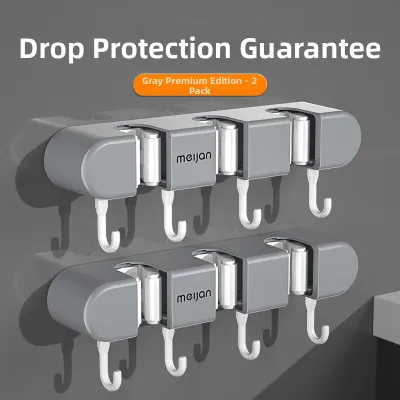
![🇸🇬【SG stock】]Lowest price ]Broom Mop Holder with Hooks Punch-free Broom Storage Rack Mop Broom Organizer for Bathroom Bathroom hook 拖把夹,Broom holder](https://img.lazcdn.com/g/p/81ab42d5f0548a45e8660866c932b791.png_400x400q80.png_.webp)
![[NEW] 3pcs No Drill No Punch Bathroom Mop Holder Broom Hanger Clip Waterproof](https://img.lazcdn.com/g/p/0f2d52949514e6a732bc8978b276993d.jpg_400x400q80.jpg_.webp)
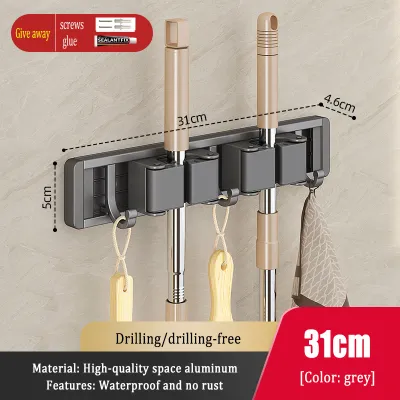
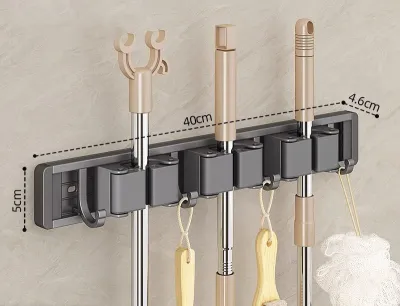
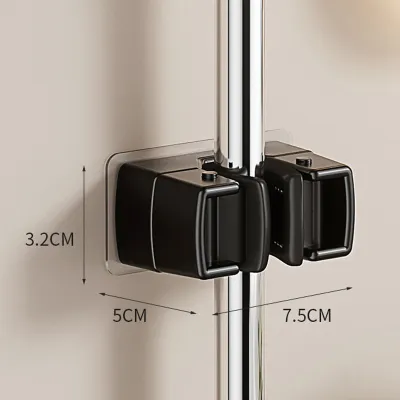
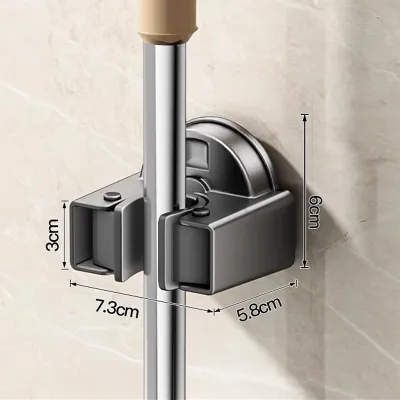
Prices are valid at publication and may change. Please refer to the product page for the latest price.
Next, examine the doors in your utility area. If you plan to use an over-door hanger, you must check the clearance gap between the top of the door and the frame. A gap that is too narrow will cause the hanger to jam, preventing the door from closing fully or damaging the frame over time. You can test this by placing a small coin on top of the door and closing it; if the door shuts without resistance, you likely have enough clearance for a standard over-door bracket.
Finally, evaluate the floor footprint and traffic flow of the room. If you are considering a freestanding unit, map out its potential position on the floor. Ensure the unit will not obstruct access to your washing machine door, the rubbish chute, the sink, or the water heater. A freestanding rack that blocks daily pathways quickly becomes a frustrating daily obstacle rather than a helpful storage solution.
Wall-Mounted Broom Holders: Best for Clear Floors
Wall-mounted broom holders are excellent for keeping your utility floor completely clear of clutter. By lifting mops, brooms, and dustpans off the ground, you make it much easier to sweep and mop the utility floor itself. However, successful wall mounting depends heavily on the structural material of your walls.

In Singapore HDB flats, utility walls are often made of solid concrete or structural precast panels, though some partition walls may be drywall. Concrete walls require a hammer drill and masonry wall plugs to secure heavy-duty screws. If you are renting or prefer not to drill into tiled surfaces, heavy-duty adhesive mounts are an alternative, but they have strict weight limits. Always verify whether your wall surface can support adhesive backing before relying on it for heavy wet mops.
Another critical factor is the handle diameter of your cleaning tools. Wall-mounted holders typically use rubberized grip slots or spring-loaded rollers to hold handles in place. Measure the thickness of your broom and mop handles to ensure they fall within the holder’s specified grip range. Additionally, plan the mounting height carefully; position the holder high enough so that the longest broom hangs completely clear of the floor, yet low enough that you can easily reach and release the tools without straining.
Over-Door Broom Holders: Best for Hidden Storage
If you have limited wall space but a standard swing door leading into your utility area, an over-door broom holder is a highly efficient way to utilize hidden storage. This setup keeps your cleaning tools tucked neatly behind the door, out of sight from the rest of the home.
Before choosing this option, verify that your door and its hinges can handle the extra weight. Standard HDB timber doors are generally sturdy, but lightweight hollow-core doors or plastic folding doors may warp or sag under the weight of multiple heavy tools. Check that the hinges are securely tightened and show no signs of wear. The bracket that hangs over the top of the door must also match the door’s thickness to prevent rattling whenever the door is opened or closed.
Additionally, consider the clearance behind the door when it is fully open. Hanging bulky items like brooms and mops will increase the overall profile of the door. Ensure that these tools will not scratch the adjacent wall, catch on nearby shelving, or prevent the door from opening wide enough for you to pass through comfortably. Using soft bumpers on the back of the holder can help cushion any contact with the door surface.
Freestanding Broom Holders: Best for Flexible Layouts
Freestanding broom organizers are ideal if you want a flexible storage layout that requires absolutely no installation. These racks can be placed in corners, inside deep closets, or next to the washing machine, and they can be moved easily whenever you decide to reorganize your utility space.
When choosing a freestanding rack, the base footprint is the most critical measurement. Look for compact designs that fit snugly into tight corners without protruding into walking paths. Because these units stand on the floor, they must remain stable even when fully loaded. Check the manufacturer’s specifications regarding the base weight and center of gravity; a bottom-heavy design is essential to prevent the rack from tipping over when you pull a broom out of its slot.
For exceptionally tight spaces, look for freestanding models that feature a narrow profile or foldable frames. Some designs allow you to fold the rack flat when it is not in use, which is incredibly useful if you only need to store tools occasionally. Ensure the floor surface where the rack will sit is completely level to maintain optimal stability.
Decision Matrix: Matching Holder Type to Your Space
To help you finalize your choice, the table below maps common HDB utility area conditions to the most suitable broom holder type, highlighting the key trade-offs of each option.
| Space Condition | Recommended Holder Type | Primary Advantage | Key Trade-off |
|---|---|---|---|
| No-drilling allowed / Tiled walls | Adhesive Wall-Mounted | Keeps floors clear without damaging tiles | Lower weight capacity; adhesive can degrade in humid conditions |
| Solid concrete walls / Permanent setup | Drilled Wall-Mounted | Extremely secure; handles heavy wet mops | Requires drilling tools and permanent wall alteration |
| Zero wall space / Standard swing door | Over-Door Rack | Uses hidden space; zero installation effort | Can rattle; requires sufficient top-door clearance gap |
| Rental home / Flexible layout needed | Freestanding Rack | Easy to move; no installation required | Consumes floor space; potential tipping hazard if overloaded |
Choosing the right match ensures that your organizer remains secure and functional without causing damage to your home’s fixtures or surfaces.
Installation and Safety Checks for Small Spaces
Once you have selected your broom holder, proper installation is key to ensuring safety and longevity in a cramped utility area. Always read the manufacturer’s instructions carefully to understand the maximum weight limits and the specific hardware required for installation. Overloading any holder can lead to structural failure, causing tools to fall and potentially damage nearby appliances.
If you are using adhesive-mounted holders on tiles or glass, clean the surface thoroughly with rubbing alcohol to remove grease and dust before application. Test the adhesive on a small, inconspicuous area first to ensure it bonds correctly without damaging the finish. After applying the adhesive mount, allow it to cure for the manufacturer’s recommended time—often 24 hours—before hanging any heavy tools on it.
After installation, perform a thorough stability check. Load your heaviest cleaning tools onto the holder and observe how it responds. For wall-mounted units, check for any signs of pulling away from the wall. For over-door units, open and close the door at normal speed to ensure the tools do not swing violently or slide off. For freestanding racks, gently nudge the unit to confirm that the center of gravity remains stable and secure.
Frequently Asked Questions (FAQ)
Can I use adhesive broom holders on painted HDB walls?
Adhesive broom holders are generally not recommended for direct use on painted HDB walls. The weight of hanging brooms and mops can pull the adhesive pad away, often tearing the paint layer off the drywall or plaster underneath. If you must use them on a painted surface, check the product label to ensure the adhesive is specifically rated for painted walls, and strictly adhere to the lower weight limits specified by the manufacturer. For long-term reliability on painted surfaces, mechanical fasteners like screws and wall plugs are highly preferred.
How do I prevent an over-door holder from scratching my door?
To protect your door’s finish, look for over-door holders that include protective foam or rubber padding on the inside of the hanging brackets. If your holder does not come with padding, you can apply thin felt strips or double-sided foam tape to the contact points yourself. Additionally, ensure the door is properly aligned on its hinges so that the holder does not rub against the door frame when opening or closing. Regularly check that the brackets remain snug and do not slide horizontally during daily use.
Community discussion
Share your experience or ask a question. Comments are reviewed before publication.