
Integrating a wardrobe mirror into a compact Housing & Development Board (HDB) bedroom requires balancing functional viewing with the realities of limited floor space. In a typical HDB bedroom, which generally ranges from 9 to 12 square meters, every centimeter of clearance matters. To achieve a full-body reflection without making the room feel cramped, you must carefully select the mirror’s dimensions and configuration based on your wardrobe door style and room layout.
Assessing Bedroom Space and Clearances for Mirror Placement
HDB floorplans often feature tight clearances, with common bedrooms averaging 9 square meters and master bedrooms around 12 to 14 square meters. When planning a wardrobe installation, measuring the available wall length and floor space is the first step. Look out for structural columns and overhead air-conditioning trunking, which are common architectural features in Singapore flats that can restrict wardrobe height and mirror placement.
To see your entire body in a mirror, you must stand at a distance that allows the reflection of your head and feet to fit within your field of view. In a compact room, this standing distance is a critical constraint. If your wardrobe faces the bed, the gap between the wardrobe doors and the bed frame might only be 60 cm to 80 cm, which is insufficient for a comfortable full-body view unless the mirror is specifically sized and positioned.
Products mentioned in this guide
![[SG Stock]Wardrobe built-in full-length mirror folding sliding mirror escopic rotary mirror](https://img.lazcdn.com/g/p/16ffc4056d4d9b39e115c9836ce5035b.jpg_400x400q80.jpg_.webp)


![[INNDESIGN.SG] Rey 3 Doors Wardrobe + Mirror + Drawer (Fully Assembled and Free Delivery)](https://img.lazcdn.com/g/p/5d53f103a5e2f003c5c6c97e2fbd2a21.jpg_400x400q80.jpg_.webp)
Prices are valid at publication and may change. Please refer to the product page for the latest price.
Furthermore, you must calculate physical clearances for door swings. Standard swing wardrobe doors require 45 cm to 60 cm of clearance to open fully. If you have bedside tables or a main bedroom door that swings inward, these paths can easily collide with your wardrobe or block your view of the mirror. Measuring these arcs ensures that you do not install a mirror that is permanently obscured or prone to getting struck by opening doors.
Determining Functional Wardrobe Mirror Dimensions
Choosing the size of a wardrobe mirror is not a matter of guesswork; it relies on simple optical physics. To view your entire body, a vertical mirror does not need to be your full height. According to the laws of reflection, a mirror needs to be exactly half your height, provided its top edge is aligned with the top of your head and its bottom edge is halfway between your eyes and the floor. For an average height of 160 cm to 175 cm, a mirror height of 90 cm to 100 cm is theoretically sufficient, though a standard height of 120 cm to 150 cm is typically preferred to accommodate users of different heights in the same household.

Width is equally important for visual comfort. A single-person mirror should have a minimum width of 35 cm, while 45 cm to 50 cm is ideal to prevent the reflection of your shoulders and arms from being cut off. If a couple shares the bedroom and intends to use the mirror simultaneously, a wider configuration of 60 cm or more is recommended, though this is often split across two wardrobe doors to maintain structural balance.
Vertical constraints in HDB bedrooms frequently include skirting boards at the floor level and bulkheads or plaster ceilings at the top. These architectural features reduce the usable vertical surface of your wardrobe doors. When calculating mirror dimensions, always subtract the height of the skirting board (typically 7 cm to 10 cm) and any top trim or cornice to ensure the mirror fits perfectly on the door panel without overlapping structural joints.
Choosing the Right Mirror Configuration for Your Wardrobe
Sliding Door Wardrobes
Sliding doors are highly popular in compact HDB bedrooms because they do not require forward clearance to open. When integrating a mirror, you can choose to cover an entire sliding door panel with mirror glass or alternate between mirror and solid wood or laminate panels. Covering both doors in a two-door sliding wardrobe with mirrors can make the room look twice as large, but it also increases the visual weight and can feel overwhelming.
When opting for sliding door mirrors, pay close attention to track clearance and panel overlap. Wardrobe sliding doors slide behind one another, meaning there must be enough clearance (typically 1 cm to 2 cm) between the overlapping panels so that the mirror frame or glass does not scrape against the adjacent door. Additionally, thick frames can reduce the visible glass area and add unnecessary weight, making slim profile aluminum frames or frameless bevel-edged mirrors a superior choice for sliding mechanisms.
Swing Door Wardrobes
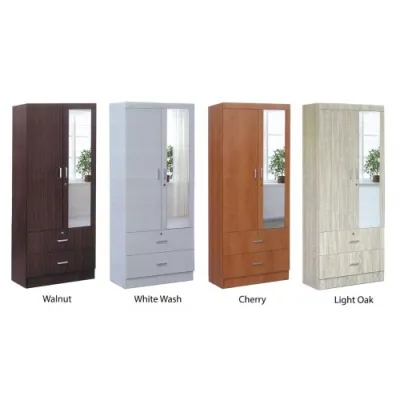
Swing door wardrobes offer a classic aesthetic and allow you to mount mirrors either on the exterior or interior of the doors. Exterior mounting provides immediate access to the mirror without opening the wardrobe, while interior mounting keeps the mirror hidden when not in use. If you choose exterior mounting, a single full-length mirror on one door is often sufficient, but you can also install mirrors on adjacent doors to create a multi-angle viewing station.
The primary technical concern with swing door mirrors is the weight capacity of the hinges. Standard wardrobe hinges are designed to support the weight of a wooden or MDF door panel, not the heavy load of a large sheet of glass. Adding a full-length mirror can strain these hinges, leading to sagging doors that scrape against the floor or fail to close properly. To prevent this, ensure your wardrobe builder uses heavy-duty hinges (such as those rated for 15 kg or more per door) and adds extra hinges (typically four instead of three) to distribute the weight safely.
Concealed and Pull-Out Mirrors
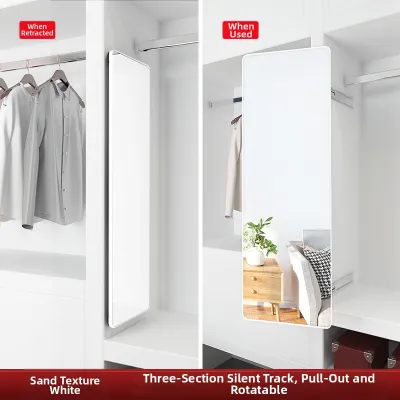
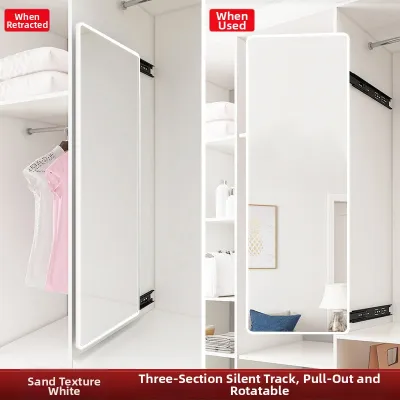
For bedrooms where external mirrors are undesirable due to design preferences or cultural beliefs, concealed pull-out mirrors are an excellent alternative. These mirrors are mounted on a sliding track inside the wardrobe carcass. To use them, you simply pull the mirror out of the wardrobe and pivot it to the desired angle.
While highly space-saving, pull-out mirrors require specific internal clearances. The wardrobe must have a minimum internal depth of 55 cm to 60 cm to accommodate the track mechanism alongside hanging clothes. You must also reserve about 5 cm to 10 cm of lateral space inside the wardrobe compartment, which slightly reduces the available hanging width. Ensure that clothes hanging on the adjacent rail do not catch on the mirror track or block its smooth operation.
Maximizing Space and Light with Strategic Placement
In compact HDB flats, strategic mirror placement can dramatically alter the perception of space. Placing a wardrobe mirror directly opposite or adjacent to a window allows it to capture and bounce natural daylight throughout the room. This simple optical trick brightens dark corners, softens shadows, and makes a standard 9-square-meter bedroom feel significantly more spacious and airy.
However, visual comfort must be carefully balanced. Mirrors reflect everything in their line of sight, meaning a mirror facing a cluttered open shelf, a laundry basket, or a messy desk will visually double the clutter, creating a sense of restlessness. Furthermore, many homeowners in Singapore prefer to avoid placing a mirror directly facing the bed. Seeing a sudden reflection when waking up in the middle of the night can be startling, and in traditional feng shui practices, a mirror facing the bed is believed to disrupt sleep quality and energy levels.
The design of the mirror edge also plays a role in visual clutter. Frameless mirrors with polished or beveled edges blend seamlessly into the wardrobe door, creating a clean, modern look that minimizes visual boundaries. In contrast, heavy, dark, or ornate frames draw attention to the physical limits of the mirror, which can make a small bedroom feel more segmented and confined.
Ensuring Safe Installation and Long-Term Maintenance
Safety is paramount when dealing with large sheets of glass in a high-traffic area like a bedroom. Before mounting a mirror, verify the structural integrity of the wardrobe door. Hollow-core doors, which are common in mass-produced furniture, may not have the internal support required to hold heavy screws or mounting adhesives. Solid wood, high-density fiberboard (HDF), or reinforced plywood doors are highly recommended for external mirror mounting.
To mitigate the risk of injury, always specify shatterproof backing or apply a high-quality safety film to the back of the mirror glass. In the rare event that the mirror is struck and breaks, the safety film will hold the shattered glass fragments together, preventing sharp shards from scattering across the bedroom floor. This is a critical safety measure, especially in households with active children or pets.
Long-term maintenance of wardrobe mirrors involves protecting the silver backing from moisture and chemical damage. Singapore’s humid tropical climate can accelerate the degradation of the mirror’s reflective backing, leading to a phenomenon known as “black edge” or silvering rot. To prevent this, avoid using harsh chemical glass cleaners that contain ammonia or acid, as these can seep behind the edges and dissolve the silver coating. Instead, clean the mirror with a microfiber cloth slightly dampened with warm water, and wipe the edges completely dry immediately afterward.
Common Sizing and Layout Mistakes to Avoid
One of the most frequent mistakes is choosing a mirror that is too short or mounting it too high. When a mirror’s vertical range is restricted, users are forced to step backward to see their entire outfit. In a narrow HDB bedroom corridor or a tight space between the wardrobe and the bed, there may not be enough physical room to step back, rendering the full-length mirror ineffective.
Another common oversight is ignoring the swing paths of other doors in the bedroom. If your wardrobe is positioned near the entrance of the room or adjacent to the en-suite bathroom, an outward-swinging bathroom door or an inward-swinging bedroom door can easily collide with the wardrobe door. If a mirror is mounted on the exterior of that wardrobe door, a sudden collision can result in shattered glass and expensive damage.
Lastly, avoid placing your wardrobe mirror where it directly reflects overhead light fixtures or bedside lamps. Direct reflections of light bulbs can create intense glare, causing eye strain and visual discomfort when you are trying to dress or relax in bed. Position the mirror so that it reflects ambient, diffused light rather than direct, exposed light sources.
Frequently Asked Questions (FAQ)
What is the minimum distance I need to stand from a full-length wardrobe mirror?
To view your entire body from head to toe, the minimum standing distance depends on the height and placement of the mirror. For a standard 120 cm tall mirror mounted at the correct height (with the top of the mirror aligned with your forehead), you typically need to stand at least 1.2 to 1.5 meters away to capture your full reflection. If your bedroom layout only allows for a standing distance of 1 meter or less, you will need a taller mirror (at least 150 cm to 180 cm) mounted closer to the floor to compensate for the limited viewing angle.
Can I retrofit a mirror onto my existing HDB built-in wardrobe?
Yes, retrofitting a mirror onto an existing wardrobe is highly feasible, but it requires careful preparation. First, check the weight capacity of your existing hinges or sliding tracks to ensure they can handle the additional load of glass, which typically weighs around 10 kg per square meter for 4mm thick mirror glass. For mounting, a combination of high-strength polyurethane mirror adhesive and double-sided mounting tape is recommended for a secure hold on laminate or wood surfaces. Always refer to the adhesive manufacturer’s instructions for curing times and load limits, and consult a professional carpenter if your doors feel flimsy.
Are frameless wardrobe mirrors safe for bedrooms with children or pets?
Frameless wardrobe mirrors are safe, provided they are installed correctly and feature polished or beveled edges. Unpolished glass edges are extremely sharp and pose a severe cutting hazard. For households with children or pets, ensure the mirror edges are flat-polished or pencil-polished to eliminate sharp corners. Additionally, the mirror must be securely bonded to the wardrobe door across its entire surface area using industrial-grade mirror adhesive, and a shatterproof safety backing should be applied to prevent any loose shards from falling if an accidental impact occurs.
Community discussion
Share your experience or ask a question. Comments are reviewed before publication.