
Selecting the right bags organizer for a compact Singapore HDB bedroom is a balancing act between conserving limited floor space and keeping your collection structured and accessible. Modern HDB layouts, particularly in newer Build-To-Order (BTO) flats, often feature bedrooms where every square centimeter counts. Standard freestanding wardrobes frequently lack dedicated compartments for handbags, backpacks, or clutches, leading to cluttered surfaces or squished accessories. By shifting your storage strategy toward vertical wall space and hidden, underutilized zones, you can keep your bags in pristine condition without making your bedroom feel cramped.
Map Your HDB Bedroom's Available Storage Footprint
Before purchasing any new furniture, it is essential to conduct a thorough spatial audit of your bedroom. Many homeowners make the mistake of buying storage units based solely on product photos, only to find the piece blocks natural foot traffic or prevents doors from opening fully. In a typical HDB bedroom, the most valuable real estate is often hidden in plain sight. Walk around your room and identify potential dead zones, such as the blank wall space behind your bedroom door, the empty gap between your wardrobe and the ceiling, the narrow pocket of space next to your bedside table, or the deep void underneath your bed frame.
When measuring these zones, precision is critical to avoid costly return fees or assembly headaches. One of the most common oversights is ignoring the thickness of your skirting boards. These baseboards, which run along the bottom of your walls, typically protrude by 10 to 15 millimeters. If you fail to account for this gap, a tall, flat-backed bags organizer will not sit flush against the wall, causing it to tilt forward and become unstable. Always measure the distance from the outer edge of the skirting board rather than the bare wall.
Products mentioned in this guide
![[Local Seller] Removable bag storage box partition adjustable bag storage rack Handbag organizer closet bag storage rack extendable](https://img.lazcdn.com/g/p/f828139566d9b1b55f7bcdea4ee1175e.jpg_400x400q80.jpg_.webp)
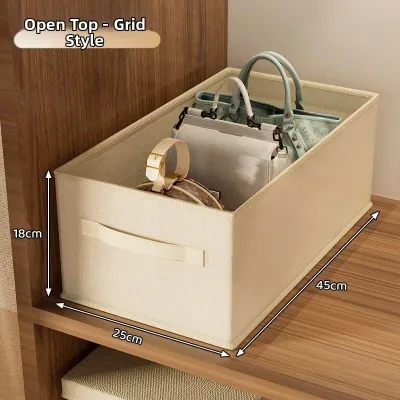
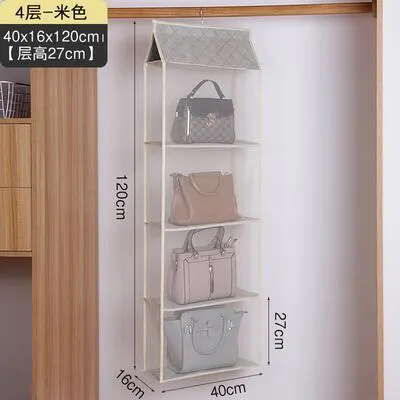
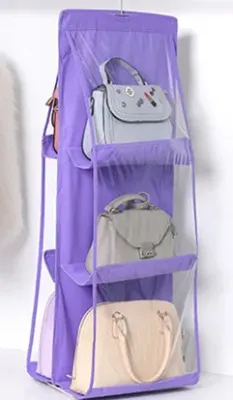
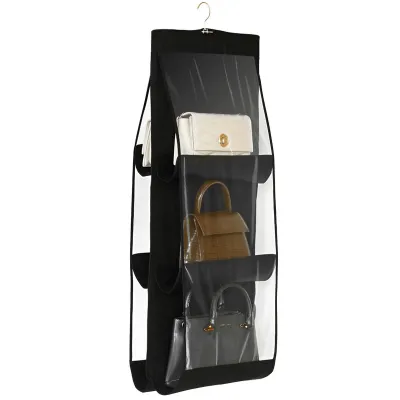
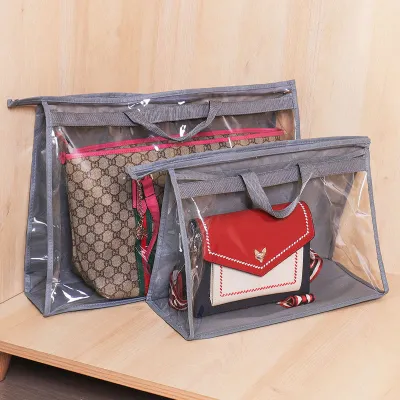
![[SG Stock] Bag storage dustproof bag Luxury bag handbag organizer storage bag wardrobe sealed leather protective bag](https://img.lazcdn.com/g/p/ea7088e5fe6e212fa5d859ca96921ce6.jpg_400x400q80.jpg_.webp)
Prices are valid at publication and may change. Please refer to the product page for the latest price.
Additionally, you must map out the operational clearance of every moving element in the room. This includes the swing arc of your bedroom door, wardrobe doors, and even low-hanging ceiling fans or air-conditioning trunking. If a wall-mounted shelf or over-the-door rack extends too far, it can collide with these elements, causing cosmetic damage to both your home and your bags. Aim to preserve a minimum walkway clearance of 50 to 60 centimeters around your bed and along the path to your en-suite bathroom to ensure comfortable, unobstructed movement daily.
Vertical and Hidden Bags Organizer Furniture for Tight Layouts
Maximizing a small bedroom layout requires furniture that works harder without expanding your footprint. By categorizing potential solutions by their spatial zones, you can match the right style of organizer to the specific layout of your HDB room.

Over-the-Door and Wall-Mounted Solutions
Utilizing vertical surfaces is the most effective way to free up floor space. Over-the-door racks and hooks are highly convenient for storing daily-use bags, but they require careful compatibility checks. Before buying, measure your door frame’s thickness; standard HDB internal doors are usually 35mm to 40mm thick. You must also check the clearance gap between the top of the door and the frame. A clearance of at least 2mm to 3mm is typically required to allow the door to close smoothly without the metal brackets scraping the paint or damaging the frame.
For a more permanent and visually appealing option, wall-mounted pegboards, slatwalls, or floating shelves turn your bag collection into a decorative feature. However, the installation method must match your wall type. External walls and structural columns in HDB flats are made of solid reinforced concrete, which requires a hammer drill, masonry drill bits, and heavy-duty wall plugs to mount securely. Internal partition walls, on the other hand, are often made of lightweight concrete panels or drywall, requiring specialized hollow-wall anchors to prevent the weight of your bags from pulling the screws out of the wall.
Under-Bed Drawers and Slide-Out Hidden Storage
The space beneath your bed is one of the largest underutilized areas in a bedroom. Rolling under-bed drawers or zippered fabric storage boxes are perfect for seasonal bags or larger travel totes that you do not need to access daily. When selecting under-bed options, measure the exact vertical clearance from the floor to the lowest point of your bed frame. Remember to factor in the height of the drawer’s castor wheels—typically 3cm to 5cm—and the height of your structured bags to ensure they can slide in and out without being compressed or scuffed.
Alternatively, if you have a small gap next to your wardrobe or bed, consider a slide-out tower cabinet. These narrow, vertical pull-out units function similarly to kitchen pantry organizers. They keep your bags organized upright and completely enclosed, protecting them from dust, humidity, and direct sunlight while remaining highly accessible with a simple pull.
Slim Gap Fillers and Corner Towers
Awkward gaps between your wardrobe and the wall are often left empty because standard furniture does not fit. Slim pull-out towers, ranging from 15cm to 30cm in width, are designed specifically to slide into these tight spaces. Before choosing a pull-out model, verify that the floor area directly in front of the gap is completely clear, allowing the drawer mechanism to extend to its full depth without hitting your bed frame or bedside table.
If you have an empty corner, a tiered corner rack or corner shelving unit can turn a dead angle into a functional storage zone. When evaluating corner shelves, pay close attention to the shelf depth. Handbags and backpacks require a stable, flat base to sit upright. If the corner shelf is too shallow or tapers too sharply, the bases of your bags will hang over the edge, making them prone to tipping over and losing their shape.
Critical Clearances and Installation Checks for HDB Rooms
Ensuring your chosen bags organizer fits perfectly and remains safe to use involves verifying several structural and installation details unique to HDB flats.
To address the skirting board issue, look for freestanding organizers designed with a recessed base or a cut-out back. These design features allow the furniture to slide over the skirting board so the upper frame can rest flush against the wall. If your preferred organizer does not have this feature, you can install small spacer blocks behind the top mounting brackets to keep the unit perfectly vertical and prevent it from leaning forward.
Operational clearance must also extend to your daily routines. Ensure that slide-out drawers, pull-out towers, or low-hanging hooks do not block your main walking paths when fully extended. If you have a built-in wardrobe with swing doors, verify that a freestanding bag rack placed nearby will not obstruct the wardrobe doors from opening to their full 90-degree angle.
Safety is paramount when dealing with tall, narrow, or wall-mounted furniture. Always check the manufacturer’s specified load capacity for each shelf, hook, or drawer. Tall gap-fillers and heavy wall-mounted units should always be anchored to the wall using appropriate anti-tip hardware. This is an essential safety precaution to prevent accidental tip-overs, especially in households with active children, curious pets, or older adults who might use the furniture for support.
Structural and Material Checks to Protect Your Bags
A good bags organizer should not only store your collection but also preserve its structural integrity and material quality over time. Avoid choosing furniture based solely on generic material descriptions like “solid wood” or “metal” without inspecting the actual finish and construction details.
Examine the surfaces that will come into direct contact with your bags. Look for rounded, wide, or padded hooks to hang shoulder straps; narrow, sharp metal hooks can crease leather or stretch out fabric straps permanently. Ensure wooden shelves have high-quality, smooth edge banding to prevent delicate silk, canvas, or leather from snagging on rough wood grain. For premium leather bags, look for drawers or shelves lined with soft felt or microfiber to prevent hardware scratches and tarnish.
Evaluate the structural joints of the furniture to ensure long-term stability. High-quality organizers utilize sturdy joint construction, such as wooden dowels, metal screws, or interlocking joints, rather than simple glue or staples. Always check for explicit weight capacity labels per shelf to ensure the unit can handle your heaviest leather totes or laptop bags without bowing over time.
Finally, consider environmental protection. Singapore’s tropical climate brings high humidity and strong sunlight, both of which can cause leather to mold, fade, or crack. If your organizer is positioned near a window, choose a model with tinted acrylic doors or use breathable fabric dust covers to shield your bags from UV rays and dust while still allowing air to circulate.
Frequently Asked Questions (FAQ)
Can I install wall-mounted bag organizers on HDB partition walls?
Yes, but you must use the correct installation hardware. HDB flats feature a mix of solid concrete structural walls and lighter, non-load-bearing partition walls. You can identify partition walls by consulting your official HDB floor plan or by gently tapping the wall to listen for a hollow sound. Never use standard plastic wall plugs in a partition wall. Instead, use heavy-duty hollow-wall anchors, such as toggle bolts or spring toggles, which expand behind the wall board to distribute the weight. If your bag collection is particularly heavy, it is safer to opt for a freestanding or floor-supported organizer that does not rely solely on the wall’s holding power.
How do I prevent dust accumulation on open bag shelves?
To protect your bags on open shelving units, store them inside individual, breathable non-woven dust bags or clear aftermarket acrylic display boxes. These boxes keep dust off while keeping your bags visible. Avoid using airtight plastic bags, as they can trap moisture and encourage mold growth in Singapore’s humid climate. Additionally, try to position your open shelves away from direct air-conditioning vents, as the continuous airflow can blow dust particles directly onto your bags and dry out natural leather fibers. Implement a regular maintenance routine by gently wiping down the shelves and bags with a dry microfiber cloth once a week.
Community discussion
Share your experience or ask a question. Comments are reviewed before publication.