
Finding the perfect balance between keeping your footwear pristine and retrieving it quickly is a common challenge in modern homes, especially where space is at a premium. If you are choosing between standard stackable and drop-front options for your shoes box storage system, the short answer is that drop-front boxes are vastly superior for everyday access. Because they feature a front-opening door, they allow you to retrieve any pair of shoes instantly without disturbing the boxes stacked above them. Standard stackable boxes, which typically require you to remove the lid from the top, are better suited for seasonal rotation, long-term archival storage, or budget-constrained setups where you do not need to pull shoes from the middle of a stack daily. The right choice ultimately depends on your daily footwear habits, your home’s layout, and how high you plan to stack your collection.
Quick Answer: Which Shoe Box Design Wins for Daily Use?
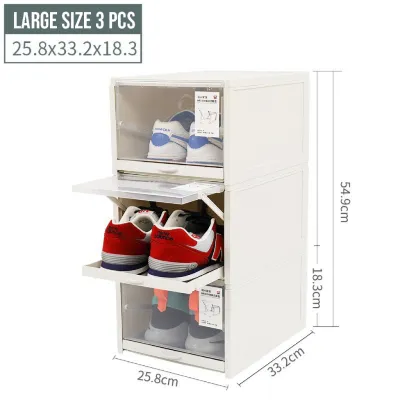
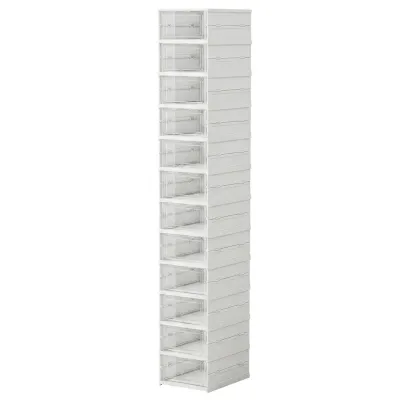
For anyone managing a busy morning routine in a high-traffic household, the drop-front shoe box is the clear winner. The fundamental flaw of standard stackable boxes is the physical effort required to access lower pairs. To retrieve a pair of shoes at the bottom of a five-box stack, you must physically lift and remove the top four boxes, take off the lid of the fifth, retrieve the shoes, replace the lid, and restack the boxes. This repetitive physical chore quickly leads to messy piles, as users frequently abandon the system and leave shoes scattered on the floor. Drop-front boxes solve this friction entirely by utilizing a front-facing door—often secured with magnetic closures or simple latches—that swings down or out. This design allows you to slide a pair of shoes out in seconds with one hand.
However, standard stackable boxes still hold value. If you are storing off-season footwear, expensive dress shoes only worn for special occasions, or organizing a high closet shelf where you can easily reach the top lid, standard boxes offer a highly cost-effective, lightweight alternative. They are also excellent for deep-cleaning days, as they are simple to wash, dry, and stack away when not in use. Ultimately, the drop-front design is an investment in daily convenience, while the standard stackable design is a functional solution for low-frequency storage.
Products mentioned in this guide
![[SG Stock] Transparent Shoe Box | Front and Side View Organizer | Storage Box](https://img.lazcdn.com/g/p/8fbcf778ff80155edfb52d595c04e35f.png_400x400q80.png_.webp)
Prices are valid at publication and may change. Please refer to the product page for the latest price.
Defining the Designs: Standard Stackable vs Drop-Front Shoes Box Storage
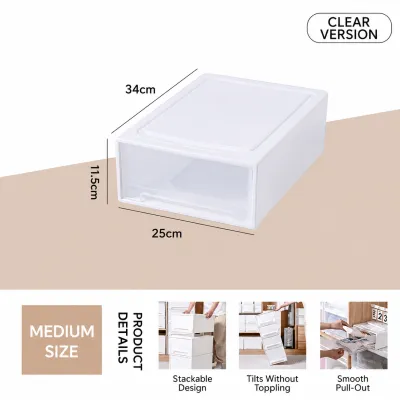
To make an informed decision for your shoes box storage setup, it is essential to understand the structural differences between these two modular systems, as the market often uses these terms interchangeably. Standard stackable boxes are the traditional plastic containers most people are familiar with. They typically consist of a semi-flexible plastic tub and a matching, separate lid. Some modern variations feature interlocking ridges on the top and bottom to prevent sliding, but the primary method of entry remains the top lid. To open the box, the lid must be completely detached. This means the structural integrity of the stack relies on the lids supporting the weight of the boxes above them, making access to any box other than the top one a multi-step physical task.

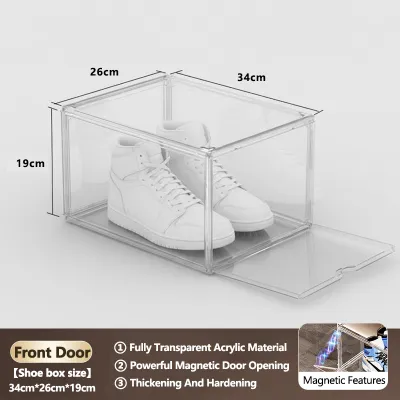
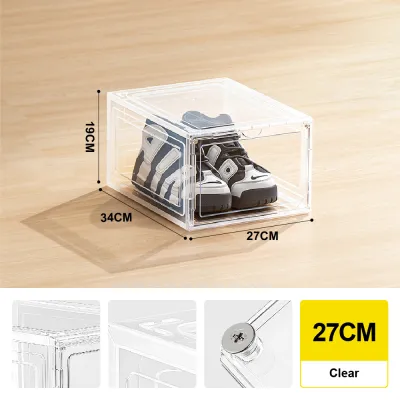
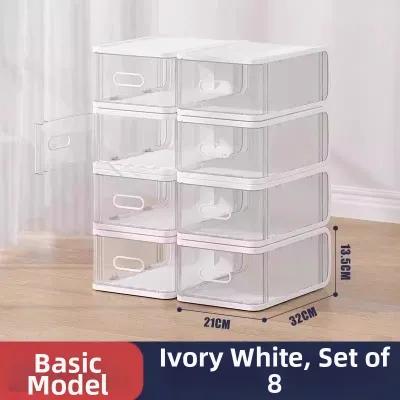
In contrast, drop-front shoe boxes are a highly engineered, rigid evolution of modular storage. While they are also stackable, they feature a reinforced hard plastic or acrylic frame with an integrated front door. This door is hinged at the bottom or side, allowing it to swing open while the box remains structurally locked in the stack. The frame itself bears the load of the upper boxes, ensuring that opening the front door does not compromise the stability of the entire column. The door mechanisms typically use magnetic clasps, snap-latches, or gravity-assisted hinges to stay securely closed. Understanding this distinction is crucial: the comparison is not merely about whether the boxes can sit on top of one another, but rather how the entry point—top-opening versus front-opening—transforms your daily interaction with your footwear.
Everyday Access: Retrieving Shoes Without the Hassle
Think about a typical weekday morning when you are rushing to leave the house, and the shoes you want to wear are at the bottom of a six-tier stack. With standard stackable boxes, this scenario represents a major bottleneck. The physical effort of unstacking, opening, closing, and restacking takes time and physical energy. In contrast, a drop-front box transforms this into a single-motion task. You simply pull the front panel down, slide your shoes out, and let the door snap shut. This ease of access encourages household members to actually put their shoes away, reducing entryway clutter.
The spatial mechanics of your room or closet play a huge role in which box works best. Drop-front boxes require forward clearance. Because the door swings outward and downward, you must have enough floor or shelf space in front of the stack to accommodate the door’s radius and your hands. If you have a narrow entryway corridor or a tight walk-in wardrobe, this forward clearance is a critical measurement to verify. On the other hand, standard top-opening boxes require overhead clearance. When stacked, this overhead clearance is completely blocked by the box above it, making them useless for vertical stacks unless you have wide open shelving where each box sits on its own dedicated shelf. Side-opening boxes are another variation, requiring lateral aisle space, which can be even more restrictive in narrow hallways.
Different types of shoes present unique storage challenges. High-top sneakers, chunky platform heels, and leather ankle boots require more vertical clearance. Standard stackable boxes, with their flexible plastic walls, can sometimes stretch slightly to accommodate bulkier shoes, or you can simply leave the lid slightly off-kilter (though this ruins the stack’s stability). Drop-front boxes, however, have rigid frames with fixed door openings. If a shoe is too tall or wide for the door frame, you cannot force it in without risking damage to the shoe or the door hinge. This is particularly important for sneaker collectors who own high-top designs; they must look for “extra-large” or “tall” drop-front boxes specifically designed with higher door clearances.
The physical mechanism of the door itself dictates the speed and noise of your routine. Drop-front doors with magnetic closures offer the smoothest, quietest experience. They snap shut with a satisfying, quiet click and open with a gentle pull. Mechanical latches or snap-locks, while often cheaper, require more force to click open and close, which can produce a loud plastic snapping sound—not ideal if you are trying to get dressed quietly while your family is still asleep.
Space Efficiency and Stacking Safety
Maximizing vertical space is essential in compact living areas, such as apartments where floor area is highly optimized. Standard stackable boxes are often made of thin, flexible polypropylene. This minimalism means they have very thin walls, maximizing the internal storage space relative to their external footprint. Drop-front boxes require a sturdier, rigid frame (usually made of heavy-duty ABS or acrylic) to support the weight of the stack without bowing. This thicker frame slightly increases the external dimensions of each box, meaning a stack of six drop-front boxes might stand a few centimeters taller and wider than a stack of six standard boxes, slightly reducing the total number of boxes you can fit into a highly restricted alcove.
Safety is a major consideration when building tall vertical columns of shoe storage. Standard boxes rely on the interlocking ridges molded into their lids and bases. Because they are lightweight, a tall stack of standard boxes can become highly unstable and top-heavy, especially if heavier shoes like leather boots are placed near the top. Drop-front boxes are heavier and more stable, but they introduce a different physical risk: the center-of-gravity shift. When you open a drop-front door at the top of a tall, freestanding stack and pull out a heavy pair of shoes, the forward motion and the weight of the open door can cause the entire column to tip forward. To mitigate this, always place your heaviest footwear (such as boots or heavy trainers) in the bottom rows to anchor the stack. If you plan to build freestanding stacks higher than five or six tiers, check the manufacturer’s guidelines and consider using adhesive anti-tip wall anchors or placing the stack against a secure wall.
Where you place your boxes determines which design is safer and more functional. Standard top-opening boxes are excellent for high closet shelves. Since you have to pull the entire box down to access it anyway, a lightweight, standard box with a secure lid is easy to grab, bring down to eye level, open, and return. Placing a heavy, rigid drop-front box on a high shelf is counterproductive, as you cannot easily see or access the front door from below, and the extra weight makes it dangerous to pull down. Conversely, drop-front boxes excel as freestanding floor-to-ceiling columns in entryways, walk-in closets, or storage rooms, where they function like a modular cabinet system without requiring permanent carpentry.
Always check the manufacturer’s weight limits and stacking height recommendations before building your storage tower. Placing heavy, unstable stacks in high-traffic walkways where they could be bumped by children or pets poses a safety risk. By keeping the heaviest shoes at the bottom and ensuring the interlocking tabs are fully engaged, you can maintain a secure, upright storage system.
Closet Integration and Visual Organization
For shoe enthusiasts, visual presentation is almost as important as protection. Drop-front boxes are frequently designed with high-clarity, crystalline acrylic front panels. This provides an unobstructed view of your footwear, turning your shoe collection into a visual display. This is highly beneficial for quickly identifying the exact pair you want without opening multiple boxes. Standard stackable boxes are often semi-translucent or frosted plastic, which obscures the details of the shoes inside. While some standard boxes feature small clear windows, they rarely match the display-grade aesthetic of a fully transparent drop-front door.
Your local climate presents unique preservation challenges. High relative humidity can lead to mold and mildew growth on leather, suede, and canvas shoes, while dust accumulation can degrade materials over time. Standard stackable boxes with tight-fitting lids often provide a more complete seal against dust, but they can trap moisture inside, creating a microclimate ripe for mold if the shoes are put away damp. Drop-front boxes often feature small, built-in ventilation holes at the back or around the door frame to promote air circulation. While this ventilation helps prevent mold by letting moisture escape, it does allow a small amount of dust to enter over long periods. For everyday shoes, the ventilation of drop-front boxes is highly beneficial; for rare, expensive collector pairs, a completely sealed standard box with a silica gel pack inside may offer better long-term preservation.
Visual clutter can make a small room feel chaotic. Mixing different brands, sizes, or styles of shoe boxes disrupts the clean lines of your closet. If you choose drop-front boxes, it is wise to purchase them in matching multi-packs to ensure a uniform, clean look. Standard boxes, while cheaper, often come in mismatched colors or varying plastic finishes that can look untidy in open areas like an entryway. Keeping a single, cohesive style of box creates a polished, built-in wardrobe appearance at a fraction of the cost of custom carpentry.
The Final Verdict: How to Choose Your Shoe Storage System
To finalize your purchase, evaluate your daily habits, closet space, and budget against the strengths of each design.
Choose Drop-Front If:
- You wear a wide rotation of shoes daily and need to retrieve them quickly.
- You plan to stack boxes higher than three levels directly on the floor or in an entryway.
- You want a premium, display-grade look that showcases your collection.
- You want to avoid the physical chore of unstacking boxes to reach lower pairs.
Choose Standard Stackable If:
- You are storing out-of-season footwear or shoes worn only for special occasions.
- You are placing the storage boxes on high, existing closet shelves where you must pull the entire container down anyway.
- You are working with a strict budget (standard boxes typically cost between S$2 and S$5 each, whereas premium drop-front boxes can range from S$8 to S$25+ per box).
- You only need to access the top box of the stack regularly.
Verify First If: Before buying, measure your available space. Check the depth of your wardrobe or entryway alcove; some drop-front boxes are deeper to accommodate larger shoe sizes and may prevent closet doors from closing. Furthermore, verify the internal dimensions of the box against your largest pair of shoes (especially if you wear US size 11/EU size 45 or larger, or high-top sneakers), as many standard boxes are too short or narrow, forcing you to store shoes on their sides.
| Feature | Standard Stackable Boxes | Drop-Front Shoe Boxes |
|---|---|---|
| Access Convenience | Low; requires unstacking upper boxes to reach lower pairs | High; front-opening door allows instant access |
| Stacking Stability | Moderate; relies on flexible plastic lids | High; rigid frames support vertical weight |
| Space Requirements | Requires overhead clearance to remove lids | Requires forward clearance for door swing |
| Aesthetic Appeal | Utility-focused; often frosted or semi-translucent | Display-grade; often features crystal-clear panels |
| Typical Price Range | Budget-friendly (approx. S$2 – S$5 per box) | Premium investment (approx. S$8 – S$25+ per box) |
| Best Use Case | Long-term storage, high closet shelves, seasonal rotation | Everyday footwear, freestanding floor stacks, entryways |
Frequently Asked Questions (FAQ)
Can I mix drop-front and standard stackable boxes in the same stack?
Mixing different types of shoe boxes in a single stack is generally not recommended. Standard stackable boxes and drop-front boxes use completely different locking mechanisms, plastic thicknesses, and dimensions. Attempting to stack a rigid drop-front box on top of a flexible standard box—or vice versa—will prevent the interlocking grooves from aligning. This compromises the structural integrity of the column, creating a severe tipping hazard. If you must use both, keep them in separate, dedicated stacks or place standard boxes on high shelves and drop-front boxes on the floor.
How do I prevent stacked shoe boxes from tipping over?
To ensure your vertical shoe storage remains stable, always place your heaviest footwear, such as boots, heavy sneakers, or platform heels, in the bottom two rows. This lowers the center of gravity of the entire stack. Additionally, avoid building freestanding columns higher than five or six boxes without securing them. If you are stacking higher or have pets and young children in the home, use adhesive anti-tip straps or wall anchors to secure the top boxes to the wall, preventing accidental tip-overs if the stack is bumped.
Are shoe storage boxes suitable for storing items other than shoes?
Yes, both designs are highly versatile organizers for other household items. Drop-front boxes are excellent for high-frequency items like small handbags, folded t-shirts, caps, or electronic accessories, as you can retrieve them easily. Standard stackable boxes are ideal for long-term storage of seasonal clothing, crafting supplies, or holiday decorations, keeping them dust-free on closet shelves.
Community discussion
Share your experience or ask a question. Comments are reviewed before publication.