
Finding the right slim shoe cabinet in Singapore requires balancing ultra-shallow depths with sturdy construction and reliable local service. Because entryway space in modern Housing & Development Board (HDB) flats and condominiums is highly constrained, a tilt-out or narrow-profile cabinet is the most efficient way to organize footwear without obstructing daily foot traffic. Rather than chasing a single universal winner, homeowners should evaluate options based on precise spatial measurements, material resilience against Singapore’s high humidity, and the specific structural realities of local entryways. By focusing on practical verification steps and structural details, you can secure a storage solution that keeps your foyer tidy, safe, and visually appealing.
Assessing Your Entryway Space Constraints in Singapore
Before browsing online marketplaces or visiting local furniture showrooms, you must establish the exact physical boundaries of your entryway. Start by measuring the available width, depth, and height of the designated wall space. Use a metal measuring tape for accuracy, and record the dimensions in millimeters to avoid rounding errors that could lead to a poor fit. When measuring depth, pay close attention to the skirting boards along the base of the wall; a cabinet that is flush against the upper wall may be pushed outward at the bottom by thick skirting, leaving an unsightly gap or causing instability if not accounted for.
Next, map out the clearance zones for all moving elements in the foyer. This includes the swing arc of your main entrance door, gate, and any adjacent room or kitchen doors. A slim shoe cabinet placed too close to the entrance can prevent the main door from opening fully to a 90-degree angle, making it difficult to move large items or groceries into the home. Additionally, locate your household shelter door. These heavy steel doors require wide clearance arcs and cannot be obstructed under safety guidelines. If your entryway opens directly into a narrow common corridor, be mindful of Singapore Civil Defence Force regulations regarding escape routes. While shoe cabinets are typically kept inside the unit, any external placement or open-door clearance must not infringe upon the mandatory 1.2-meter clear escape path in the corridor.
Products mentioned in this guide
![[OKLIFE. SG]Fit HDB between Doorway and Gate/BTO Shoe Rack / Narrow Slim Cabinet/ Storage Organizer](https://img.lazcdn.com/g/p/b5b66f5f6de4469b6558ff86085ad157.jpg_400x400q80.jpg_.webp)
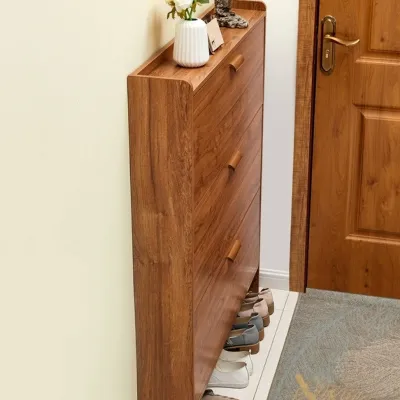
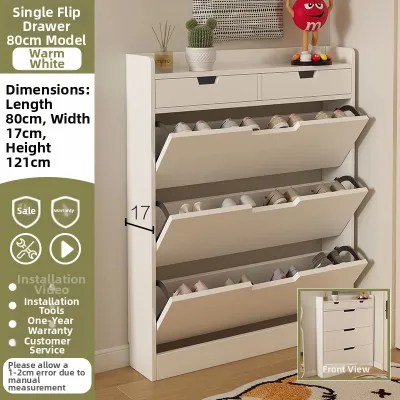
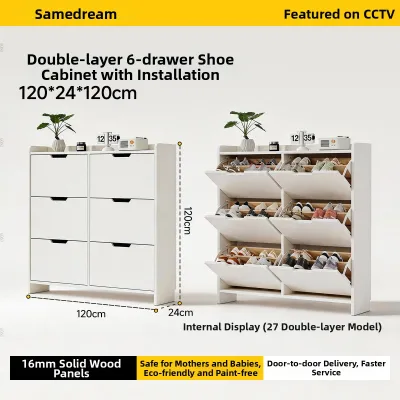
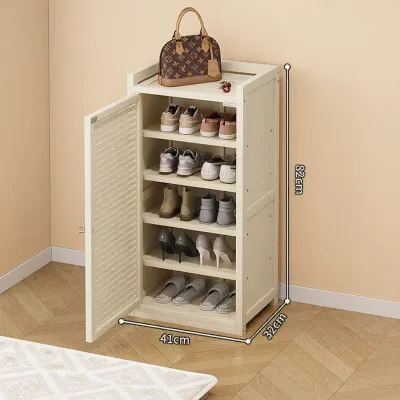
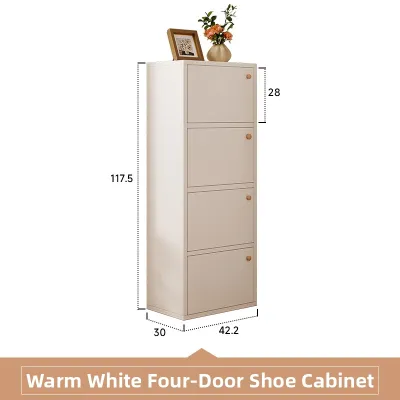
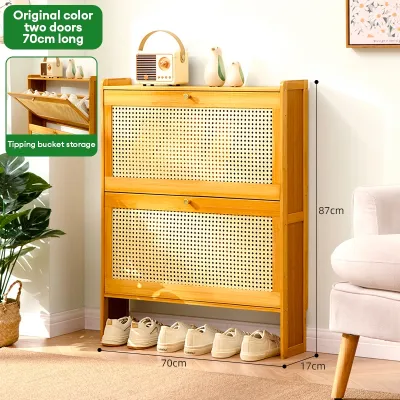
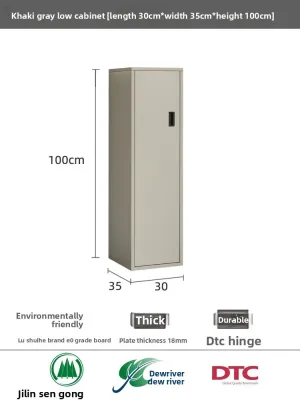
Prices are valid at publication and may change. Please refer to the product page for the latest price.
Finally, balance your household’s shoe capacity requirements against the physical footprint your foyer can realistically support. A family of four might require storage for 16 to 24 pairs of daily-wear shoes. If your entryway can only accommodate a cabinet with a depth of 17 cm, you will need to utilize vertical height rather than horizontal width. Calculate the maximum height you can comfortably reach, and consider whether a taller, multi-tiered vertical cabinet is more suitable than a wider, low-profile unit that eats up valuable floor space.
Defining the Right Dimensions and Features for Slim Cabinets
To find a cabinet that is truly slim yet highly functional, you must understand the mechanical designs that make these space-saving dimensions possible. Standard shoe cabinets typically require a depth of 30 to 35 cm because shoes are stored flat on horizontal shelves. In contrast, slim shoe cabinets utilize tilt-out mechanisms or drop-down doors, reducing the required depth to a mere 15 to 24 cm. In these designs, shoes are stored vertically or at an angle, sliding into pockets on the inside of the door. When the door is closed, the shoes stand upright, minimizing the outward projection of the furniture.

While tilt-out designs are exceptionally space-efficient, their internal configurations dictate what types of footwear they can hold. Look for cabinets that feature adjustable or removable internal dividers within each compartment. Fixed compartments may easily accommodate flat sandals, flip-flops, and low-profile canvas shoes, but they will struggle to house bulky running sneakers, high heels, or leather dress shoes. Adjustable dividers allow you to customize the pocket depth, ensuring that larger shoe sizes or taller profiles do not get crushed when the door is closed. If you regularly wear high-top boots or platform shoes, verify if at least one compartment can be configured without dividers to provide the necessary clearance.
Another critical feature to evaluate is ventilation. Singapore’s tropical climate and high relative humidity create an environment where enclosed, unventilated spaces quickly trap moisture and odors. Placing damp or sweaty shoes into a completely sealed cabinet can lead to mold growth, which can ruin leather footwear and create unpleasant smells in your entryway. When evaluating cabinets, prioritize designs that incorporate ventilation features. These can include slatted front doors, open-back frames, decorative cut-outs, or built-in mesh grilles. A semi-open design promotes continuous airflow, allowing moisture to evaporate and keeping your footwear in better condition over time.
Evaluating Furniture Brands for Compact Storage Solutions
When searching for the ideal slim shoe cabinet, focusing on how brands design, deliver, and support their products is more reliable than relying on fluctuating stock levels or generic reviews. Begin by checking whether a brand specializes in space-saving, modular, or apartment-sized furniture lines. Brands that focus on compact living often design their pieces with integrated safety features, standardized modular dimensions that can be stacked, and hardware optimized for frequent use in tight spaces.
Because slim shoe cabinets rely heavily on moving parts, the quality of the hardware is a primary indicator of longevity. Inspect the warranty terms offered by the manufacturer or retailer, paying specific attention to what is covered. While a basic structural warranty might cover the wooden frame, you want to ensure there is explicit coverage for moving parts such as hinges, drawer slides, magnetic catches, and tilt-out brackets. These components bear the physical weight of your shoes every time the cabinet is opened and closed. A brand that offers a multi-year warranty on hardware demonstrates confidence in the durability of their mechanical components.
Delivery and assembly services are equally important considerations in Singapore’s high-rise housing landscape. Verify whether the retailer’s delivery team is experienced in navigating narrow HDB corridors, tight elevator spaces, and compact entryways. Some flat-pack furniture brands require complete self-assembly, which can be challenging if you lack the proper tools or experience in leveling furniture on slightly uneven screed floors. If you opt for professional assembly, confirm whether the service includes leveling and secure wall mounting.
Lastly, review the retailer’s return and exchange policies. Inspecting the product immediately upon delivery is crucial, as transit damage to thin panels or missing hardware can delay your installation. A reputable brand should have a clear, responsive customer support channel to handle replacement parts or exchanges promptly without charging additional transport fees.
Checking Material and Build Quality for Narrow Designs
The materials used to construct a narrow shoe cabinet directly impact its load-bearing capacity, moisture resistance, and overall stability. Engineered wood, such as medium-density fibreboard (MDF) or particle board, is highly common and cost-effective. However, its performance in Singapore’s humid climate depends entirely on the quality of its protective finish. Unsealed engineered wood can absorb ambient moisture, leading to swelling, warping, and structural weakening over time. To prevent this, inspect the edge banding on all panels. High-quality edge banding should be seamless and tightly bonded, leaving no exposed core material where moisture or wet shoes can penetrate.
For superior durability, consider metal frames or high-density plastic options. Powder-coated steel or aluminum cabinets offer exceptional structural strength with incredibly thin profiles, allowing for maximum internal storage space. Metal is entirely impervious to moisture and mold, making it an excellent choice for entryways near wet zones or open corridors. However, ensure the powder coating is uniform and scratch-resistant to prevent rust. High-density plastic cabinets are lightweight and completely waterproof, making them easy to clean, but they may lack the aesthetic refinement and structural rigidity required for taller, multi-tiered installations.
The overall weight of the cabinet relative to its height is a critical safety factor. Tall, narrow furniture inherently has a high center of gravity, making it prone to tipping forward when multiple drawers are opened simultaneously. While lightweight materials are easier to transport, a slightly heavier base or a robust metal frame can provide better inherent stability. Regardless of the material chosen, always inspect the surface finish for resistance to scuffs and dirt. Entryway furniture is subjected to daily contact with dirty shoe soles, keys, and bags, so a wipe-clean, scratch-resistant laminate or powder-coated surface will keep the cabinet looking new for longer.
Planning Safe Installation in Tight Corridors and Foyers
Installing a slim shoe cabinet in a high-traffic entryway requires careful planning to ensure household safety and structural integrity. Because these cabinets typically have a depth of less than 25 cm, they are highly unstable on their own. Opening a single heavily loaded drawer shifts the center of gravity forward, creating an immediate tipping hazard. Therefore, secure wall anchoring is not optional; it is a mandatory safety step for all slim designs.
Before mounting, identify the construction material of your entryway wall. In Singapore, internal walls are commonly made of solid concrete, precast concrete panels, or lightweight drywall. Concrete walls require a hammer drill, masonry drill bits, and heavy-duty wall plugs to secure the mounting brackets. Drywall, on the other hand, requires specialized hollow-wall anchors or toggle bolts that expand behind the plasterboard to distribute the weight safely. Always use the anti-tip hardware supplied by the manufacturer, or purchase high-quality aftermarket brackets if the included hardware is not suitable for your specific wall type.
Clearance planning is also vital during the installation phase. Ensure that when the cabinet doors are fully extended, there is still sufficient space for a person to pass safely. This is especially important in households with young children or elderly family members who may need extra room to maneuver.
Finally, recognize when to stop a DIY installation and consult a professional. Entryway walls often contain hidden hazards, such as concealed electrical conduits running from the DB box, light switch wiring, or internal water pipes. Drilling into these utilities can cause severe damage, costly repairs, or personal injury. Use a reliable multi-scanner or stud finder with live wire and metal detection before drilling any holes. If you encounter resistance, find unexpected wiring, or feel unsure about drilling into concrete, hiring a qualified local handyman is the safest and most efficient course of action.
Frequently Asked Questions (FAQ)
How many pairs of shoes can a typical slim tilt-out cabinet hold?
The capacity of a slim tilt-out cabinet depends on its width, height, and internal shelf configuration. A standard three-compartment cabinet with a width of 50 cm to 70 cm typically holds between 9 and 18 pairs of shoes. If the cabinet features adjustable or double-tier dividers within each drawer, you can maximize efficiency by storing flat shoes, such as sandals and flats, in a stacked arrangement. However, storing bulky footwear like high-top sneakers, running shoes, or men’s formal leather shoes will reduce the overall capacity, as these larger profiles often require you to remove the internal dividers entirely, limiting each compartment to a single row of shoes.
Are freestanding slim shoe cabinets safe without wall anchoring?
No, freestanding slim shoe cabinets are not safe without secure wall anchoring. Because these units have an extremely shallow depth (often under 20 cm) and a tall vertical profile, their center of gravity is highly unstable. When you pull open a tilt-out drawer, the weight of the shoes shifts outward and downward, pulling the top of the cabinet forward. This physical shift can easily cause the entire unit to tip over, posing a serious injury risk to anyone nearby, particularly young children or pets who might pull on the handles. Always follow the manufacturer’s instructions and use the provided anti-tip kits to anchor the cabinet securely to a solid wall.

Community discussion
Share your experience or ask a question. Comments are reviewed before publication.