
Selecting a high-quality home massager is a major lifestyle and financial decision, especially in Singapore where living space is premium and the market is filled with diverse options. The “best” massage chair is not a single, universal model; rather, it is the one that aligns perfectly with your physical needs, home layout, and budget. While some buyers require intense, clinical-grade deep-tissue therapy to manage chronic muscle tension, others seek a compact, aesthetically pleasing lounge chair that provides gentle, relaxation-focused programs.
To make an informed decision, you must look past marketing buzzwords and evaluate the underlying engineering, material durability, and spatial requirements of each brand. High-end chairs offer sophisticated roller tracks and multi-dimensional mechanisms, whereas entry-level models focus on essential compression and fixed-path rollers. By establishing a clear set of comparison criteria—spanning mechanical capabilities, frame construction, upholstery resilience in tropical climates, and installation logistics—you can confidently identify the profile that fits your household. Always verify official manufacturer specifications and warranty terms before committing to a purchase.
Core Features to Compare Across Leading Brands
When comparing different brands in the Singapore market, understanding the core mechanical and electronic features is essential. These components dictate how the chair feels, how deeply it can target muscle groups, and how much control you have over the massage experience.
Products mentioned in this guide
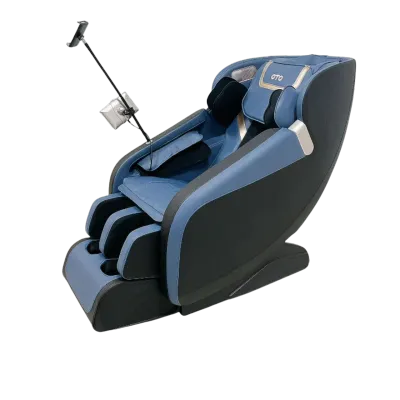
Prices are valid at publication and may change. Please refer to the product page for the latest price.
Massage Mechanisms and Roller Tracks
The heart of any modern massage chair is its roller mechanism, typically categorized as 2D, 3D, or 4D. A 2D system operates on a flat plane, moving up and down your back and adjusting its width to cover the shoulders and spine. While effective for general relaxation, it cannot adjust its depth to press harder into tight muscles. A 3D system introduces depth control, allowing the rollers to protrude outward to mimic the pressure of a massage therapist’s hands. This is highly beneficial for targeting deep-seated tension in the neck, shoulders, and lower back.
A 4D mechanism takes customization further by introducing real-time speed and rhythm variations to the 3D movement. Instead of a mechanical, constant-speed stroke, a 4D system speeds up or slows down during specific parts of the movement, simulating human techniques like kneading, tapping, and shiatsu.
These rollers travel along a guide track, which determines the overall coverage area. An S-track follows the natural curvature of your spine, focusing primarily on the neck down to the lower lumbar region. An L-track extends straight down past the lower back, wrapping under the seat to massage the glutes and hamstrings. The most advanced systems utilize an SL-track, which combines the spinal contouring of the S-track with the extended reach of the L-track. When comparing brands, verify the exact length of the track and check if the roller width and depth can be manually adjusted to accommodate different family members.
Specialized Functions and Customization
Beyond the primary rollers, high-quality chairs offer a suite of specialized functions designed to enhance therapeutic benefits. Zero-gravity positioning is a key feature to look for; it reclines the chair to an angle where your knees are elevated slightly above your heart. This position distributes your body weight evenly across the chair, reducing the gravitational load on your spine and allowing the rollers to deliver a deeper, more effective massage.
Airbag compression systems work in tandem with the rollers, using inflatable bladders to squeeze and release the shoulders, arms, hips, calves, and feet. When evaluating different models, check whether the airbag intensity can be adjusted independently across different zones, rather than being controlled by a single master setting.
Heated therapy is another highly desirable feature, particularly for soothing stiff joints and improving blood circulation. However, the implementation of heat varies significantly between brands. Some models only offer basic heating pads in the lumbar region, while others feature heated rollers or dedicated heating elements in the calves and footrest.
Finally, automated body scanning technology is crucial for a personalized experience. Before a program begins, the chair should scan your spine and detect your shoulder height to calibrate the roller starting points. Ensure the model you choose allows you to manually override these scan results, as automated sensors can occasionally miscalculate the height of shorter or taller users.
Assessing Build Quality and Durability in a Home Massager
A premium massage chair is a long-term investment, often lasting several years with proper care. To ensure your chosen model stands up to daily use, you must look closely at its physical construction, structural limits, and exterior materials.

Frame Construction and Weight Capacity
The structural integrity of a massage chair depends entirely on its internal frame. High-durability models utilize heavy-duty, powder-coated steel frames that resist bending, warping, and corrosion over time. Lower-tier or highly compact models may rely more heavily on reinforced plastic or lightweight aluminum alloys to keep costs and weight down. While lighter frames make the chair easier to move, they may compromise stability and overall longevity under heavy, daily use.
Always check the manufacturer’s official specification sheet for the maximum weight capacity, which typically ranges from 100kg to 150kg. Operating a chair close to or beyond its weight limit puts excessive strain on the internal motors, gears, and linear actuators, leading to premature mechanical failure.
Furthermore, pay attention to the stability of the chair’s base footprint. When the chair is fully reclined into a zero-gravity position, it should remain perfectly balanced without any rocking, creaking, or structural flexing. Robust moving parts, high-torque motors, and reliable electrical actuators are essential for smooth, quiet transitions between upright and reclined states.
Upholstery, Surface Treatment, and Maintenance
In Singapore’s hot and highly humid climate, the choice of upholstery is critical to the chair’s lifespan. Most massage chairs are wrapped in synthetic materials like Polyurethane (PU) leather or specialized synthetic blends, rather than genuine leather. Genuine leather is rarely used because it lacks the elasticity required to stretch and flex repeatedly under the pressure of moving massage rollers, and it is highly susceptible to cracking when exposed to sweat and humidity.
However, labels like “premium synthetic leather” or “commercial-grade PU” do not automatically guarantee durability. Without proper surface treatments, synthetic leather can undergo hydrolysis—a chemical process where moisture breaks down the polyurethane chains, causing the surface to peel, crack, and flake.
To protect your investment, look for brands that specify hydrolysis-resistant treatments on their upholstery. Check the manufacturer’s care instructions: high-quality synthetic leather should be easy to wipe down with a dry or slightly damp microfiber cloth, and should not require complex chemical conditioners.
Examine the stitching quality along major seams, particularly around high-friction areas like the shoulders, lumbar region, and footrest. Double-stitched seams and reinforced fabric backing indicate superior craftsmanship. Finally, carefully review the warranty terms; many brands offer separate, shorter coverage periods for the upholstery compared to the internal mechanical frame and motors.
Space, Clearance, and Installation Requirements
Given the compact nature of many Singaporean homes, including HDB flats and private condominiums, the physical dimensions of a massage chair are just as important as its features. Failing to plan for spatial constraints can lead to delivery failures or an unusable living space.
First, measure the exact footprint of the chair in both its fully upright and fully reclined positions. A standard massage chair can require significant space when extended. To mitigate this, look for models equipped with “wall-hugging” or space-saving recline technology. These chairs are engineered on a sliding track system; as the backrest reclines, the entire chair slides forward on its base. This design allows you to place the chair as close as 5cm to 10cm from a wall, compared to older or simpler designs that require up to 50cm of rear clearance.
Second, carefully map out the delivery route from the building’s drop-off point to the final room in your home. You must measure the width and height of all door frames, hallway turns, and elevator doors. Many premium massage chairs are exceptionally heavy, often weighing between 80kg and 150kg, and cannot be easily tilted or maneuvered around tight corners.
Some brands ship their chairs in a single, pre-assembled box, which may require a minimum door clearance of 80cm or more. Other brands design their chairs with detachable side panels or armrests, allowing them to pass through narrower doorways of 70cm before being reassembled inside the room. Always confirm the minimum delivery clearance specifications with the retailer.
Lastly, ensure that professional delivery and assembly are included in your purchase. The technicians must set up the chair on a flat, level surface and follow the manufacturer’s structural and electrical guidelines. Avoid placing the chair in direct sunlight or directly beneath an air conditioning unit, as extreme temperature fluctuations and UV exposure can accelerate the degradation of both the upholstery and the internal electronics.
Decision Framework: Matching Brands to Your Priorities
To narrow down your options among the various brands available in Singapore, it is helpful to categorize them by their primary design philosophy and target audience. Rather than focusing on brand names alone, match your personal priorities to one of the following profiles.
- Choose clinical/rehabilitation-focused brands if: Your primary goal is therapeutic relief from chronic muscle pain, spinal stiffness, or poor circulation. These brands invest heavily in advanced 4D roller mechanisms, highly accurate body-scanning sensors, and deep-tissue programs that target specific acupressure points. They offer extensive customization, allowing you to fine-tune roller depth, speed, and airbag pressure. Be prepared for a larger physical footprint, a heavier frame, and a higher price point, typically ranging from S$5,000 to over S$10,000.
- Choose compact/lifestyle-focused brands if: You live in a smaller HDB apartment or condominium where space is at a premium, and you want a chair that doubles as stylish home furniture. These brands prioritize sleek, modern aesthetics, space-saving wall-hugging mechanisms, and a smaller overall footprint. The massage programs are generally geared toward light relaxation, stress relief, and gentle stretching rather than intense deep-tissue manipulation. These models often sit in the mid-range price bracket, from S$2,500 to S$5,000.
- Choose value-oriented brands if: You are a first-time buyer wanting to enjoy the benefits of a home massage chair without a massive upfront investment. These chairs typically feature reliable 2D or basic 3D roller systems, standard S- or L-tracks, and essential airbag compression. While they may lack advanced features like automated body scanning, heated rollers, or app connectivity, they offer excellent everyday relaxation. Prices generally range from S$1,000 to S$2,500.
- Verify first if: You have pre-existing medical conditions, such as severe osteoporosis, herniated discs, or cardiovascular issues, or if you are purchasing the chair for elderly family members. In these scenarios, always consult a qualified healthcare professional before use. Additionally, verify that the brand has an established, local after-sales service center in Singapore to handle maintenance, repairs, and spare part replacements efficiently.
Frequently Asked Questions (FAQ)
Do massage chairs consume a lot of electricity?
No, massage chairs are surprisingly energy-efficient. Most models have a power rating between 100 Watts and 250 Watts, which is comparable to a desktop computer or a large television. The exact power consumption depends on how many motors are running simultaneously and whether you use power-heavy features like heated therapy zones. To estimate the operating cost, locate the manufacturer’s power rating on the product label (usually found near the power switch) and multiply it by your daily usage time and the current Singapore electricity tariff. For example, running a 150-Watt chair for 30 minutes a day will consume approximately 0.075 kWh of electricity, resulting in a negligible impact on your monthly utility bill.
What should I look for in a massage chair warranty?
When evaluating a warranty in Singapore, look beyond the headline number of years and examine the specific terms of coverage. A comprehensive warranty should clearly outline the split between parts, labor, and on-site service. Because massage chairs are heavy and difficult to transport, ensure the warranty includes local, in-home (on-site) repair services where a technician visits your home. Verify if the warranty covers the main structural frame, the motors, and the electronic motherboards for the entire duration. Be aware that high-wear components, such as the synthetic leather upholstery and the fabric footrest liners, are often excluded from the main warranty or carry a much shorter coverage period (typically one year or less).
Community discussion
Share your experience or ask a question. Comments are reviewed before publication.