
Determining whether a specific bunk bed is safe for your child requires looking beyond the brand name to verify the actual structural design, hardware, and compliance labels of the model you are considering. While bunk beds offer a practical space-saving solution for compact bedrooms, they introduce elevated fall and entrapment risks that must be managed through strict adherence to safety standards. Rather than relying solely on brand reputation, parents must conduct a hands-on verification of the bed frame’s physical components, assembly integrity, and suitability for their children’s ages and physical development.
Evaluating a Seahouse bed frame involves understanding the engineering principles that keep elevated furniture stable. By learning what safety features to look for and how to perform routine maintenance, you can create a secure sleeping environment that maximizes floor space without compromising your child’s well-being.
Baseline Safety Standards for Children's Bunk Beds
Every children’s bunk bed sold must adhere to strict dimensional guidelines to prevent the most common bedroom accidents. The most critical of these measurements is the height of the guardrails on the top bunk. To prevent a sleeping child from rolling over the edge, the top of the guardrail must extend at least 127 mm (5 inches) above the upper surface of the mattress. When choosing a mattress for your Seahouse bed frame, you must factor in this thickness; a mattress that is too thick will compromise the protective height of the guardrail.
Products mentioned in this guide
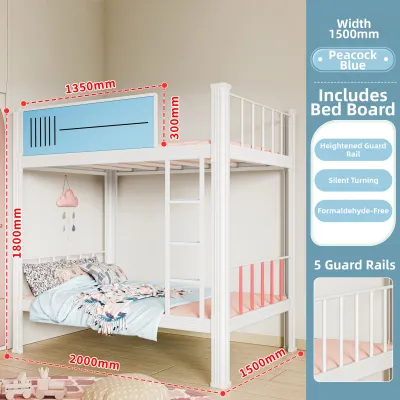
Prices are valid at publication and may change. Please refer to the product page for the latest price.
Entrapment zones are another vital safety consideration that standards strictly regulate. Gaps between individual guardrail slats, or between the bottom rail and the bed frame, must be carefully controlled to prevent a child’s head or limbs from becoming trapped. Safety standards dictate that these gaps must either be smaller than 89 mm (3.5 inches) to prevent a child’s body from slipping through, or larger than 230 mm (9 inches) to ensure their head can pass through freely without getting stuck.
Before purchasing any bunk bed, parents should locate and verify recognized safety certification labels on the product packaging or the frame itself. Look for markings indicating compliance with international safety standards, such as ASTM F1427 or EN 747. These certifications serve as independent verification that the manufacturer’s design has undergone rigorous testing for load capacity, structural stability, and material safety.
Finally, the structural integrity of the bed’s foundation relies heavily on the quality of its support slats and joints. A safe bunk bed utilizes robust, closely spaced wooden or metal slats that are securely fastened to the side rails to prevent the mattress from sagging or falling through. Cross-bracing and heavy-duty corner joints are essential to absorb the lateral forces generated when children climb in and out of bed.
Physical Safety Checks for Your Seahouse Bed Frame
When your Seahouse bed frame is delivered or assembled, performing a physical inspection is the most effective way to ensure its structural integrity. Begin by checking the guardrails on the top bunk for continuity and secure attachment. The guardrails must be installed on all four sides of the upper bed, with the only permissible opening being the entry point for the ladder. Ensure the mattress fits snugly within the frame; if you can insert more than two fingers between the mattress and the bed frame, the gap is too wide and poses an entrapment hazard.

Next, evaluate the stability and design of the ladder. The ladder must be securely bolted directly to the bed frame rather than simply hooked over the side, as hooks can easily shift or lift when a child climbs. The rungs should be wide enough to support a child’s foot comfortably, spaced evenly apart, and feature slip-resistant textures or grooved surfaces to prevent slips.
Inspect all fasteners, bolts, and hardware connections across the entire frame. High-quality bunk beds utilize barrel nuts and bolts that create a tight, metal-to-metal connection, which is far more durable than wood screws that can strip the timber over time. Run your hand along the frame to ensure there are no sharp edges, splinters, or protruding hardware that could snag clothing or scratch skin.
Lastly, verify that the assembly manual includes clear wall-anchoring instructions and that the package contains an anti-tip kit. Even the sturdiest bunk beds can become unstable if multiple children attempt to climb the outer structure simultaneously. Anchoring the frame to the wall provides an essential layer of protection against accidental tip-overs.
Age, Weight Limits, and Safe Usage Rules
Age limits are a fundamental safety boundary that parents must strictly enforce. Pediatric and safety organizations globally agree that the top bunk is not suitable for children under six years of age. Younger children lack the coordination, spatial awareness, and balance required to safely navigate a ladder in the dark or avoid rolling against the guardrails during deep sleep.
Weight capacities vary significantly between different bunk bed models and materials. You must locate and interpret the manufacturer’s specific weight capacity labels, which are typically affixed to the inside of the bed frame or detailed in the user manual. Remember that this weight limit must accommodate the combined weight of the child, the mattress, the pillows, and all bedding materials.
Establishing and enforcing clear behavioral rules is just as important as verifying the bed’s physical safety features. Teach your children that the bunk bed is a place for sleeping, not a playground. Prohibit jumping on both the top and bottom bunks, as this exerts sudden, high-impact forces that can damage the support slats and weaken the joints.
Additionally, never allow children to hang items such as ropes, belts, bags, or jump ropes from any part of the bed frame or guardrails. These items present severe strangulation hazards if a child slips or plays near the bed. Keep the area around the ladder clear of toys, shoes, and clutter to prevent trips and falls during nighttime bathroom trips.
Bedroom Placement and Long-Term Maintenance
Safe bedroom placement is crucial to preventing injuries once the bunk bed is assembled. Position the bed well away from ceiling fans, hanging light fixtures, and air conditioning units to prevent head injuries. Ensure there is at least 75 cm of vertical clearance between the top of the upper mattress and the ceiling so your child can sit up comfortably. Avoid placing the bed near windows where children could reach window blind cords or screens, which present fall and strangulation risks.
Wood is a natural material that expands and contracts with changes in indoor humidity and temperature, which can cause hardware to loosen over time. Establish a routine maintenance schedule to inspect your Seahouse bed frame every three to six months. Use this time to tighten all bolts, check for hairline cracks in the wood, and ensure that all joints remain flush and wobble-free.
Knowing when to stop using the bed is essential for long-term safety. If you observe structural fatigue, such as cracked support slats, stripped bolt holes, or a persistent wobble that cannot be resolved by tightening the hardware, restrict access to the bed immediately. Contact the manufacturer or a qualified furniture professional to source original replacement parts rather than attempting makeshift DIY repairs with non-standard hardware.
Frequently Asked Questions (FAQ)
Do I need to anchor a Seahouse bunk bed to the wall?
Yes, anchoring your bunk bed to the wall is highly recommended to prevent tip-over accidents. While a heavy wooden frame may feel exceptionally stable on its own, the dynamic forces applied when children climb the ladder or play near the bed can shift its center of gravity. Always refer to your specific Seahouse assembly manual for mandatory or recommended anchoring steps. Use the provided anti-tip brackets and select heavy-duty wall plugs appropriate for your wall type, such as masonry plugs for concrete walls or toggle bolts for drywall.
What should I do if a guardrail feels loose after assembly?
If a guardrail on your Seahouse bed frame feels loose or wobbles, immediately stop using the top bunk and do not allow children near the upper level. Disassemble the guardrail section and inspect the hardware against the instruction manual to ensure you have used the correct bolts and washers in the proper sequence. Check if the wood or metal surrounding the bolt holes has stripped or cracked. If the hardware is defective or the frame material is damaged, contact the retailer or manufacturer immediately to obtain original replacement parts before reassembling the bed.

Community discussion
Share your experience or ask a question. Comments are reviewed before publication.