
When choosing a princess bed frame for your child, safety must take precedence over whimsical design. To ensure a bed frame is safe, it should meet rigorous international and local standards, including EN 71-3 for chemical safety, EN 1725 for structural strength, and low-formaldehyde emission standards like CARB Phase 2 or E1. Parents can verify these standards by checking product labels, requesting third-party laboratory test reports, or examining the manufacturer’s official documentation. Aesthetic details like crown-shaped headboards, castle turrets, and high canopies must never compromise structural safety, chemical purity, or physical design limits.
Essential Safety Certifications and Quick Checklist
Identifying a safe princess bed frame requires looking beyond the pastel colors and decorative carvings to verify official safety marks. Legitimate manufacturers display compliance certifications directly on the product packaging, the physical bed frame, or within the digital user manual. If a seller cannot provide traceable safety documentation or a third-party test report upon request, it is best to look elsewhere.
Unverified listings on online marketplaces and discount ecommerce platforms often bypass standard safety checks to keep production costs low. These budget-friendly frames frequently use low-grade adhesives, unsealed engineered wood, and lead-based finishes that pose serious health risks. To protect your child, use this quick safety verification checklist before making a purchase:
Products mentioned in this guide
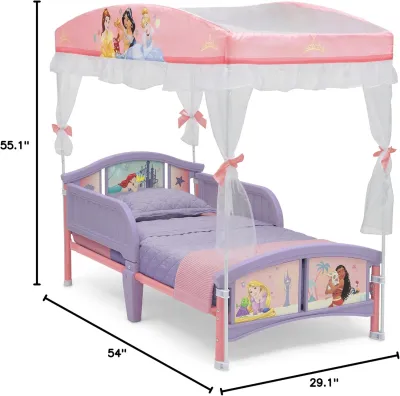
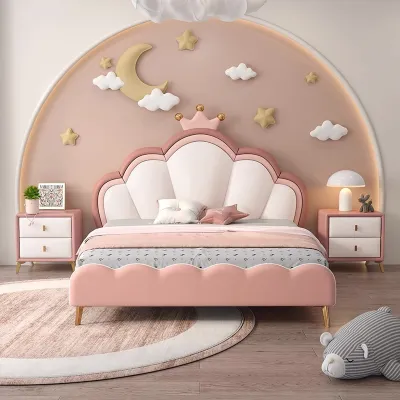
Prices are valid at publication and may change. Please refer to the product page for the latest price.
- Chemical Compliance: Look for EN 71-3 (migration of certain elements) or GREENGUARD Gold certifications, which verify that the paints, finishes, and adhesives are non-toxic and lead-free.
- Formaldehyde Limits: Ensure any engineered wood components meet CARB Phase 2, EPA TSCA Title VI, or E1 emission standards.
- Structural Standards: Check for compliance with EN 1725 (domestic beds) or ASTM F1427 (if the frame features a loft, bunk, or elevated design).
- Traceable Documentation: Verify that the manufacturer provides clear assembly instructions, load capacity ratings, and contact details for customer support.
Structural Integrity and Physical Safety Checks
Children often use their beds for more than just sleeping; they play, climb, and jump on them. A princess bed frame must possess the structural integrity to withstand these dynamic forces without collapsing, tipping, or causing physical injury.

Guardrail Height and Spacing If the princess bed is elevated or features a toddler-bed design with side guardrails, you must verify their physical dimensions. Guardrails must be rigid, securely bolted, and extend at least 12.7 centimeters (5 inches) above the top of the mattress. To prevent head or limb entrapment, the spacing between individual slats, spindles, or decorative cutouts in the guardrail must be less than 7.5 centimeters.
Frame Stability and Wall Anchoring Tall canopy frames, castle towers, and elaborate carriage-style princess beds have a high center of gravity, making them susceptible to tipping over if a child climbs on the outer frame. Check the base footprint of the bed; wider, heavier bases provide better natural stability. For any bed frame with a height exceeding 120 centimeters, verify if the manufacturer includes wall-anchoring hardware and explicitly instructs you to secure the frame to the wall.
Weight Capacity and Dynamic Loads Always check the manufacturer’s stated weight limits for both static weight (sleeping) and dynamic weight (movement). A high-quality single-size children’s bed frame should support a static weight of at least 100 to 120 kilograms. This capacity ensures the bed can safely accommodate the child, a mattress, and a parent sitting bedside during storytime without structural bowing or joint stress.
Corner and Edge Finishes Inspect the physical design of the headboard, footboard, and side rails for sharp edges or prominent decorative protrusions. Princess beds often feature carved crowns, plastic finials, or pointed castle spires. Ensure all corners are rounded to a radius of at least 2 millimeters, and that decorative hardware is flush with the frame to prevent clothing from snagging, which can lead to accidental falls or strangulation hazards.
Material Safety and Chemical Emission Checks
Because children spend up to half their day in close contact with their beds, the materials used to construct the frame must be chemically safe. Heavily decorated themed furniture requires extra scrutiny regarding finishes and adhesives.
Non-Toxic Paints and Finishes Children, especially toddlers, may chew on bed rails or frequently touch the painted surfaces of their bed. Ensure the paint or protective lacquer complies with EN 71-3 or equivalent toy safety standards, which restrict heavy metals like lead, cadmium, and antimony. Ask the retailer for written confirmation that the finishes are lead-free and phthalate-free, as exposure to these chemicals can impact a child’s development.
Formaldehyde Emissions in Engineered Wood Intricately shaped princess beds are often manufactured using Medium-Density Fibboard (MDF) or particleboard, which rely on synthetic resins and adhesives. In Singapore’s hot and humid climate, poorly sealed engineered wood can accelerate the off-gassing of formaldehyde, a known indoor air pollutant. Look for frames certified as E0 or E1, or those meeting CARB Phase 2 standards. Ensure all edges of the engineered wood panels are fully sealed with edge banding to prevent moisture absorption and minimize chemical emissions.
Fabric and Canopy Safety If the princess bed includes fabric drapes, upholstered headboards, or a textile canopy, these materials must be evaluated for safety. Verify that the fabrics are certified under OEKO-TEX Standard 100, which guarantees they are free from harmful dyes and formaldehydes. Additionally, check the manufacturer’s care label to confirm that the textiles are flame-retardant and can be easily removed for regular washing to prevent dust mite accumulation.
Age Appropriateness and Mattress Fit Verification
A safe bed must match your child’s physical and developmental stage. Using a bed frame that is too advanced or pairing it with an incompatible mattress introduces severe safety hazards.
Developmental and Age Limits Many elaborate princess beds, particularly loft beds, high sleepers, or those with built-in slide attachments, have strict age recommendations. International safety standards dictate that children under the age of six should never sleep on an elevated bed or top bunk due to the risk of falling. If your child is younger, opt for a low-to-the-ground toddler princess bed with protective side rails.
Mattress Gaps and Entrapment Risks When buying a bed frame and mattress separately, you must measure the internal dimensions of the bed frame carefully. The gap between the mattress sides and the bed frame should not exceed 3 centimeters when the mattress is pushed to one side. Gaps wider than this create a dangerous entrapment hazard where a child’s arm, leg, or head can become wedged between the mattress and the frame.
Mattress Thickness and Guardrail Clearance Always check the manufacturer’s specifications for the maximum allowable mattress thickness. If you place a thick pillow-top mattress on a bed frame with built-in guardrails, you may inadvertently reduce the effective height of the safety barrier. To maintain safe guardrail clearance, the mattress thickness must leave at least 12.7 centimeters of the guardrail exposed above the mattress surface to prevent the child from rolling out of bed.
Safe Assembly and Long-Term Maintenance
Even the most highly certified princess bed frame can become hazardous if it is assembled incorrectly or neglected over time. Proper installation and routine maintenance are essential to preserving the bed’s structural integrity.
Assembly Safety and Space Planning Before assembling the bed, measure your room’s dimensions and plan the layout carefully. Ensure there is at least 2 meters of clearance between any elevated parts of the bed frame and ceiling fans, light fixtures, or air conditioning units. In Singapore homes with standard ceiling heights, this clearance is critical to prevent head injuries. Follow the manufacturer’s assembly manual step-by-step, use all the provided hardware, and avoid using makeshift screws or omitting stabilizing slats.
Routine Inspections Checklist Establish a monthly routine to inspect the structural condition of the bed frame. Use this checklist to identify and resolve potential safety issues before they cause an accident:
- Tighten Fasteners: Check and tighten all bolts, screws, and brackets, as regular use can loosen connections and cause the frame to wobble.
- Inspect Joints: Examine the joints of the bed frame, particularly where the headboard and footboard meet the side rails, for hairline cracks or splitting.
- Check Wood Surfaces: Run your hand along the frame to check for splintering wood, peeling paint, or exposed staples on upholstered sections.
- Examine Guardrails and Ladders: Ensure guardrails remain rigidly attached and that ladder rungs are secure and free of cracks.
When to Retire the Bed Monitor your child’s growth relative to the manufacturer’s height and weight limits. If your child’s head or feet are within 10 centimeters of the bed frame ends, or if their weight approaches the maximum limit, it is time to transition them to a standard single or queen-size bed. Additionally, if you notice irreversible structural damage, such as cracked main support beams or severely bent metal brackets, stop using the bed immediately to prevent a collapse.
Frequently Asked Questions (FAQ)
Are canopy princess beds safe for young children?
Canopy princess beds can be safe, but they carry unique risks that parents must actively manage. The primary hazards include fabric flammability, dust accumulation, and strangulation from long drapes or tie-backs. To minimize these risks, choose lightweight, breathable fabrics that are flame-retardant and certified under OEKO-TEX Standard 100. Avoid using long, heavy draperies or cords that can form loops, as these present a severe strangulation risk for toddlers. Ensure the canopy frame is structurally sound, securely bolted to the main bed frame, and anchored to the wall if the design is top-heavy.
How can I verify a bed frame's safety certification online?
To verify a bed frame’s safety credentials online, start by visiting the manufacturer’s official website to look for dedicated safety compliance pages or downloadable technical specification sheets. If the information is not readily available, contact the seller directly and request a copy of the third-party laboratory test report (such as reports from SGS, TÜV Rheinland, or Intertek). A legitimate safety certificate will display the specific testing standard (e.g., EN 71-3 or ASTM F1427), the date of the test, the manufacturer’s name, and the specific model number of the princess bed frame. Cross-reference these details with the product label upon delivery.
Community discussion
Share your experience or ask a question. Comments are reviewed before publication.