
Choosing a marble dining table is a significant investment that instantly elevates the aesthetic of a home, but many buyers find themselves paralyzed when choosing between a high-gloss polished surface and a matte honed finish, fearing that an incorrect choice will lead to permanent stains, unsightly scratches, or a mismatched dining room design. The ideal option depends entirely on your household’s daily dining habits and your tolerance for ongoing maintenance: a polished finish offers a classic, reflective elegance that highlights the stone’s deep veining but easily reveals micro-scratches and acidic etching, whereas a honed finish provides a contemporary, matte texture that masks physical wear more effectively but remains highly porous and susceptible to deep liquid stains if not sealed regularly. Understanding how these mechanical finishes interact with light, food acids, and daily use is the key to selecting a table that remains beautiful for years to come.
What Are the Visual and Tactile Differences Between Polished and Honed Marble?
Polished marble features a highly reflective, mirror-like surface that intensifies the stone’s natural colors and veining, while honed marble presents a satin-smooth, matte finish with muted tones and minimal light reflection. These visual and tactile differences stem entirely from the level of mechanical grinding the stone undergoes during production, transforming the same raw slab into two completely distinct design statements.
When marble is polished, manufacturers use progressively finer abrasive pads to buff the stone’s surface to an incredibly smooth, flat plane. This flat surface acts like a mirror, reflecting light directly back to the viewer’s eyes. This high reflectivity enhances the optical depth of the stone, making the background colors appear richer and the natural veining patterns look incredibly sharp and high-contrast. Tactilely, polished marble feels exceptionally sleek, cool, and glass-like to the touch, offering a traditional sense of luxury that has dominated high-end interiors for centuries.
Products mentioned in this guide



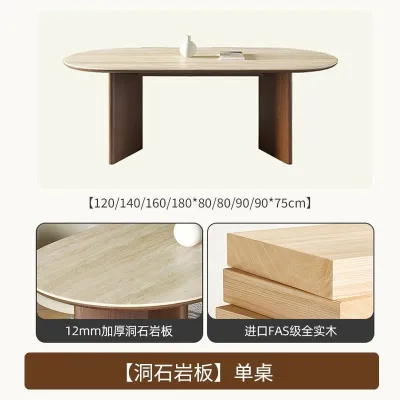


Prices are valid at publication and may change. Please refer to the product page for the latest price.
In contrast, a honed finish is achieved by stopping the grinding process earlier, using coarser abrasives that leave the surface flat but not reflective. The resulting matte or satin appearance softens the overall look of the stone. Instead of sharp, high-contrast veins, honed marble displays muted, subtle patterns with softer transitions between colors. To the touch, honed marble feels velvety, organic, and slightly textured, providing a more relaxed, tactile experience that feels closer to the raw state of the natural stone.
These physical characteristics significantly influence how each finish interacts with your dining room’s lighting setup. In a room with large windows or low-hanging pendant lights directly over the table, polished marble can create harsh, distracting glare that makes it uncomfortable to look at the table during certain times of the day. Honed marble, however, diffuses incoming light across its matte surface, eliminating harsh reflections and creating a softer, more inviting ambiance that complements warm, layered dining room lighting.
How Do Polished and Honed Finishes Handle Daily Dining Table Wear and Stains?
Neither finish is inherently impervious to damage, but they show wear differently: polished marble highlights scratches and chemical etching due to its reflective surface, whereas honed marble hides physical abrasions better but is slightly more porous, making it more vulnerable to deep liquid staining if left unsealed. Because marble is a natural calcium carbonate stone, its durability cannot be guaranteed by its name alone; instead, its long-term appearance depends on how each finish interacts with daily dining hazards.

Physical scratches from ceramic plates, metal cutlery, and sliding serving dishes are inevitable on any dining table. On a polished marble table, even minor micro-scratches disrupt the perfectly flat, reflective plane, showing up clearly as dull lines when light hits the table at an angle. On a honed table, the pre-existing matte texture naturally diffuses light, which means minor scratches and scuffs blend into the background and remain largely invisible under normal viewing conditions.
Chemical etching is another common issue that is frequently confused with staining. Etching occurs when acidic substances—such as lemon juice, wine, vinegar, tomato sauce, or carbonated beverages—come into contact with the calcium carbonate in the marble and chemically dissolve a microscopic layer of the stone. On a polished surface, an etch mark instantly strips away the glossy shine, leaving a highly visible, dull, rough spot that stands out against the surrounding reflection. On a honed surface, the same chemical reaction occurs, but because the surrounding stone is already matte, the resulting etch mark is far less noticeable, making it a much more forgiving option for meals involving acidic ingredients.
While honed marble excels at hiding scratches and etches, its open-pore structure makes it slightly more susceptible to staining from dark pigments, such as coffee, red wine, or soy sauce. Because the surface has not been buffed to the tight, dense finish of polished stone, liquids can penetrate deeper into the pores more quickly. To manage this risk, both finishes require regular application of a high-quality, penetrating stone sealer to create a temporary barrier against liquid absorption. Daily maintenance for both finishes must involve wiping up spills immediately with a soft microfiber cloth and using only pH-neutral stone cleaners, as standard household detergents and acidic cleaners will cause immediate etching.
Which Marble Finish Best Matches Your Household's Dining Habits?
A polished marble finish is best suited for formal dining rooms or low-traffic households where meals are structured and immediate cleanup is guaranteed, while a honed finish is more practical for active, family-style dining spaces where frequent spills, heavy dishware, and casual use are common. Aligning your choice with your household’s daily lifestyle and your personal tolerance for the natural aging process of stone will prevent future frustration.
If your dining table serves as the central hub of your home—where children do homework, guests gather for casual buffet-style meals, and daily dinners involve a variety of hot pots and shared platters—a polished finish will require constant vigilance. You will find yourself constantly placing coasters, placemats, and trivets under every item to prevent scratches and etch marks. A honed finish, on the other hand, allows for a more relaxed dining experience, as the occasional minor mishap will not ruin the uniform look of the tabletop.
Your tolerance for a natural patina is another critical decision factor. Over years of use, any marble dining table will develop a lived-in character shaped by minor scratches, faint etch marks, and subtle color shifts. On a polished table, this wear can look uneven and patchy, often prompting homeowners to pay for professional repolishing to restore the original high-gloss look. On a honed table, the wear integrates seamlessly into the stone’s matte surface, developing a soft, uniform patina that many appreciate as a sign of natural beauty and shared family history.
Finally, consider how each finish fits into your long-term interior design goals. Polished marble is a classic choice for traditional, glamorous, or ultra-modern dining spaces that utilize high-contrast elements, metallic accents, and glossy surfaces to create a sense of grandeur. Honed marble is highly compatible with contemporary, Scandinavian, minimalist, or rustic aesthetics, where the focus is on organic textures, muted color palettes, and a relaxed, understated sense of luxury.
What Must You Verify Before Purchasing or Refinishing a Marble Dining Table?
Before committing to a marble dining table, you must verify the manufacturer’s sealant specifications, physically inspect the slab for structural integrity, and confirm that your home’s access points and floor structure can safely accommodate the stone’s immense weight. Taking these practical steps ensures that your investment is structurally sound and compatible with your living space.
First, review the manufacturer’s technical specifications regarding factory sealants and care guidelines. Ask whether the table has been treated with an impregnating sealer or a topical coating, as this determines how often you will need to reapply protection. You should also inquire about refinishing options; some manufacturers offer proprietary restoration kits or warranties that cover professional resurfacing if the table suffers severe etching or staining over time.
Second, perform a thorough physical inspection of the marble slab under strong, angled lighting. Run your hands across the surface and edges to check for consistency in the finish. Look closely for natural fissures, which are distinct from structural cracks. While fissures are normal geological features of marble, they should be professionally filled with resin at the factory to ensure they do not catch food particles or compromise the strength of the tabletop. Pay close attention to the edge profiling; rounded or beveled edges are less prone to chipping than sharp, 90-degree corners.
Third, evaluate the structural and spatial requirements of your dining area. A solid marble tabletop is exceptionally heavy and requires a robust, stable base engineered specifically to support stone without wobbling or tipping over under uneven loads. Measure your dining room’s available space, keeping in mind that a heavy stone table cannot be easily slid or repositioned once placed. Most importantly, measure your home’s entryways, hallways, stairwells, and lift dimensions. Confirming these physical access routes beforehand is essential, as transporting a massive, fragile stone slab into an apartment or upper-floor dining room often requires specialized delivery equipment and careful spatial planning.

Community discussion
Share your experience or ask a question. Comments are reviewed before publication.