
Deciding whether to upgrade to the OSIM uDivine V3 from an older massage chair model requires evaluating your current equipment’s physical condition, comparing technical specifications, and understanding the logistical demands of delivery and disposal. While a new massage chair represents a significant financial investment, it can offer substantial improvements in comfort, body-scanning accuracy, and targeted muscle relief. However, if your existing chair remains in excellent mechanical condition and continues to meet your daily relaxation needs, keeping your current setup may be the most practical choice. By analyzing the wear on your current chair, verifying the mechanical advancements of the V3, and calculating the total cost of replacement, you can make a logical decision that aligns with both your physical wellness goals and your household budget.
Assessing the Condition of Your Current Massage Chair
To determine if your existing massage chair has reached the end of its practical lifespan, begin with a mechanical and physical inspection. Over years of regular operation, internal motors, gears, and drive belts undergo continuous friction. Turn on your current chair and listen closely during a complete cycle. Unusual grinding noises, persistent squeaks, or a noticeable stuttering as the rollers travel along the track are clear indicators of mechanical wear. Inconsistent roller pressure or occasional stalling indicates a failing drive system, compromising comfort and safety.
Upholstery degradation is another common sign that a massage chair is ready for replacement. Most massage chairs utilize synthetic leather or polyurethane covers designed to withstand regular movement. Over time, exposure to body heat, sweat, and ambient humidity can cause these materials to crack, peel, or tear. Once the outer layer peels, the underlying foam absorbs dust and perspiration, creating hygiene concerns that standard cleaners cannot resolve. Because professional upholstery replacement for a full-sized massage chair can be exceptionally costly, severe peeling is often a primary catalyst for upgrading to a new model.
Products mentioned in this guide
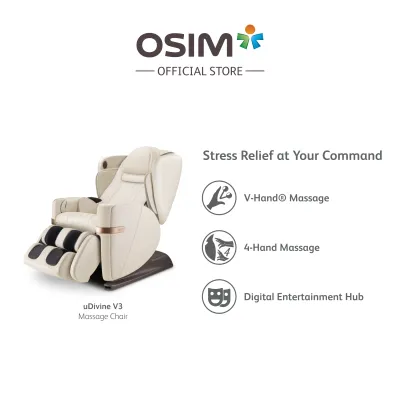
Prices are valid at publication and may change. Please refer to the product page for the latest price.
Finally, evaluate the warranty status and the long-term availability of replacement parts for your current model. If your chair is out of warranty, future repairs will incur full diagnostic, labor, and component costs. Contact the manufacturer’s customer service department to verify if critical parts, such as main circuit boards, air pumps, or specific roller assemblies, are still actively manufactured and stocked for your older model. If parts are obsolete or repair costs represent a substantial portion of a new chair’s price, transitioning to the uDivine V3 is the more sensible financial path.
Core Feature Differences to Verify Before Upgrading
Before committing to an upgrade, compare the technical specifications of your older model against those of the OSIM uDivine V3. The core of any massage chair’s performance lies in its roller mechanism. Older generations typically rely on standard 2D or basic 3D mechanisms, which move along vertical and horizontal axes with limited depth adjustment. The uDivine V3 utilizes advanced multi-dimensional or adaptive roller systems designed to mimic the precise pressure of a professional masseuse. Check product brochures to verify your current chair’s roller designation and compare how the V3’s mechanism adjusts to your spine’s contours.

Track length and coverage areas are equally important parameters to verify. Older chairs often feature shorter, straight tracks that only cover the upper back and lumbar regions, leaving the glutes untouched. Modern chairs like the uDivine V3 typically employ extended tracks (L-tracks or S-L tracks) that follow the spine’s natural curvature from the neck to the upper thighs. Verify the track length on official spec sheets to ensure the V3 covers the specific muscle groups where you experience tension. If your current chair leaves your lower back or glutes neglected, the V3’s extended track represents a major functional upgrade.
Additionally, evaluate the advancements in auxiliary technologies such as airbag distribution, zero-gravity positioning, and automated body scanning. Older models often use fewer, larger airbags that inflate uniformly, which can feel restrictive. Newer systems utilize a denser network of smaller airbags that inflate sequentially to deliver a more nuanced compression massage. Furthermore, verify whether your current chair offers true zero-gravity reclining, which elevates your knees above your heart to reduce spinal pressure. An advanced, automated body scanner in the V3 also ensures that rollers align precisely with your acupressure points, a feature older scanning systems often struggle to execute accurately.
Calculating the Financial and Physical Costs of Replacement
Upgrading to a premium massage chair involves both direct financial outlays and physical logistics that must be carefully calculated. Begin by checking the current retail price of the uDivine V3 in S$. Because pricing can fluctuate based on seasonal promotions, roadshows, and bundle offers, monitor official retail channels or visit an authorized showroom to obtain a formal quote. Ask if the quoted price includes delivery, installation, and an extended warranty, as these add-ons significantly alter the final financial equation.
The physical removal of your old massage chair is a major logistical hurdle, particularly in Singapore’s high-density housing environments. If you reside in a Housing & Development Board (HDB) flat or a private condominium, you must adhere to strict estate management rules regarding bulky item disposal and moving hours. Some condominiums require a security deposit or prior written approval before allowing movers to transport large items through service lifts. If the retailer does not offer a direct trade-in or disposal service, you must arrange a licensed private disposal service or coordinate with your local town council for bulky item removal.
Finally, verify the physical footprint and utility requirements of the uDivine V3 to ensure it fits your home layout. Consult the user manual for the exact dimensions of the chair in both its upright and fully reclined positions. Pay close attention to the minimum rear wall clearance required; some modern chairs require very little clearance due to forward-sliding mechanisms, while others need substantial space behind them. Additionally, check the weight of the V3 to ensure your flooring can support it, and verify its power consumption specifications to confirm that your existing electrical outlets can safely accommodate the load.
Decision Paths: Upgrade, Maintain, or Wait?
To arrive at a clear conclusion, apply a structured decision framework based on your physical, functional, and financial assessments. An immediate upgrade to the OSIM uDivine V3 is recommended if your current chair exhibits irreversible mechanical failures, such as a burnt-out motor, or if the upholstery has degraded to an unhygienic state. Furthermore, if you have developed new physical wellness needs—such as chronic lower back pain—that require the specific multi-dimensional rollers, extended track coverage, or advanced compression therapy of the V3, the investment is easily justified.
Conversely, maintain your current chair if it operates smoothly, fits your space perfectly, and meets your basic relaxation requirements. If the technological differences are primarily cosmetic, or if the V3’s upgrades consist of software features you are unlikely to use, there is little practical reason to incur the expense of a replacement. A well-maintained massage chair that still delivers effective relief is a valuable asset that does not need to be replaced simply because a newer model is available.
If you find yourself in a middle ground—where your current chair is functional but showing minor signs of wear—consider alternative actions before committing to a full replacement. You can explore professional upholstery repair services to refresh the look of your existing chair at a fraction of the cost of a new purchase. Alternatively, if your current chair performs well on your back but lacks lower-body coverage, you can supplement it with targeted massagers, such as dedicated foot and calf massagers. This modular approach allows you to address specific pain points without the financial outlay and space requirements of a brand-new chair.
Frequently Asked Questions (FAQ)
Does OSIM provide a trade-in or disposal service for old chairs?
When upgrading to a new model like the uDivine V3, managing the exit of your old chair is a primary concern. To verify if you are eligible for an official trade-in program, contact OSIM customer service or visit an authorized showroom in Singapore. Retailers frequently run promotional campaigns where they accept older massage chairs and apply a trade-in valuation as a discount toward your new purchase. If a trade-in promotion is active, the delivery team will typically handle the dismantling and removal of your old chair when they install the uDivine V3, simplifying the logistics. If no official trade-in program is available, you must arrange for private bulky item disposal or contact your local town council to schedule a removal, ensuring compliance with local guidelines.
What are the space and clearance requirements for the uDivine V3?
Ensuring that the uDivine V3 can physically enter and operate within your home requires precise measurements before delivery. First, consult the product specifications for the minimum doorway, elevator, and hallway widths required to transport the chair. Many delivery issues arise not from the room itself, but from tight corners in corridors or narrow lift doors. Once inside the room, measure the designated floor area against the chair’s fully reclined dimensions. Check the manufacturer’s guidelines for the required rear wall clearance; many modern chairs feature a space-saving slide-forward mechanism that allows placement just a few centimeters from the wall, while older designs might require substantial clear space behind the headrest to recline fully.
Community discussion
Share your experience or ask a question. Comments are reviewed before publication.