
Selecting the right mattress firmness is one of the most critical decisions for securing restful sleep and long-term spinal health. The ideal nestora mattress for your home depends heavily on how its specific firmness levels align with your sleeping position, body type, and personal comfort preferences.
Nestora offers a curated selection of firmness options designed to accommodate a diverse range of sleepers, from those who prefer a soft, cloud-like cradle to those who require rigid, flat support. Each model is engineered with distinct material layers that alter the perceived firmness and responsive feel of the bed.
Understanding these differences allows you to bypass generic marketing terms and select a sleep surface that matches your physiological needs. By evaluating how these firmness levels behave, you can make an informed investment for your bedroom.
Products mentioned in this guide
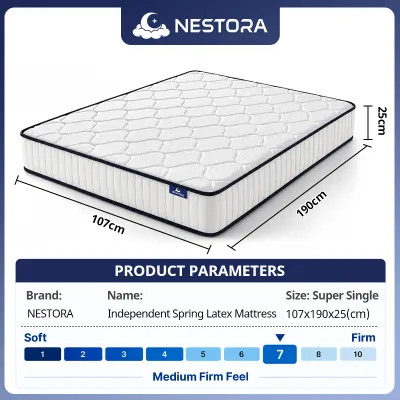
Prices are valid at publication and may change. Please refer to the product page for the latest price.
Identifying Nestora's Firmness Options
Mattress manufacturers frequently employ proprietary names such as “Luxury Firm,” “Cushion Firm,” or “Plush” to describe their products. While these creative labels help differentiate models within a brand’s lineup, they do not always correspond directly to a universal industry standard. Most sleep experts use a basic 1-to-10 scale, where 1 represents extreme softness and 10 represents a surface as rigid as a floorboard.
To determine where a specific nestora mattress falls on this spectrum, you should consult the manufacturer’s official product specifications or examine the physical product tags. These resources provide the designated rating and outline the exact material layers used in construction. Because product lineups can evolve, verifying the latest specifications directly from official channels ensures you receive accurate information.
The internal composition of the mattress plays a fundamental role in how any stated firmness level actually feels. An all-foam mattress relies on comfort layers that contour deeply under body heat, which can make a medium rating feel highly enveloping. Conversely, a hybrid pocket spring model combines foam comfort layers with an underlying coil system, providing active pushback that makes the same medium rating feel more buoyant and supportive.
Decoding the Feel: What Each Firmness Level Means
The physical sensation of a mattress goes beyond a simple number on a scale; it dictates how your body interacts with the sleep surface throughout the night. Translating these technical ratings into tangible sensations helps set realistic expectations for your sleeping comfort.

Soft to Medium (Plush Feel)
A soft to medium mattress, typically rating between 3 and 5 on the standard scale, is characterized by deep contouring and a distinct “sleeping in” sensation. When you lie down, the upper comfort layers yield quickly to your body weight, allowing your shoulders and hips to sink gently into the material. This deep sinkage provides exceptional pressure relief for sensitive joints, distributing your weight evenly across the surface.
These plush options prioritize cushioning and pressure mitigation over rigid, upward pushback. While they offer a cozy, enveloping embrace, they do not provide the flat, solid resistance found in firmer models.
Medium to Medium-Firm (Balanced Feel)
Positioned in the 6 to 7 range on the firmness scale, a medium to medium-firm mattress represents a balanced middle ground. This configuration offers a harmonious blend of initial contouring and robust underlying support, accommodating the vast majority of sleepers. Instead of sinking deeply, you experience a “sleeping on” the bed sensation where the mattress cradles your curves without letting you feel trapped.
This balanced feel ensures that you can change sleeping positions easily during the night without exerting extra effort. The responsive comfort layers cushion your pressure points, while the supportive core prevents your midsection from dropping too low.
Firm to Extra Firm (Solid Support)
Ranging from 8 to 10 on the scale, firm to extra-firm mattresses are engineered for maximum structural support and minimal surface yield. When lying on this type of bed, you will experience a floating sensation, remaining entirely on top of the mattress with very little contouring. The primary focus of these models is to provide strong spinal alignment and immediate resistance to body weight.
These options prioritize structural pushback and overall stability over plush cushioning. The surface remains flat and highly stable, making it an excellent choice for those who dislike the feeling of being enveloped by foam.
Matching Firmness to Your Sleep Profile
Your preferred sleeping position and physical build are the primary biological factors that dictate which firmness level will keep your spine aligned. Choosing a mattress without considering these variables can lead to chronic discomfort and poor sleep quality.
Side sleepers generally require a softer to medium mattress that offers sufficient contouring for their shoulders and hips. Because these areas project outward, a rigid surface creates high-pressure zones that can cut off circulation and cause tossing and turning. A plush surface allows these key pressure points to sink just enough to keep the spine in a straight, neutral line.
Back and stomach sleepers require a firmer surface to maintain proper alignment. When sleeping on your back or stomach, your body weight is concentrated around your pelvis and hips; a soft mattress allows this midsection to sag, arching your lower back unnaturally. A firm to extra-firm mattress provides the necessary upward resistance to keep your hips level with your shoulders.
Body weight also alters how you perceive mattress firmness. Heavier individuals compress comfort layers more deeply, often pushing through the soft upper foam to meet the firmer support core beneath, meaning they typically need a firmer mattress to prevent bottoming out. Lighter individuals do not exert enough force to compress firm layers, meaning a firm bed may feel uncomfortably hard; they generally require a softer model to activate the contouring layers. Always cross-reference these physical guidelines with the specific recommendations provided for each Nestora model.
Final Checks Before Choosing Your Nestora Mattress
Before finalizing your purchase, you must evaluate several practical factors that affect long-term satisfaction in the local Singaporean context. First, check the available sleep trial period and return policy. Because your body requires time to adapt to a new sleep surface, testing the mattress in your own air-conditioned or naturally ventilated home is the most reliable way to judge its true comfort.
If you share a bed with a partner who has different comfort preferences, verify if the specific Nestora model offers dual-firmness or split-tension options. A dual-firmness design allows each side of the bed to be customized independently, preventing compromises that leave one partner uncomfortable.
Additionally, pay close attention to the edge support specifications of your chosen model. Weak edges compress easily, which can make the mattress feel softer and less stable when you sleep near the border or sit on the side to put on shoes. Robust edge support maximizes the usable sleeping surface and ensures the structural integrity of the bed. Finally, always verify that the dimensions of the mattress align with your bed frame and that your home’s doorways and lifts can easily accommodate delivery.
Frequently Asked Questions (FAQ)
Will a Nestora mattress feel softer or firmer over time?
Almost all mattresses undergo a natural break-in period during the first few weeks of use. Brand-new foam layers and pocket springs are initially stiff and will gradually soften as they adapt to your body weight and local temperature. In Singapore’s warm climate, high humidity and room temperature can also make memory foam feel slightly more pliable. You should allow at least 30 days of continuous use to let the materials settle before deciding if the firmness is correct for you.
Can I change the firmness of my Nestora mattress after buying it?
You cannot fundamentally alter the internal core firmness of a mattress once it has been manufactured. However, you can effectively adjust the surface feel by adding a high-quality mattress topper. A plush memory foam or latex topper can soften a bed that feels too rigid, while a dense, firm topper can add surface stability, though a topper cannot correct a mattress that is already sagging from age.
Community discussion
Share your experience or ask a question. Comments are reviewed before publication.