
Parents in Singapore often appreciate the clean, minimalist aesthetic of MUJI bed frames, but when transitioning a child from a baby cot to a proper bed, safety must take precedence over home decor trends. Standard MUJI bed frames are designed primarily for adult use, meaning they do not inherently feature the specialized safety guards, rounded edges, or strict chemical certifications typically found on dedicated children’s furniture. While they can be adapted for older children who have outgrown the high-risk toddler stage, using them for younger kids requires careful evaluation, physical modifications, and a clear understanding of local safety guidelines.
Before making a purchase, it is crucial to understand that adult furniture and children’s furniture serve entirely different structural purposes. By evaluating the physical design of these frames, checking for potential hazards, and understanding how to safely accessorize them, you can make an informed decision that protects your child while maintaining your desired home aesthetic.
Understanding the Difference Between Adult and Kids' Bed Frames
Adult bed frames and specialized children’s beds are engineered with completely different design priorities. Standard adult frames, including most minimalist wooden designs, focus on aesthetic simplicity, space efficiency, and static weight support. They often feature sharp, clean lines and low profiles that look beautiful in a modern Singapore apartment but can present unexpected hazards for a highly active child who uses the bedroom as a play space.
Products mentioned in this guide
![[Bundle Set] MUJI Rubberwood Storage Bed with Mattress](https://img.lazcdn.com/g/p/bbcdaeece706ac3fbc2fb70ca0228b95.jpg_400x400q80.jpg_.webp)
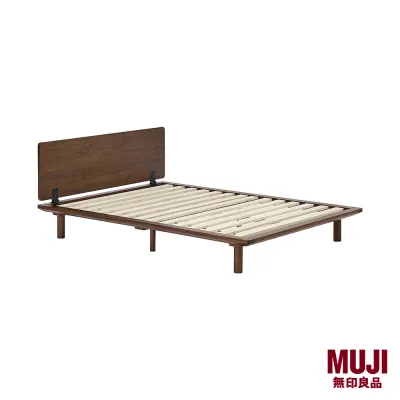
![[HOMIEST] Muji Style Full Solid Rubber Wood Bed Frame in Queen/King Size](https://img.lazcdn.com/g/p/ded810c11f610d4eb5f0d35561aa117b.jpg_400x400q80.jpg_.webp)
Prices are valid at publication and may change. Please refer to the product page for the latest price.
In contrast, dedicated children’s beds are designed with dynamic safety as the primary objective. These specialized beds typically incorporate built-in guardrails to prevent falls during sleep, rounded corners to minimize impact injuries during active play, and non-toxic finishes that can withstand teething or close physical contact. Standard adult frames completely lack these integrated fall-prevention features, meaning a child transitioning to an open adult frame is exposed to a significant drop risk, especially if the bed is elevated on legs.
Furthermore, the structural demands placed on these two types of furniture differ significantly. Adult beds are designed for static weight distribution, assuming the user will lie relatively still or sit on the edge. Children, however, interact with beds dynamically—jumping, climbing, and shifting weight rapidly. This dynamic movement exerts concentrated lateral forces on the frame’s joints, slats, and legs. Standard adult frames may not be reinforced to handle these specific lateral stresses over long periods, which can lead to premature wear or structural failure if used as a play surface.
Key Safety Checks for Using a MUJI Bed Frame for Children
If you are considering using a standard MUJI bed frame for your child, a thorough physical inspection is essential before allowing them to sleep on it. You must evaluate the frame’s physical dimensions, stability, and compatibility with your child’s current developmental stage.

First, inspect the slat and rail gaps. Measure the distance between individual wooden slats and any gaps between the frame and the headboard. If these gaps are too wide, they can pose a serious entrapment hazard where a child’s limb, or worse, head and neck, could become stuck. Ensure that the spacing does not allow a child’s head to pass through or get wedged between components.
Second, check for sharp edges, protruding hardware, or unfinished surfaces. Run your hands along the corners of the frame, the edges of the headboard, and the legs. Minimalist wooden frames often feature sharp 90-degree angles. If you find sharp edges, you will need to apply aftermarket corner guards or edge cushions to prevent head injuries during accidental falls or active play.
Third, assess overall stability and resistance to tipping. Push the bed frame from different angles to see if it wobbles or slides easily on your flooring. In Singapore, many homes have smooth vinyl, laminate, or tiled floors where a light frame might slide during active play. Ensure the legs are sturdy and do not flex under lateral pressure. If the frame feels light or prone to shifting, you may need to secure it or place non-slip pads under the legs.
Fourth, verify the mattress fit to eliminate dangerous gaps. A critical safety check is ensuring the mattress fits snugly within the frame’s perimeter. If there is a gap of more than a few centimeters between the mattress edge and the wooden frame, a child’s foot or hand can easily slip into the gap and become trapped, leading to joint strains or panic. Always match the mattress dimensions precisely to the frame’s specifications.
Navigating Children's Furniture Safety Standards in Singapore
When purchasing furniture for children in Singapore, relying solely on brand reputation or minimalist appeal is not enough. Parents must understand how to verify safety compliance and consumer protections independently without relying on marketing claims.
In Singapore, the Consumer Product Safety Office (CPSO), which is managed by Enterprise Singapore, oversees the safety of consumer goods. While general adult furniture is subject to basic safety expectations, children’s furniture must meet much more stringent requirements. When researching bed frames, look for recognized safety certification marks or test reports on product packaging and retailer documentation. Standards such as the European Standard (EN 716 for cots, EN 1725 for domestic beds) or international ISO standards indicate that the furniture has undergone rigorous testing for structural integrity, stability, and chemical safety.
Retailers have a responsibility to provide clear safety information, including age recommendations and maximum weight capacities. When shopping at local showrooms, ask the staff for official product specifications and safety test reports rather than accepting verbal assurances. If a retailer cannot provide documentation showing compliance with recognized safety standards for children’s use, you should treat the product as an adult-only item.
Consulting local consumer protection guidelines can help you understand what to look for. For instance, guidelines emphasize that any furniture intended for children must be free from lead-based paints, volatile organic compounds (VOCs) above safe thresholds, and hazardous pinch points. Because MUJI frames are primarily designed for adults, they may not carry these specific children’s safety certifications, making it the parent’s responsibility to verify the materials and finishes used.
How to Safely Accessorize a Standard Bed Frame for Child Use
If you decide to adapt a standard MUJI bed frame for your child, you must do so using low-risk methods that do not compromise the structural integrity of the frame or void its warranty. Proper accessorizing can bridge the gap between adult design and child safety.
Selecting and installing third-party bed rails is the most common modification. However, not all bed rails fit all frames. You must choose a rail that is explicitly compatible with the frame’s design. For example, if the frame uses a slatted base, the bed rail’s anchor straps or metal brackets must secure firmly around the slats without bending or damaging them. Avoid rails that require drilling into the wooden frame, as this can weaken the structure and void the manufacturer’s warranty.
Use anti-tip furniture anchors if the bed frame is positioned near walls or in high-activity areas. While bed frames are generally low to the ground, a child climbing on a headboard can still cause a tip-over hazard or cause the bed to slide away from the wall, creating a dangerous gap. Securing the headboard to the wall or ensuring the frame is flush against a solid wall can prevent shifting and eliminate entrapment zones.
Choosing the right mattress is equally important. The mattress must be firm enough to support a growing child’s spine and prevent suffocation risks for younger kids. Additionally, the mattress depth must align with the frame’s side rails. If the mattress is too thick, it will reduce the effective height of any added safety rails, rendering them useless. Ensure the top of the safety rail sits at a safe height above the mattress surface.
When to Avoid Using a Standard Bed Frame for Young Children
There are clear boundaries where a standard adult bed frame is entirely inappropriate, and parents must opt for a dedicated children’s bed instead. Recognizing these stop-conditions is vital for preventing serious injuries.
Age and mobility thresholds are the primary indicators. Children under the age of four generally lack the coordination and spatial awareness to sleep safely on an open, elevated adult bed frame. For these younger children, the risk of falling out of bed or getting trapped between the bed and the wall is unacceptably high. If your child is still transitioning from a baby cot, a dedicated toddler bed with integrated high sides is a much safer choice.
Structural warning signs on the frame itself should prompt immediate discontinuation. If you notice persistent squeaking, loose joints, shifting slats, or widening gaps between the frame components, the bed is no longer safe for a child. In Singapore’s humid climate, wooden joints can expand and contract, potentially loosening hardware over time. These signs indicate that the frame’s structural integrity has been compromised, potentially by dynamic play or improper assembly, and requires immediate repair or replacement.
Finally, recognize when your child’s specific sleep behavior necessitates a specialized environment. If your child is an active sleeper who thrashes violently, sleepwalks, or experiences frequent night terrors, a standard open bed frame poses a high risk of injury. In these cases, a specialized, low-to-the-ground, or fully enclosed sleep environment is necessary to keep them safe throughout the night, and an adult minimalist frame should be avoided entirely.
Frequently Asked Questions (FAQ)
Can I use a standard MUJI bed frame for a toddler?
It is generally not recommended to transition a toddler directly from a cot to a standard adult MUJI bed frame. Toddlers require specialized safety features, such as low heights and integrated guardrails, to prevent falls. If you must use one, choose an ultra-low profile frame, place it on a soft carpeted surface, and install secure, compatible third-party safety rails that are rated for toddler use.
What are the general rules for bed rail gaps to prevent entrapment?
To prevent entrapment, any gaps between the bed rail and the mattress, or between the rail and the headboard/footboard, must be carefully managed. Generally, gaps should either be virtually non-existent (less than 6 centimeters) to prevent limbs from slipping through, or wide enough (greater than 23 centimeters) so that a child’s head and torso cannot get wedged. Regularly check that the mattress has not shifted, which can create dangerous new gaps.
Does MUJI offer dedicated safety-certified kids' beds in Singapore?
MUJI’s product lineup in Singapore primarily focuses on adult and general household furniture. While they offer low-profile bed frames and customizable options, these are not typically marketed or certified as specialized children’s beds under local safety standards. Always check the latest product specifications and labels at local retail outlets to verify if a specific model has been certified for children’s use.

Community discussion
Share your experience or ask a question. Comments are reviewed before publication.