
Choosing between a local Singaporean leather sofa brand and an imported one depends on how you prioritize delivery speed, customization, design exclusivity, and after-sales support. Local brands typically offer faster lead times, straightforward warranty claims, and designs tailored for space-constrained apartments. Imported brands often provide unique European aesthetics, specialized artisan craftsmanship, and premium leather selections, but they usually come with longer shipping timelines and potential logistical hurdles for repairs.
Before making a commitment, it is essential to evaluate how the sofa’s materials, construction, and support services align with your specific living space and lifestyle. A leather sofa is a major investment, and understanding how different brands handle the local climate and logistical challenges will ensure your purchase remains comfortable and durable for years to come.
Climate Suitability and Material Adaptation
Singapore’s high relative humidity and tropical temperatures require careful consideration when selecting leather upholstery. Genuine leather is naturally porous, but its ability to breathe depends heavily on the specific type of leather and how it has been treated. Full-grain and top-grain leathers retain the natural pore structure of the hide, allowing heat and moisture to dissipate, which prevents the sofa from feeling sticky on warm afternoons. Semi-aniline leather offers a practical middle ground, featuring a very thin protective coating that resists stains while maintaining excellent breathability.
Products mentioned in this guide
![[SG Seller] Twentyone HALF LEATHER COWHIDE SOFA (1 SEATER /2 SEATER /3 SAETER /4 / 2+L / 3+L SEATER AVAILABLE)](https://img.lazcdn.com/g/p/8b1e99fe2462b95dc28896ac60c293ca.jpg_400x400q80.jpg_.webp)
![[SG Seller] Twenty one ADAM FAUX LEATHER SOFA (3-SEATER / 2-SEATER / 1-SEATER AND WITH CHAISE)](https://img.lazcdn.com/g/p/8c9ee40a836016580b799ac0dd343bed.jpg_400x400q80.jpg_.webp)
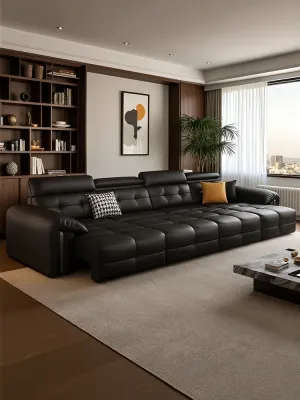
Prices are valid at publication and may change. Please refer to the product page for the latest price.
In contrast, heavily pigmented leathers or synthetic leather blends rely on thick polymer coatings. While these surfaces are easy to wipe clean, they lack breathability and tend to trap body heat, making them less comfortable in non-air-conditioned rooms. Furthermore, low-grade synthetic blends or bonded leathers are highly susceptible to delamination and peeling when exposed to persistent humidity.
When evaluating any leather sofa, do not rely solely on the country of origin or broad material names like “Italian leather.” Instead, ask the retailer for the specific leather classification and inspect the manufacturer’s care instructions. Look for sofas that feature breathable dust covers on the underside, which prevent moisture from becoming trapped within the internal frame and cushioning.
To protect your investment in a tropical environment, verify the required maintenance routine. Genuine leather requires regular dusting and occasional conditioning with specialized, non-clogging formulas to prevent mold growth and keep the fibers supple. Ensure the sofa can be positioned away from direct sunlight and in a well-ventilated area to minimize climate-related wear.
Warranty Claims and After-Sales Support
Resolving issues with your sofa is significantly influenced by where the brand’s service operations are located. If a local brand’s sofa experiences a sagging spring, a broken frame joint, or a split seam, the company can typically dispatch a technician to your home quickly. Because their workshops and parts inventories are kept locally, repairs or component replacements can often be completed within a few days.

For imported brands, the ease of after-sales support depends on their local representation. Before purchasing, verify whether the brand has an authorized local distributor with dedicated service technicians, or if they rely on third-party upholstery workshops. If a proprietary mechanism or a specific matching leather panel needs to be sourced from an overseas factory, the resolution process can take several weeks or even months.
Carefully review the warranty booklet to understand the exact terms and coverage periods. A bold “10-year warranty” claim often applies exclusively to the internal wooden frame. The suspension systems, such as pocket springs or elastic webbing, may carry a shorter coverage period of three to five years, while the leather upholstery, stitching, and reclining mechanisms might only be covered for one to two years.
Identify any potential hidden costs associated with warranty claims. Ask the retailer if you will be responsible for transport fees to move the sofa to a workshop, or if there are shipping charges for importing replacement parts. Knowing these terms beforehand prevents unexpected expenses if your sofa requires professional attention.
Delivery Timelines and Customization Options
Logistical efficiency and design flexibility are key differentiators between local and imported sofa options. Local brands often maintain warehouses with ready stock of popular configurations, enabling delivery within a week. If you choose a custom-made model from a local manufacturer, the lead time is typically a manageable four to eight weeks, as the production and assembly occur nearby.
Imported sofas, particularly custom orders from European design houses, generally require a waiting period of 12 to 24 weeks. This timeline accounts for overseas manufacturing, consolidation, sea freight, customs clearance, and local port handling. If you are furnishing a new home, you must plan well in advance and verify the retailer’s policy regarding delivery delays, including whether they offer temporary loan sofas or compensation for unexpected hold-ups.
Local brands excel at providing customization options tailored to typical Singaporean residential layouts. They frequently allow you to adjust the overall length of the sofa by the centimeter, select specific modular configurations to fit around structural pillars, and choose from a wide palette of leather colors. Imported brands usually offer fixed, standardized dimensions that may be more challenging to integrate into compact living rooms.
Visiting a physical showroom is crucial to test the exact materials and cushion densities before ordering. Sit on the showroom model for at least 15 minutes to evaluate the support of the high-resilience foam or pocket springs. Ensure you measure your home’s entryways, corridors, and lift doors carefully; local delivery teams can advise on whether a specific sofa configuration can safely navigate your building’s access points.
Design, Craftsmanship, and Price Value
The aesthetic appeal and structural build quality of a leather sofa must be weighed against its total cost. Imported brands often lead in global design trends, offering exclusive, award-winning silhouettes, sleek minimalist profiles, and sophisticated motion mechanisms. Local brands, on the other hand, tend to focus on highly practical designs, such as high-legged frames that accommodate robot vacuums and shallower seat depths optimized for smaller rooms.
To evaluate craftsmanship, look closely at the physical details of the sofa rather than relying on brand prestige. Inspect the stitching for straight, tight seams with no loose threads, which indicates strong tension and durability. Ask about the frame construction; high-quality sofas utilize kiln-dried hardwood frames reinforced with corner blocks and screws, rather than simple plywood held together with staples and glue.
Price structures reflect these differing logistics and branding costs. Imported sofas carry premiums for international freight, import handling, and global marketing. Local brands can often offer comparable material quality—such as sourcing premium top-grain hides from European tanneries—at a lower price point because they bypass heavy international shipping overheads.
| Budget Range | Typical Origin | Expected Leather Grade | Frame & Suspension | Key Value Trade-off |
|---|---|---|---|---|
| Under S$2,500 | Mostly Local / Regional | Corrected grain or split leather | Plywood frame, standard webbing | Affordable and fast delivery, but less breathable leather upholstery |
| S$2,500 to S$6,000 | Local Premium / Mid-tier Import | Top-grain or semi-aniline leather | Kiln-dried hardwood, pocket springs | Excellent balance of comfort, durability, and customization options |
| Above S$6,000 | Premium Imported | Full-grain or aniline leather | Solid hardwood, advanced suspension | Exclusive designer aesthetics and artisan finishes, but long delivery lead times |
How to Make Your Final Decision
To choose the right leather sofa, align your purchase with your immediate household priorities and space constraints. If you require fast delivery, want straightforward local warranty support, and need custom dimensions to fit a specific living room layout, a local brand is highly practical. This choice ensures easier communication and faster resolution if any maintenance issues arise.
If you prioritize exclusive designer aesthetics, highly specialized artisan craftsmanship, or unique leather finishes, and you are comfortable waiting several months for delivery, an imported brand is a compelling option. Before finalizing an import purchase, always confirm that the brand has a stable, long-term local distributor in Singapore to handle future servicing, leather care, or mechanical repairs.
If your budget cannot accommodate genuine, high-quality leather, consider opting for premium fabric alternatives rather than low-grade bonded leather. Bonded leather is highly prone to peeling in humid conditions, which can quickly ruin the appearance of your sofa. Taking the time to verify material specifications, measure your space, and read the warranty terms will lead to a successful, long-lasting investment.
Frequently Asked Questions (FAQ)
Does genuine leather peel in a humid climate?
No, genuine high-quality leather, such as top-grain or full-grain, does not peel. Peeling typically occurs in bonded leather, faux leather, or low-grade split leathers that have been heavily coated with a thick synthetic polyurethane layer. Over time, humidity and friction cause this synthetic layer to separate from its backing. To keep genuine leather in excellent condition, maintain good room ventilation, keep the sofa out of direct sunlight, and apply a specialized leather conditioner once or twice a year.
Are imported leather sofas always more expensive?
Not necessarily. While imported sofas often carry high shipping and logistics costs, premium local brands that source top-tier European hides and use high-end internal components can be priced similarly to mid-tier imports. Instead of relying solely on the country of origin, compare the specific leather grade, frame construction, suspension type, and warranty terms to determine the true value.
Community discussion
Share your experience or ask a question. Comments are reviewed before publication.