
Quick Answer: Maximum Sofa Sizes and Walkway Clearances
When selecting a storage sofa for a Singapore Housing & Development Board (HDB) flat, the ideal dimensions are determined by your specific flat layout and the sofa’s opening mechanism, rather than just the length of your living room wall. To maintain comfortable, unhindered movement, standard interior design guidelines recommend keeping primary walkways between 60 cm and 90 cm wide. For smaller 3-room and 4-room BTO flats, a sofa length of 150 cm to 180 cm is generally the practical limit, while larger 5-room or executive flats can comfortably accommodate lengths of 200 cm to 230 cm. However, you must account for the “operational footprint”—the additional floor space required to fully extend drawers or lift hydraulic compartments—to prevent the sofa from colliding with coffee tables, TV consoles, or adjacent walls during daily use.
Mapping Your HDB Living Room and Walkway Clearances
To plan your living room layout effectively, you must first analyze the physical shape of your space. Most modern HDB living rooms feature rectangular, square, or open-concept L-shaped configurations. Rectangular layouts usually dictate a wall-hugging placement to keep the central area clear, whereas square or larger open-concept rooms may allow for a “floating” arrangement where the sofa sits away from the wall to define a distinct seating zone.

When mapping out the space, draw a clear distinction between primary and secondary traffic paths. Primary thoroughfares (connecting entryways to kitchens, bedrooms, or balconies) require a minimum clearance of 90 cm. Secondary paths, such as the gap between your sofa and the coffee table, can be narrower but should measure at least 45 cm to 60 cm for comfortable legroom and easy passage.
Products mentioned in this guide
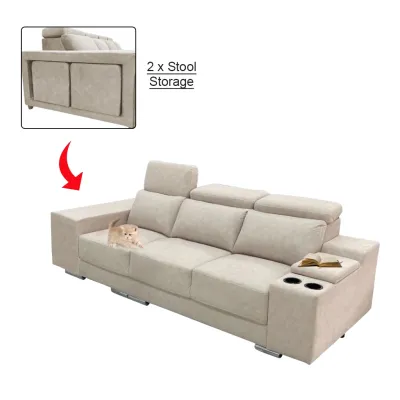
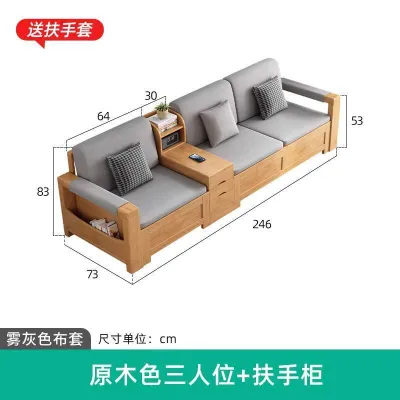
Prices are valid at publication and may change. Please refer to the product page for the latest price.
Before committing to a sofa size, identify the boundaries of your designated “sofa zone.” You must ensure the sofa does not obstruct structural or architectural elements unique to HDB flats. Check that the sofa’s position will not block access to sliding balcony doors, cover low-mounted electrical outlets or fiber termination points, or interfere with air-conditioner trunking running along the walls.
To find your maximum allowable sofa depth, use a simple subtraction formula: subtract your TV console depth and required walkway clearance from the total room width. For example, in a 300 cm wide living room with a 40 cm deep TV console and a 75 cm walkway, your maximum combined depth for the sofa and coffee table is 185 cm. A standard 90 cm deep sofa leaves a generous 170 cm of clearance, whereas a 105 cm seat significantly restricts movement.
Matching Sofa Dimensions and Storage Mechanisms to Your Layout
Length and Depth Proportions
Sofa length calculations must account for side clearances. Leave 15 cm to 30 cm of space on either side of the sofa for curtains, standing lamps, side tables, or power sockets. If your wall is 240 cm long, a sofa length of 180 cm to 200 cm is the safest choice to prevent a cramped look in the corners of your living room.
Sofa depth is equally critical to the spatial flow of your home. Standard sofas range from 85 cm to 95 cm deep, fitting comfortably in most HDB layouts. Deep-seat models exceeding 100 cm reduce central floor space and can make a compact room feel restricted. To maximize seating without expanding the physical footprint, prioritize slim, low-profile armrests or armless configurations. Thick, rolled armrests add up to 30 cm of non-functional width, consuming valuable floor space.
Space Requirements for Storage Mechanisms
The type of storage mechanism you choose directly dictates the physical space you must preserve in front of or beside the sofa.
- Hydraulic Lift-Up Storage: This system uses gas struts to lift the seating platform, exposing a large under-seat compartment. While efficient for bulky items like bedding, it requires substantial front clearance. You need standing room in front of the raised platform to access the compartment without being pinned against a coffee table. This mechanism suits layouts where the space in front of the sofa can be easily cleared, making lightweight or wheeled coffee tables ideal.
- Pull-Out Drawers: These slide outward from the front or sides of the sofa base. Drawers require dedicated floor clearance equal to their fully extended depth—typically an additional 50 cm to 70 cm. If your coffee table is heavy or stationary, opening these drawers becomes difficult. Pull-out drawers are ideal for wider rooms where front clearance is ample, but less practical in narrow layouts.
Before purchasing, always check the manufacturer’s technical specifications for the “open dimensions” or “operational footprint” of the sofa. Do not rely solely on the closed dimensions listed on the showroom tag, as the physical space required to operate the storage features is often significantly larger.
Selecting Fabric Sofas for Compact HDB Spaces
Fabric texture, pile, and color heavily influence the visual weight of your sofa. Heavy, dark fabrics like black velvet or thick chenille absorb light and make a sofa look massive, overwhelming a small room. To create an open atmosphere, select light-toned, low-pile, smoothly woven fabrics like linen blends or flat-weave polyesters, which reflect light and maintain a clean, streamlined aesthetic.
Singapore’s hot and humid tropical climate requires careful consideration of fabric performance. High humidity can trap moisture in dense fabrics, leading to musty odors or mold growth over time. When browsing fabric options, check the manufacturer’s care instructions and product labels for breathability ratings.
For easy maintenance, look for sofas with removable, washable covers. If you prefer fixed covers, check the manufacturer’s care label for factory-applied stain-resistant treatments and cleaning instructions, rather than relying on unverified marketing claims. Additionally, verify the fabric’s durability via the Martindale rub test rating on the spec sheet; a rating of 20,000 rubs or higher is recommended for heavy daily use.
Common Sizing and Placement Mistakes to Avoid
A frequent layout error is ignoring the operational footprint of the storage compartments. Homeowners often buy a hydraulic lift-up or drawer-style storage sofa only to find that a heavy coffee table blocks the mechanism, rendering the storage inaccessible.
Do not block key architectural features. Placing a deep sofa near a sliding balcony door can restrict its opening range, while positioning a tall backrest against a low window sill blocks natural light. Ensure the sofa does not cover essential wall outlets, light switches, or data ports, which creates safety hazards and limits access.
Overlooking the delivery path is another major issue. Measure the entire delivery route before ordering, including the HDB lift interior, lift lobby clearance, common corridor width, and your main door frame. Be particularly mindful of tight corridor corners or low-hanging pipework that could block a long, non-demountable sofa frame.
Finally, avoid misjudging visual bulk. A fabric sofa with thick cushions, high backrests, and heavy skirts will visually overwhelm a compact room. Instead, choose designs with clean lines, exposed legs that lift the sofa base off the ground, and low backrests to preserve sightlines.
Step-by-Step Measurement and Delivery Checklist
Follow this systematic measurement and verification process before finalizing your purchase:
- Step 1: Measure the designated wall length and total room depth. Note the location of obstacles like electrical sockets, trunking, light switches, window frames, or door swings.
- Step 2: Use masking tape to outline the sofa's closed footprint and its fully opened storage footprint on the floor. Walk through the taped area to test physical clearances and ensure no pathways or doors are blocked.
- Step 3: Measure the entire delivery route, including the HDB lift interior (door opening, height, and depth), the lift lobby, the corridor, and your main door frame.
- Step 4: Cross-reference your measurements against the retailer's provided dimensions and operational specs. If clearances are tight or specifications are ambiguous, stop and consult the retailer before purchasing.
Frequently Asked Questions (FAQ)
Can a storage sofa fit in a 3-room HDB living room?
Yes, a storage sofa can fit comfortably in a 3-room HDB living room, provided you select a compact model and plan the layout carefully. For these smaller spaces, prioritize a 2-seater or a compact 3-seater sofa with an overall length of 150 cm to 170 cm and a shallow depth of 85 cm to 90 cm. To maximize usability, choose pull-out drawer storage rather than a hydraulic lift-up system if your living room is narrow. Drawers allow you to access specific compartments quickly without needing to clear the entire top of the sofa, making them much more manageable in tight quarters where space in front of the sofa is limited.
How much space should I leave between the storage sofa and the TV console?
You should maintain a minimum distance of 100 cm to 120 cm between your storage sofa and the TV console. This distance provides a comfortable walking path of 60 cm to 75 cm while leaving enough room to accommodate the depth of a standard TV console (usually 40 cm) and the operational footprint of your sofa’s storage mechanism. If you plan to place a coffee table between the sofa and the TV, ensure there is at least 45 cm of clearance on either side of the table so that you can walk and access your storage compartments without physical obstruction.

Community discussion
Share your experience or ask a question. Comments are reviewed before publication.